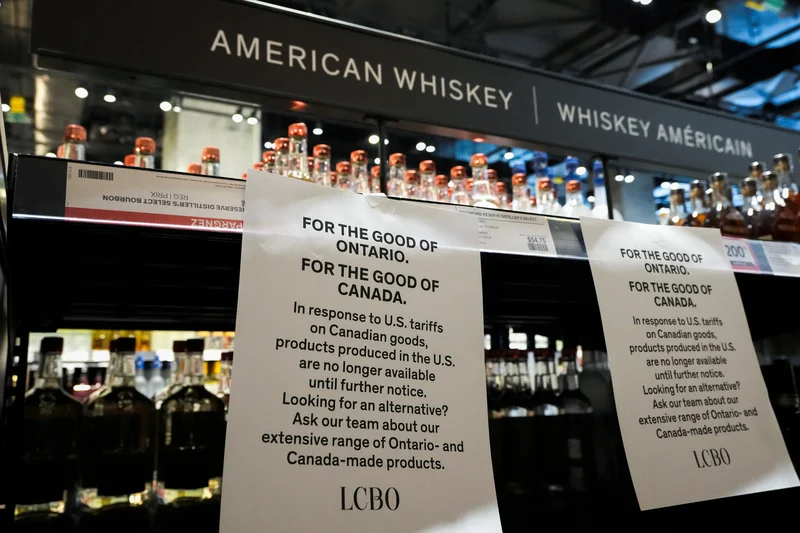
As the clock ticked on a trade deal to avert U.S. President Donald Trump’s threat of a new round of punishing tariffs, clear cracks between Canada’s premiers and Prime Minister Mark Carney started to show.
As of Friday afternoon, Ontario Premier Doug Ford – normally vocal about the need to stand up to Mr. Trump – had been completely silent on whether he will accede to a request from Mr. Carney to end the province’s ban on the sale of U.S. alcohol at its liquor stores.
The premiers routinely refer to themselves as a unified “Team Canada,” and in recent weeks Mr. Ford and the rest had mostly avoided criticizing Mr. Carney or his negotiators as they rolled up their sleeves in Washington.
But in a conference call on Wednesday about the talks, Mr. Carney asked premiers to drop their retaliatory bans on U.S. alcohol sales at provincial liquor outlets, even while any potential reduction of the tariffs on steel, aluminum, autos and lumber remained the subject of down-to-the-wire discussion.
The reception for the idea from certain premiers ranged from chilled to muted.
B.C. Premier David Eby – who was on vacation with poor cell reception and did not dial into the call with the Prime Minister – had not indicated whether his province would comply. (Alberta and Saskatchewan long ago dropped bans on U.S. booze sales.)
Manitoba’s Wab Kinew, in scrappy comments to reporters in Winnipeg on Thursday, suggested he would consider the Prime Minister’s request, which he described as “a step before begging.”
But he encouraged consumers not to buy U.S.-made alcohol if it did return to shelves. He said he believed Canada should instead “keep fighting,” and that the unpopular Mr. Trump was “weak,” facing midterm elections in a few months. Quebec Premier Christine Fréchette said she could restore U.S. booze sales, but only if the deal turned out to be positive for Quebec.
Speaking to reporters on Wednesday, Saskatchewan Premier Scott Moe suggested the booze climbdown was needed for the talks to advance. And Newfoundland and Labrador Premier Tony Wakeham said on Thursday that all the premiers had agreed to stand down “as a sign of good faith.”
Mr. Ford has in the past called for tougher “dollar-for-dollar” responses to the U.S. tariffs hammering his province, home to most of the country’s auto industry. And the Ontario Premier presides over the Liquor Control Board of Ontario, which is one of the largest buyers of alcohol in the world and normally brings in nearly $1-billion worth of U.S. booze a year.
But he has stood down on trade retaliation before, dropping a March, 2025, surcharge on electricity exports to the U.S. just a day after its imposition had attracted the ire of Mr. Trump.
Veteran trade lawyer Lawrence Herman, a senior fellow with the C.D. Howe Institute, said he predicts all the premiers will swallow their pride and restore U.S. booze to their liquor-store shelves. But Mr. Herman said the provinces’ booze bans may have indeed been useful at the bargaining table.
“In some ways, that’s a strength on our side, because we can say, look, this deal isn’t going to get the provinces on side,” Mr. Herman said. “ ... My sense is, if we have gone about as far as we can go on the tariff side, there is not much that can be done by holding out on alcohol.”
Carlo Dade, director of the New North America Initiative at the University of Calgary’s school of public policy, argued that having the premiers back down and drop their booze bans is not much of a concession – as many Canadian consumers will likely keep away from U.S. products anyway.
“It’s a bit of theatre with the Americans. It looks like we made a great concession. But what concession are we making?” he said, noting that even after Alberta and Saskatchewan put U.S. alcohol back on the shelves, sales are way down. “We’ve had a ban without having a ban. So there is no cost, except in ego. So we need to convince Eby, Ford and Kinew to lose the ego, because there is no cost.”