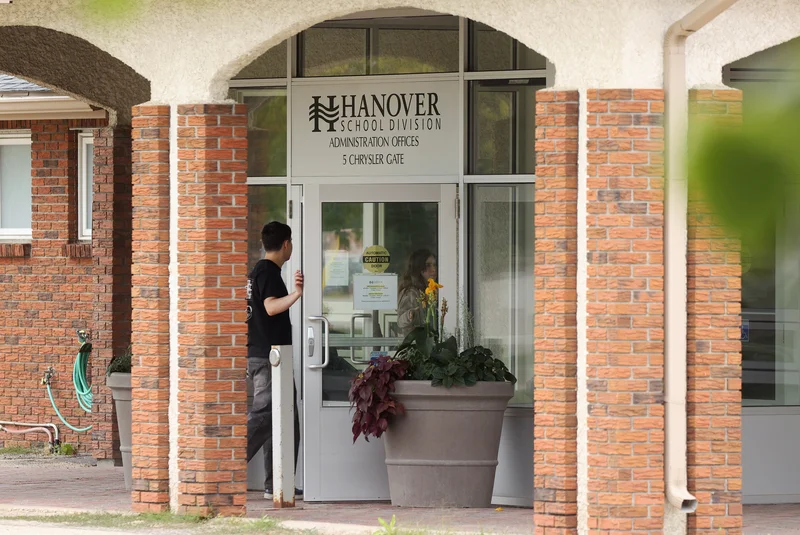
Parents and LGBTQ+ advocates have criticized a rural Manitoba school board for a passing a motion that would ignore provincial and federal mature minor regulations and prevent students from getting counselling and medical services, including contraceptive prescriptions, without their parents’ knowledge.
The board for the Hanover School Division made the decision on June 2, at one of the last board meetings before summer holidays.
A growing number of school boards and provinces, including Saskatchewan, Alberta and New Brunswick, have passed legislation or set policies that ban sex education, censor learning materials about LGBTQ+ issues and prohibit children from using certain pronouns without explicit parental permission. Many of the initiatives were the result of pressure from conservative political movements aligned around the idea of parental rights in schools.
Last month, however, Manitoba Education Minister Tracy Schmidt condemned the Hanover motion and made the rare decision to direct the board to repeal it.
In a letter addressed to the school board chair, Ms. Schmidt said the motion “contravenes” provincial regulations such as the Health Care Directives Act and the Public Health Act, along with the Charter of Rights and Freedoms.
“Your presumed knowledge of your legal and constitutional responsibilities would lead a reasonable observer to conclude you passed this motion at best for public attention and at worst to pick a fight,” Ms. Schmidt said in the July 22 letter, which was viewed by The Globe and Mail.
“We encourage you to focus on the education of children in your division and leave the health care policy development to the health care experts.”
If the school board does not repeal the motion, the province can dissolve the elected board and install a government trustee to oversee the school division.
Board chair Dallas Wiebe issued a response on Aug. 7. In a letter to Ms. Schmidt, he said the trustees will address rescinding the motion at the next meeting, scheduled for Sept. 1. But he emphasized that the motion was created and passed to address parent concerns and student well-being.
Manitoba’s southeast is home to the province’s Bible Belt, which includes many predominantly Mennonite farming communities.
The Hanover School Division has roughly 8,900 students across 20 schools. Among them is the province’s largest high school, Steinbach Regional Secondary School, which has about 2,200 students. It is the only school in the division with an on-site nursing station, staffed by the regional provincial health authority.
Trustee Cheryl Froese presented the mature minor motion to the school board on June 2. She likened the term to a “cheeseless cheeseburger.”
“There is a privilege of being a minor, but to say that a minor can be mature enough to make health care decisions either physically or mentally without a parent or legal guardian is absurd,” Ms. Froese said during the meeting.
Critics say the motion means young people may not be able to receive information about sexual health and contraception, care for sexual assault or counselling and support on gender identity and sexuality.
Jerica Capistrano, whose child attends school in the division, spoke before the board on June 23 and presented a petition with more than 1,000 signatures opposing the motion.
“This issue is larger than politics, and it’s larger than any individual viewpoint. It concerns how we support young people, how we respect legal and professional standards, and how we build trust within our schools,” she said during the meeting. Ms. Capistrano didn’t respond to an interview request.
Charlie Eau, executive director of advocacy group Trans Manitoba, said the school board’s motion follows a Canadian trend of greater parental rights in schools, as trustees inject more religious and conservative ideologies into education systems.
Ignoring Manitoba’s mature minor legislation increases the risk of queer young people being outed to their families, which can be potentially life-threatening, Mx. Eau said.
“Hanover School Division doesn’t have special human-rights violating rules. It’s absurd that they would try to make themselves an exception,” they said.
Max Harley, a co-ordinator for Rainbow Resource Centre, a Winnipeg-based non-profit 2SLGBTQ+ support centre, echoed those concerns and said mature minor standards are vital for protecting queer students.
“If youth have questions about sexual health associated with being 16 and 17 and dating each other, it’s nice to not have to book an appointment that your parent might have to drive you to so that you can have a conversation with that doctor,” Mx. Harley said.
Former Hanover School Division superintendent Ken Klassen described his first reaction to seeing the passed motion as “horror,” and he accused trustees of harnessing the growing fear of some conservative parents that schools are trying to indoctrinate their children.
“Even if [the trustees] don’t manage to get this policy into effect, or they have to rescind it, they’ve really achieved part of their agenda, which is to sow mistrust, on the part of a group of parents, of teachers, the board and public education,” he said in an interview.
The board’s motion forces teachers, health care workers and mental health professionals to decide whether to obey their employer or the law, Mr. Klassen said. (In a separate July 24 letter, provincial Health Minister Uzoma Asagwara told medical staff in the school division to continue following the law despite the passed motion.)
It also introduces physical risks for young people, Mr. Klassen said. School is a safer place than home for some students, particularly if they have abusive parents, who might not bring them for medical treatment.
“You could have a group of students that are very vulnerable and at great risk of self harm, and they’re now being pushed back to their potential abusers. Isn’t that horrific?”
Along with the mature minor motion, the Hanover board has also created policies that limit student activism in schools and address parent complaints about “inappropriate” educational resources. Those regulations, introduced last school year, still stand and are not subject to the province’s repeal.
Both school board chair Mr. Wiebe and vice-chair Jeff Friesen did not respond to requests for comment.