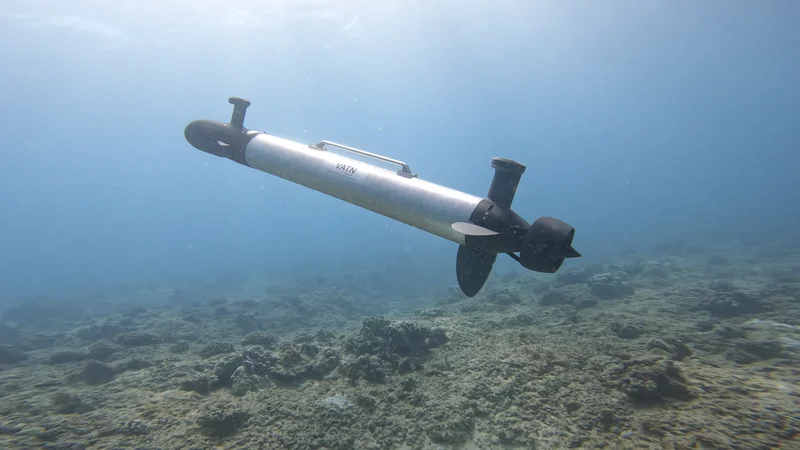
- Vatn Systems will help Taiwan build AI-powered undersea drone command systems
- Neither side has revealed how much money this partnership actually involves
- Taiwan explores Vatn’s modular S12 drones for its future undersea defense needs
Vatn Systems, a United States-based defense technology company, has agreed to explore joint undersea defense projects with Taiwan's National Chung-Shan Institute of Science and Technology (NCSIST).
The agreement, signed on behalf of Taiwan's Ministry of National Defense, opens a new chapter in the island's search for naval modernization partners.
It arrives at a moment when regional tensions have pushed several allied nations to rethink how undersea warfare and deterrence should actually function.
Vatn brings modular S12 drones
The Memorandum of Understanding lays out a framework for both organizations to jointly develop artificial intelligence-enabled command-and-control systems for undersea operations.
It also calls for the fielding of autonomous underwater vehicles, including Vatn's S12 AUV, a modular platform built for varied mission profiles.
According to details shared by both organizations, supply-chain and sustainment support based in Taiwan forms a third pillar of the deal.
Vatn's approach relies on a low-cost, modular design that lets its underwater drones be adjusted for specific ranges, accuracy levels, and sensor packages.
The company claims this flexibility sets it apart from legacy undersea systems that typically carry far heavier price tags and longer development timelines.
NCSIST, Taiwan's primary state-run defense research body, has increasingly sought partnerships with smaller, agile technology firms rather than only large traditional contractors.
"Taiwan is one of many allies rethinking what undersea defense looks like, and we're glad NCSIST sees Vatn as an integral part of that conversation," said Nelson Mills, Co-founder and CEO of Vatn Systems.
Funding remains unclear
Neither organization has disclosed a financial figure for the arrangement, leaving analysts uncertain about how quickly the partnership will move beyond paperwork.
Taiwan has spent years courting foreign defense suppliers as it tries to close gaps exposed by a much larger and better-funded regional rival.
Whether a single memorandum can translate into deployed hardware within Taiwan's own shipyards and sustainment facilities remains an open and unresolved question.
Mills believes that the collaboration fits within Vatn's broader strategy of deploying affordable undersea autonomy at scale for American and allied naval partners.
The company frames this deal as one exploration among several, rather than a finished contract for delivered submarines or finalized vehicle numbers.
Vatn claims other allied defense ministries have shown similar interest in its modular systems, though the details of these “interests” are not public.
The Taiwanese Ministry of National Defense has not issued its own separate statement elaborating on the scope or expected duration of the agreement.
For now, the agreement reads more as an invitation to negotiate than a guarantee of new capability reaching Taiwan's coastline anytime soon.
Its real significance may depend less on the announcement itself and more on whether follow-up contracts and funding eventually materialize.
Efosa has been writing about technology for over 7 years, initially driven by curiosity but now fueled by a strong passion for the field. He holds both a Master's and a PhD in sciences, which provided him with a solid foundation in analytical thinking.