“As I said very clearly on my return, I am not and never will be a Messiah; it will take a team effort.”
So said John O’Neill in The Sun-Herald in 2009, two years into his second spell as chief executive of the Australian Rugby Union, as it was called then. The tenure proved more difficult than the first, and successful second comings in Australian rugby are a tricky business – Eddie Jones being the most recent piece of evidence.
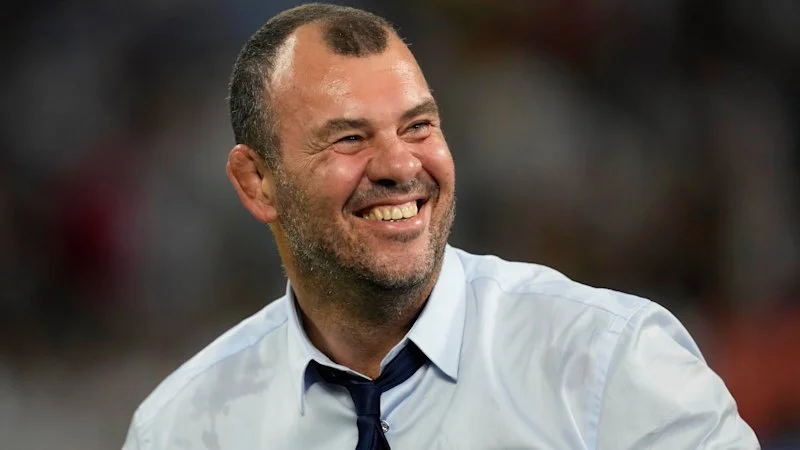
So, while Michael Cheika’s return to the Waratahs is something to be welcomed – he’s one of the big beasts of the coaching jungle – it does come with a warning.
It’s not as if O’Neill, Jones or Cheika lose the qualities that made them successful in the first instance. It’s that the world around them changes, and they return to jobs that are more complex and challenging than before.
Superficially, there are some similarities between Cheika’s first crack at the Waratahs and his second.
Take a look at the Super Rugby ladder in 2012: the Waratahs finished third in the five-team Australian conference, but 23 competition points behind both the Reds and Brumbies with four wins and 12 losses.
The Reds and Brumbies will again be Cheika’s big targets next year.
In Cheika’s first year in charge in 2013, NSW again finished third in their conference, but they narrowed the gap considerably to the Reds and Brumbies, with eight wins and eight losses.
So, successfully chasing the Reds and Brumbies is familiar territory for Cheika. That challenge will spin his wheels because he is a very proud New South Welshman.
But the landscape has changed since 2013 that Cheika is facing a bigger challenge, for two reasons.
First, the Brumbies and Reds have established such successful programs in the intervening years that both clubs supply the No.9-No.10 combinations in the Wallabies squad.
Second – and this is arguably the more significant point – the Western Force have emerged as a competitive force in Super Rugby Pacific with some of the better players in Australian rugby.
If not for halfback Henry Robertson’s ACL injury, they too would have supplied a No.9-No.10 combination to the Wallabies squad.
Neither does the situation across the ditch offer much relief for Cheika.
The Hurricanes have emerged as a powerhouse, the Chiefs have about a dozen All Blacks and the Crusaders have re-signed Richie Mo’unga. The Blues are in talks with Ardie Savea, too, and have landed the latest All Blacks No.8 Semisi Ta’eiloa.
Cheika will understand this, of course, but he is returning to a competition in which the top six teams have virtually been set in stone for five years and there has been very little evidence of upward mobility: the “nearly” clubs in Super Rugby Pacific tend to remain that way.
For that reason, Cheika’s second year is arguably going to be more important.
During his first spell, he made key signings such as Kurtley Beale and cult hero Jacques Potgieter for 2014 – acquisitions who made a massive difference to the title-winning year.
But the contract announced by the Waratahs places a question mark on Cheika’s involvement beyond 2027.
There is an “option” for 2028, but the fact it isn’t a straight two-year deal suggests both parties want to see how the sequel works out before committing to something longer.
Setting impartiality aside, you would have to be pathologically negative towards the Waratahs not to wish Cheika success.
The surge in Sydney crowd numbers towards the end of the 2014 Super Rugby campaign remains one of the competition’s highlights.
A dormant Waratahs is no good for the competition because they should be the natural home for the undeniable talent the state produces.
As stated a fortnight ago, the way they went to New Plymouth in 2014 and beat the Chiefs at their own game remains both a highlight of the Waratahs’ history and a missed opportunity to use it a benchmark.
Cheika’s return offers hope that the Waratahs can get back to that level, but O’Neill’s warning about there being no Messiahs rings as true now as it did then.