Skilled trades fight ‘unglam, dirty’ perceptions to woo young people into shrinking local workforce
AI generated
SINGAPORE - As secondary school students, Benetton and Royston Chan spent their weekends helping their father, an electrician and plumber. Under his guidance, the brothers picked up practical skills, from installing ceiling fans and lights to fitting sinks and water heaters.
Fresh out of school at ages 19 and 23, they set up their own one-stop handyman company Sparkflow, in 2013, to meet what they felt was an untapped demand.
Their father William Chan, now 70, was supportive and happy, said Benetton, 32.
“My dad felt that there would finally be someone from the family who could continue the trade and take care of the clients he had built up over the years,” he added.
Benetton, who has a degree in economics and finance from RMIT University, is open to his two-year-old son following in his footsteps one day – but he and his father are exceptions.
Over the years, a shrinking group of locals has been drawn to the skilled trades, as young entrants to the labour market seem to favour more office-based, less physically demanding work.
As more of them today also obtain university degrees, their aspirations for a stable job and career have shifted away from such vocations.
Meanwhile, those remaining in the business are getting older, with some like Richard Tock, a 65-year-old licensed plumber and gas service worker, worried that no one will inherit their knowledge and skills.
Tock, who also lectures at BCA Academy, said: “I don’t want to bring my skills and knowledge to the grave.”
In 2025, 51,600 residents were employed as craftsmen and related trades workers, said a Manpower Ministry spokesperson. This group covers a wide range of trades, including building and related trades workers, metal and machinery workers, and electrical and electronic trades workers.
In 2023, there were 53,000 residents in these occupations, with a median age of 56. MOM said then that there were 133,000 foreign workers in the sector.
The ministry acknowledged the manpower challenges facing the sector – an ageing workforce, fewer young locals entering these roles, and strong competition for manpower across sectors.
It is working to strengthen the attractiveness of these careers by providing clearer skills pathways, stronger professional recognition, and better career progression opportunities, it said.
Somchai Virabhak, president of the Singapore Electrical Contractors and Licensed Electrical Workers Association, said there are currently around 3,700 licensed electrical workers in Singapore, with more than a third of them over 60 years old.
There has been a visible decline of local workers entering the sector over the last five to 10 years, and an increasing percentage of hands-on electrical installation works are now performed by foreign technicians, he said.
This issue has surfaced in national discussions, including in the Economic Strategy Review and in debates on jobs in Parliament.
The review recommended a coordinated strategy to raise job quality, productivity and wages in essential roles such as skilled trades, and to also address barriers that lead to the undervaluing of such roles. This includes society’s willingness to pay for better-quality essential services. It also proposed broadening the definition of ‘good jobs’ to formally include skilled trades, care work and social services.
At a recent debate in Parliament on Singapore’s future economy, Workers’ Party MP Gerald Giam suggested a guild for skilled tradespersons to better structure the career pathways available, develop expertise and uplift wages.
The Government responded that it is already working towards these goals, including through a Manpower Ministry partnership with the Specialists Trade Alliance of Singapore (STAS) to develop more structured pathways into good jobs, starting with electrical trades.
There is general recognition that skilled trades provide jobs that are more resilient to disruption such as artificial intelligence and will remain an essential part of Singapore’s economy.
Implicit in this is that Singapore should continue its efforts to ensure locals enter and replenish this sector.
There are signs of promise that young people are interested in joining, but several barriers currently stand in the way.
Undervalued, undepriced
The public perception toward skilled trades has shifted as society developed, said those interviewed.
The physical nature of the job and its lagging pay have contributed to these shifts – and even a sense of stigma – as Singaporeans change their measures of success.
Tock, who has been in the sector for over 40 years, said he has seen an increasing tendency to measure success by academic qualifications or whether someone works in an office.
“For many years, society has placed considerable emphasis on academic qualifications and white-collar professions, while skilled trades are sometimes still viewed as dirty, physically demanding or lower-status work,” he said.
“That perception needs to change.”
Tock, whose initial ambition was to be an architect or interior designer, did not expect skilled trades to become his lifelong profession. He was roped in at age 20 after completing National Service to help out at his father’s firm, which provides professional plumbing, sanitary and gas-related services.
“Like many young people starting out, I learnt along the way and discovered that I enjoyed solving practical problems.”
Ernest Tan, 40, founder of Singapore Carpentry, remembers being questioned by his relatives during Chinese New Year gatherings about his choice of profession.
Tan, who has double degrees in computing and economics from NUS, incubated his company in 2013.
“They asked if my studies were that bad or if I had failed to graduate,” he said.
His parents also told him to look beyond carpentry to find a “proper” job.
“We came from a poor family. They felt it was too big a risk.”
But he saw the demand for renovations then amid a property boom, and dived into starting his own business.
Similarly, plumbing apprentice Yeo Kai Xun, 23, faced objections from his taxi driver father, who preferred that he follow the conventional academic route of getting a university degree and securing an office job in an air-conditioned environment.
Yeo, who has a diploma in architecture, said he prefers a hands-on job rather than a desk-bound office role.
But the wages have to improve for the sector to attract more people, he said. “My friends feel that a manual job is tiring and doesn’t pay well.”
How it pays is linked to how the work is priced.
Tock said good workmanship, experience, certification and accountability must have value.
“If skilled work is valued mainly by the lowest quotation rather than by competency, workmanship, certification, accountability and long-term reliability, it becomes difficult to build a sustainable local career path and attract younger people into the trade,” he said.
He said his rates are based on the scope, complexity, expertise, safety requirements and quality of workmanship.
Eric Cheung, senior director of ITE’s Curriculum and Educational Development, said skilled trades offer meaningful careers with good wages and progression. But there is a stigma around skilled trades which requires a broader shift in how society values different types of work.
“For skilled trades to become even more viable, Singaporean consumers have a role to play in recognising the expertise of these craftsmen and remunerating them fairly, just as we do for professionals in other areas,” he said.
Struggle to find local staff
With fewer locals attracted to the sector, firms here have grown to depend on foreign workers.
Singapore Carpentry’s Tan said he has nine carpenters in Singapore – all from China and Malaysia – who also operate robotic machines that partially automate some carpentry fabrication work.
He has a factory in Foshan, China, where Chinese workers perform 80 per cent of the carpentry work.
“Not that we don’t want locals. Singaporeans are not into this line,” he said. “Singapore focuses on glamorous jobs in areas like finance, medical and tourism. Carpentry is ‘unglam’ and one is exposed to glue and sawdust.”
Other Singaporeans running their own skilled trades businesses also lamented the challenges of finding local employees.
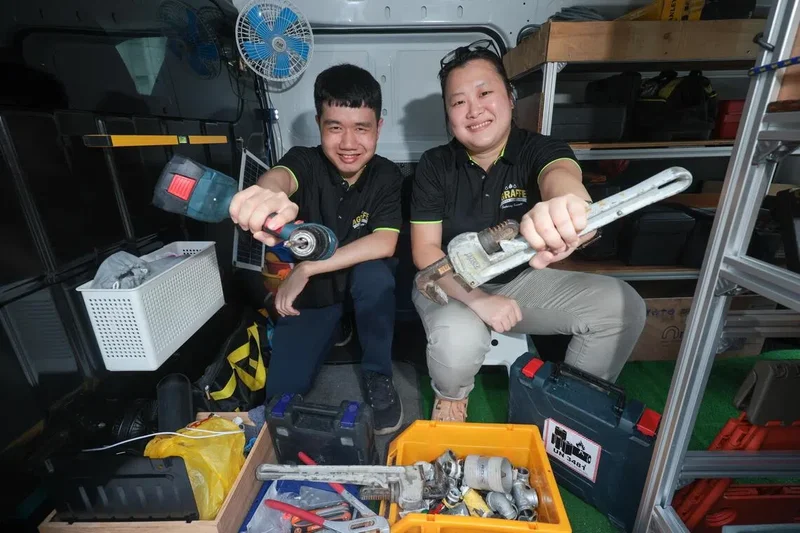
Geraldine Goh, 32, a licensed plumber who started her own firm Agraffe in 2017, said she prefers to hire locals for easier communication, even though they typically start without hands-on skills such as how to use basic repair tools.
She is even willing to pay them more, but there are few takers. She has three staff - two local and one foreign.
Local skilled tradesmen are selective about the jobs they take, she said, adding that while one potential pool of workers is existing handymen looking to upgrade their skills, many expect support to obtain the necessary licences and eventually operate their own businesses.
She offers a starting pay of about $1,800 or $2,000 to local fresh graduates from ITE and polytechnic respectively applying to be inexperienced apprentices. An experienced foreign worker is paid at least $26 a day, which adds up to about $2,000 monthly including foreign worker levy and accommodation.
Sparkflow has seven local staff who are in corporate roles like marketing and IT, and another seven foreign workers from Bangladesh who are technicians.
“To locals, this job is not as attractive as a white-collar job as one needs to get down and dirty,” said Benetton. “Foreign workers do not mind the job nature or erratic hours.”
Green Shoots
Tock, who has taught or mentored close to 1,000 students and trainees over the years, said career pathways need to be spelled out concretely to attract Singaporeans.
He also called for training to include more real-world exposure — put trainees on actual projects alongside experienced tradespeople to learn how to investigate, diagnose and solve problems, rather than relying solely on classroom instruction.
Under the pilot by MOM and STAS for electrical tradesmen, initiatives such as training and skills frameworks and industry apprenticeships are being developed.
“MOM will continue to work closely with industry, institutes of higher learning, and trade associations to attract new entrants, support mid‑career switchers, and build a resilient and sustainable skilled trades workforce for Singapore,” said an MOM spokesperson.
STAS executive director Eddy Lau said beyond the pilot, it is also working with employers and educational institutions on potential apprenticeship and workplace-learning pathways.
“For a 20-year-old, skilled trades must offer visible career progression, competitive remuneration, recognised credentials, and opportunities to work with technology,” he said. “Young people should be able to see not merely their first job, but where their skills can take them over the next five, 10 or 20 years.”
STAS represents 14 specialist trade associations and comprises more than 1,400 members across trades.
There are early signs of interest returning at the entry level for certain trades, even if they are modest against the sector’s overall decrease.
Cheung said the ITE has seen growing interest from young Singaporeans in certain courses.
For example, intake for the Higher Nitec course in facilities management and engineering, which also teaches air-conditioning and plumbing skills, grew from 130 in 2023 to 400 in 2026.
Intake for Nitec and Higher Nitec courses in rapid transit engineering increased from 150 to 200 over the same period.
Graduates in these areas generally went on to secure jobs with good remuneration, he said.
Salaries have also slowly increased – the starting salary for Higher Nitec in facilities management and engineering graduates went up from $2,297 in 2023 to $2,600 in 2025.
ITE currently offers structured diploma progression pathways, including the work-study diploma and technical diploma, and will continue to expand its diploma offerings, said Cheung.
“Together with strong industry partnerships and clear progression pathways, these efforts signal that young Singaporeans can take pride in their skills, and that skilled trades offer positive career prospects and financial stability,” he added.
Making the work more attractive
Beyond wages and credentials, industry players say technology may make trades more appealing to a generation that grew up digital.
Monica Kong, managing director of lift and escalator company KONE Singapore, said the firm is investing in AI-enabled tools and continuous upskilling to help its technicians work smarter and strengthen their expertise.
Ratheesh Kumar, a senior troubleshooter from the same firm, 44, said: “This shift is opening exciting career opportunities for young people who enjoy technology, problem-solving, and working with modern equipment.”
Tock, too, sees his trade changing shape.
Plumbing today increasingly involves better diagnostic equipment, digital drawings, sensors and leak-detection technology, he said.
Edwin Wong, 38, co-founder and director of Atlas Works which provides waterproofing and painting services, agrees about the draw of technology.
While he sees interest among his younger staff in the more tech-heavy aspects of the job, he feels there is still a need to guide them on the implementation.
Together with his brother and co-founder Eric, he also tries to make the pathways for progression clearer.
They offer apprenticeships, and currently have one local and one foreign apprentice.
By creating such opportunities, young people can see that they can also progress into specialist, supervisory, management, or business ownership roles in this sector, said Wong.
David Gomulya, professor of strategy & entrepreneurship at the Singapore Management University, said well-designed apprenticeships allow individuals to earn while they learn, gain recognised industry qualifications and build confidence through hands-on experience.
He cited the example of Germany, where apprenticeship systems are well-established and closely integrated with industry needs. In Germany, about 12 per cent of the workforce is in skilled trades.
Associate Professor Benjamin Loh of the Singapore University of Social Sciences cited Japan’s kaigo fukushishi — its certified care worker credential — as an example of how to professionalise skilled work and attach a recognised qualification to roles previously seen as unskilled.
“The principle transfers directly to skilled trades: when a qualification is nationally recognised, legally regulated, and co-designed with industry, it changes not just what a role pays but what it signals about the person who holds it.”
He said policy must address three gaps: early-career wages that reflect the physical demands and skills required, clear and respected career pathways from apprentice to master tradesperson, and greater social recognition of such work.
The ESR committee’s recommendation to broaden the definition of good jobs is a significant and welcome step, he said.
“What follows it matters as much as the step itself: the harder work of investing in credentials, adjusting wages, building career ladders, and treating skilled trades not as peripheral workforce concerns but as strategic human capital priorities for Singapore’s next decade,” he added.