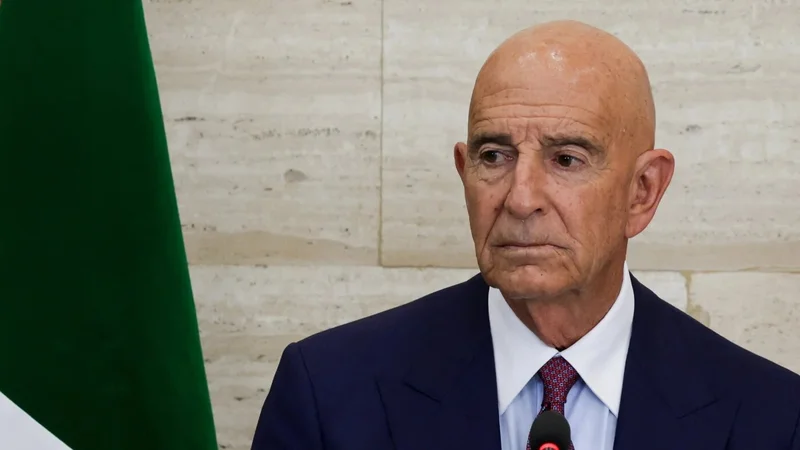
US envoy to Turkey: 'Israel occupies Golan despite UN resolutions, international order'
US ambassador to Turkey Tom Barrack has said Israel’s occupation of Syria’s Golan Heights continues even though it ran against UN resolutions and international law.
Barrack’s remarks put him at odds with his own government, as US president Donald Trump recognised Israeli sovereignty over the territory in 2019.
Golan Heights, a strategic plateau straddling Israel and Syria and overlooking southern Lebanon, was captured by Israel during the Middle East war of 1967 and subsequently annexed in a move never recognised by the international community.
UN Resolution 242 calls for Israel to withdraw from the Golan and other occupied territories including the Gaza Strip and the West Bank.
Some 20,000 Israeli settlers currently live in the Golan, alongside around 26,000 of the territory’s native inhabitants, who are predominantly Druze and identify as Syrian.
Barrack made the comments in a wider-ranging interview with broadcaster Mario Nawfal, where he was also asked whether Israel intended to annex the Lebanese territory.
“No matter what they are doing. In the long run, I think they are looking and saying ‘that is probably unlikely that anybody is going to allow us to do that’. America’s support is waning. Even the young Democrats are coming against them,” Barrack said.
He said that US president Donald Trump has “drawn a line of attempting to go moderation” and the upcoming Israeli elections will throw up a different setting.
“I just think regardless of what their intent may be now, they know that that’s not likely. Now saying that, in the Golan with Syria, they still occupy the Golan against the UN resolutions, against all of the international order, which has said the Golan is Syria's,” Barrack said.
“So how long do these (Israeli) incursions (into Lebanon) go on until the temperature comes down,” he said, and stressed that a resolution appeared difficult in the absence of “people who can take a decision at the table”.
“And the people who can take a decision are Iran and Hezbollah,” he said.
What prompted Israeli air strikes on Syria?
Barrack said Israel’s strike on Syria’s Abu al-Duhur airbase early Tuesday risked a direct confrontation with Turkey. He put forward several theories that could have prompted the strikes he called “serious and worrying”.
He said Israel may have acted on intelligence suggesting Turkish military assets were moving into the base, but checks found that was not happening.
A second possibility, he said, was that Israel detected movements others missed. But his “probably most likely” theory involved intercepted discussions about Turkey expanding training there.
Barrack also floated a more explosive possibility: “the Israelis were baiting the Turks”, deliberately testing Ankara with aircraft deployed without prior notification.
Another theory was a breakdown inside Israel, with the IDF, Mossad and prime minister’s office potentially acting on different assessments.
“The unintended consequence of a mistake could be really consequential,” Barrack said, describing how Turkish forces might have scrambled their jets without knowing Israel’s intentions.