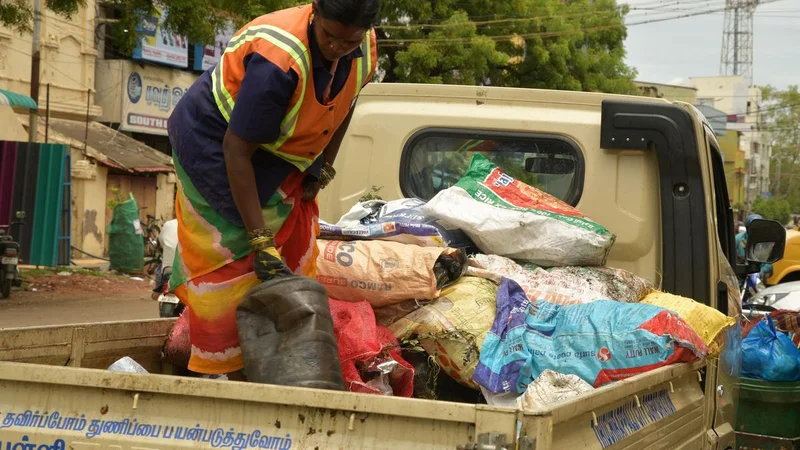
Tiruchi Corporation has directed bulk waste generators (BWGs) in the city to strengthen their waste-management infrastructure and process the waste generated on their premises, instead of handing it over to sanitation workers.
According to Corporation officials, establishments with a built-up area of 20,000 square metres or more, those consuming 40,000 litres or more of water a day or those generating 100 kg or more of solid waste a day are classified as BWGs.
The category includes commercial and business establishments, resident welfare associations, hotels and lodges, hospitals, theatres, educational institutions, IT parks, marriage halls, commercial complexes, markets, industries and other large establishments.
The Corporation has identified 212 bulk waste generators in the city and instructed them to make arrangements for handling the waste generated on their premises. At present, wet waste generated by BWGs is collected by the Corporation, which is processed at the micro compost centres, while dry waste is reportedly handed over to scrap dealers.
It has mandated BWGs to install four colour to segregate wet waste, dry waste, sanitation waste, and special-care waste, and ensure that the segregated waste is processed appropriately.
In 2024, the Corporation introduced compost bins on a pilot basis to convert household biodegradable waste into manure. Bins with a processing capacity of up to 700 kg were installed at apartment and residential communities in Srirangam, Woraiyur, and Palakkarai.
Under the system, biodegradable waste is placed in the bins, followed by a layer of microbial coco peat to accelerate decomposition. The bins are designed to regulate air circulation, enabling the waste to be converted into manure in about 40 days.
However, the initiative could not be expanded for want of sponsors. The officials said that the bulk waste generators would be advised to adopt similar composting systems and process their biodegradable waste on their premises. “A meeting will be convened to encourage them to adopt similar methods to process the daily waste generated on their premises,” a senior official said.
Karur Collector’s order
Meanwhile, the Karur district administration has directed all establishments classified as bulk waste generators to mandatorily register with the Central Pollution Control Board (CPCB) under the Solid Waste Management Rules, 2026, within 15 days.
Collector C. Muthukumaran has instructed officials to identify all BWGs across the district and complete their registration on the CPCB portal within one week. He directed the officials to create public awareness regarding proper solid waste management and ensure that waste is segregated at source into four categories.
Published - August 22, 2026 07:10 pm IST