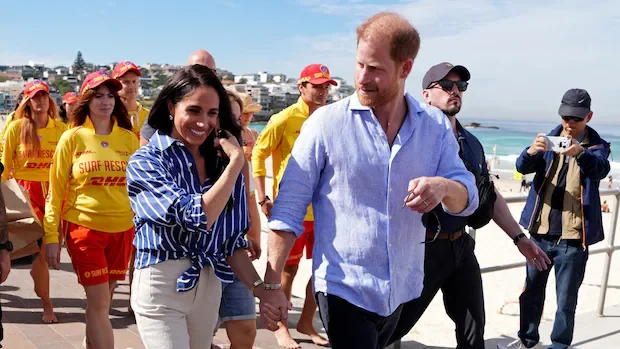
How will the British press cover Harry and Meghan this time around?
The couple’s return comes amid questions about British media’s treatment of Black public figures
When Prince Harry and Meghan Markle return to Britain this month, they will be stepping back into a country that has spent six years talking about them from afar.
Their children, Prince Archie and Princess Lilibet, are due to attend school in Britain in September, and the couple are expected to live privately outside London for an extended period, according to reports. They will remain non-working royals.
Many questions have already been asked about the couple's return — but after being away for years following a tumultuous relationship with the British press that appeared to have been a factor in their decamping to California, could the tabloids' fascination with the couple peter out this time?
Speculations about the life plans and movements of Royals are nothing new in Britain, but in the mythology that can sometimes be fomented around them, Harry and Meghan were often seen as "the evil, the bad cops, it's all very black and white," said Steven Barnett, a professor of communications at the University of Westminster.
- Prince Harry and Meghan moving back to the U.K.
- Prince Harry, Elton John and others slapped with millions in legal fees after court loss to Daily Mail
"It's very binary… There is a tendency in certain elements of the British press to go in for very personal witch hunts."
The early coverage included the Daily Mail's "(almost) straight outta Compton" headline about Meghan's mother and The Sun's "Harry's girl on Pornhub," which involved the tabloid discovering scenes from Markle's time on the American TV series Suits on a pornographic website, then apologizing for it months later.
A Guardian analysis of 843 articles across 14 U.K. newspapers from May 2018 to January 2020 found 43 per cent of coverage about Meghan was negative, compared with just eight per cent of 144 articles about Kate Middleton.
Royal commentator Afua Hagan said that interest would ramp up in Britain as they return.
She told Reuters while the couple were essentially walking back in to the "lion's den" they were better prepared this time: "They're not bringing a knife to a gunfight. They know what they have to do, what they're going to come up against, and will prepare themselves better."
It's not just the couple that has changed, Barnett said; "other soap operas" may be occupying the minds of the British public.
WATCH | What do people in the U.K. think?:When Meghan and Harry first lived in the U.K., Barnett said, the country was in a different place.
"We didn't have, you know, two wars; the possibility of this country being drawn into a war with Russia; the ravages of climate change. Not to mention, cost of living problems and people struggling to get by."
Still, the court loss Prince Harry and several others recently suffered in privacy lawsuits they had filed against the Daily Mail could lead to more "nasty and vitriolic" coverage, Barnett said.
British media scrutinized after professor's death
The couple's return comes at a time of reckoning for British media.
The death this month of Jason Arday, a 41-year-old Cambridge professor who had resigned after allegations about his academic record, has prompted an intense debate over the boundaries of legitimate scrutiny — and whether the British press crossed them in its treatment of a Black public figure.
Some have made a connection between the nearly 250 articles that were published about Arday within two weeks, according to The Independent, and the negative coverage Markle received.
"The pile on that Meghan … got for years and years and years is akin to what Professor Jason Arday had. She was piled on for years and years and years and it still goes on," Nina Myskow, a former Sun columnist, said this week on Jeremy Vine, an eponymous chat show on Channel 5.
Barnett said the "personal assault" to which Arday was subjected was unfair, despite legitimate questions about plagiarism in his work and and Cambridge University's lack of vetting of it.
"The same thing, I think, has happened in the past to Meghan, as it has to other public figures, because that's what the British tabloid press does," he said.
Arday's death has prompted questions about the way his story became entangled with much larger arguments about race, diversity and who belongs in Britain's elite institutions.
Marcus Ryder, chief executive of the Film and TV Charity and co-founder of the Sir Lenny Henry Centre for Media Diversity, sees the issue as stemming from a lack of diversity within British media.
Black people, as a result, he said, are too often denied the freedom to succeed or fail simply as individuals.
"White people are allowed to succeed and fail as individuals," Ryder said. "Whereas Black people, when we succeed and fail, it is used for good and ill as part of wider narratives."
Arday's rise became evidence for one narrative about racial progress. His downfall became evidence for another about diversity and merit.
Ryder applies that directly to Meghan: he says her presence exposes contradictions in British society — a Black woman entering one of Britain's most privileged institutions while that institution itself is rooted in hereditary privilege.
Now, the couple are no longer working royals. They have lived in California for six years. Much of the drama surrounding their departure has already been litigated, televised, published and repackaged. There may not be much more left to say.
Ryder said he hopes the perspectives reflected in the coverage of the couple reflect "the real positivity that large swaths of, of the population, especially Black women, feel towards Meghan Markle."
With files from Reuters and The Associated Press