Medical Mysteries
Work stress led woman to discover genetic condition that looks like heart attack
Medical Mysteries is a series that spotlights rare diseases or unusual conditions.
AI generated
SINGAPORE – Christina Chua began experiencing severe stress in her 50s, while overseeing administrative and finance functions for a German company with operations here.
“It came to the point where I woke up at 3am and thought about work,” recalled the 73-year-old.
She soon noticed that the stress triggered other symptoms – a fast, irregular heartbeat as well as sudden, profuse sweating.
The condition got so bad on one occasion that her husband took her to hospital.
“He thought that maybe it was a heart attack,” she said.
A doctor later diagnosed Chua with atrial fibrillation, a condition where unusual electrical activity in the heart’s upper chambers causes a chaotic, irregular heartbeat.
Also known as arrhythmia, it is the most common heart rhythm disorder, affecting more than 46 million people worldwide.
Although Chua was prescribed medication, her condition persisted.
An episode in 2013 resulted in her being hospitalised in the intensive care unit, after which the mother of three was referred to the National Heart Centre Singapore (NHCS).
There, at age 60, she was diagnosed with hypertrophic cardiomyopathy – a genetic condition that causes the heart muscle to thicken.
While thickening of the heart muscle can be caused by conditions such as hypertension, patients with hypertrophic cardiomyopathy can develop such thickening even without those conditions, said cardiologist Tang Hak Chiaw.
If left untreated, hypertrophic cardiomyopathy can lead to stroke, heart failure and even sudden cardiac death in rare cases.
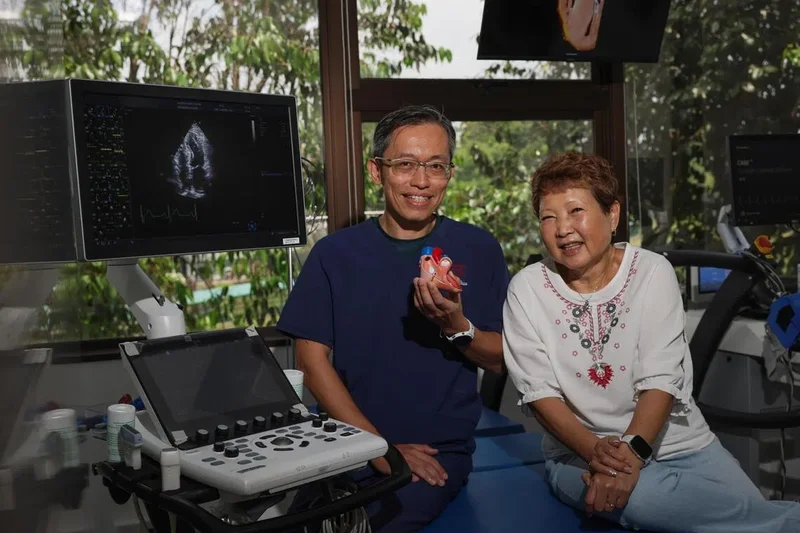
Tang, who had treated Chua at NHCS then, is now a consultant cardiologist at the Novena Heart Centre, where he continues to oversee her case.
Hypertrophic cardiomyopathy is estimated to affect about one in every 500 people worldwide, though Tang said the actual number may be higher as many with the condition may not show any symptoms.
Although not rare, the condition often goes undiagnosed as it manifests differently across patients, with symptoms similar to those of other heart or lung conditions.
For example, Tang pointed out, blockage of the arteries can also cause atrial fibrillation and breathlessness, both symptoms of hypertrophic cardiomyopathy.
He added that blocked arteries are typically diagnosed using an angiogram or a computed tomography scan, while hypertrophic cardiomyopathy is usually diagnosed with an echocardiogram.
In more serious cases, patients may have to go for septal myectomy – open-heart surgery where part of the thickened heart tissue is removed, allowing blood to flow more easily, said the cardiologist.
In Chua’s case, however, the drugs she was prescribed worked “extremely well” and she did not have to undergo such a procedure, he added.
An article on the NHCS website lists beta-blockers and calcium channel blockers – which help to slow the heart rate and ability of the heart muscle to pump – as among the medications used to control the condition.
The US Centers for Disease Control and Prevention notes that the child of someone with hypertrophic cardiomyopathy has a 50 per cent chance of inheriting the condition.
Chua said that she suspects her mother might have had the condition as she showed symptoms such as sweating and breathlessness in her later years.
Tang advises first-degree blood relatives of those with the condition to get checked, adding that genetic tests are available alongside echocardiograms.
For Chua, being diagnosed and prescribed with the right medications to manage her condition has made a world of difference. Taking her doctor’s advice, she has also started using a smartwatch that can check electrical pulses for signs of atrial fibrillation.
She can now indulge her love of travel as well as perform daily activities without feeling breathless or fatigued.
Climbing the stairs to the second floor of her home used to be a chore that required stopping and resting, said the grandmother of three.
“Now my daughter says she can see that I can climb up with no problems,” Chua said.