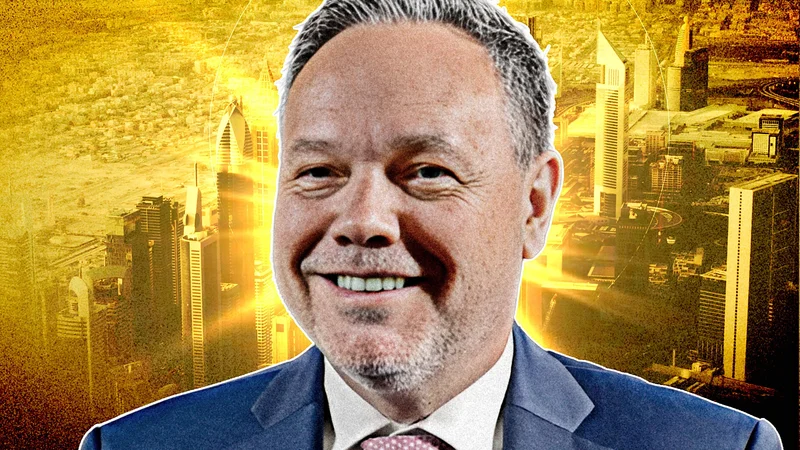
Three months after political strategist Ryan Coetzee played a key role in the DAâs GNU negotiations, the party entered into a confidential agreement with the Dubai-based private advisory firm he led to manage virtually every part of the DAâs operation inside the GNU.
Over the June/July 2024 period when the GNU was being negotiated, and for at least six months afterwards, Coetzee was the CEO of Consulum: a firm described by PR Week in 2015 as a âBell Pottinger spin-offâ due to its founding by former Bell Pottinger International chairman Tim Ryan and former director of Bell Pottinger Middle East Gunther Bushell.
The Guardian reported in 2018 that Consulum was âlargely staffed by former employees of Bell Pottingerâ.
The confidential contract between Consulum and the DA ran from September 2024 to February 2025 and was worth just over $470,000, or around R7.8-million, for six monthsâ work. Subsequently extended for one month, it required Consulum to develop strategies for DA ministers and deputy ministers, manage communications, train political staff and chair meetings of the DAâs GNU caucus, in addition to a range of other responsibilities.
As of at least 4 December 2024, more than three months into Consulumâs DA contract, Coetzee was still being marketed by Consulumâs LinkedIn account as the companyâs chief executive. His replacement as CEO was announced only on 17 May 2025, and UK company records show that Coetzeeâs directorship of Consulum UK was formally registered as ending only on 30 June 2025.
The fact that Coetzee was negotiating the DAâs entry into national government and subsequently managing the DAâs GNU caucus while still formally at the helm of a company described in a 2020 investigation as âoccupying an even more nebulous sphere than Bell Pottingerâ raises fresh questions about the DAâs relationship with lobbyists and the partyâs handling of conflicts of interest.
Four DA MPs, meanwhile, have told Daily Maverick that the extent of Coetzeeâs influence over the GNU operations and policy currently is causing increasing concern to the DA caucus.
The DA, through spokesperson Jan de Villiers, denied any conflicts of interest and claimed âfewâ individuals in the party would have any issue with Coetzee.
The unelected strategist
at the GNU negotiating table
at the GNU negotiating table
Coetzee was the DAâs chief strategist between 1999 and 2009 and a one-term DA MP between 2004 and 2009, a position he resigned from after losing the election for the post of DA Parliamentary Leader to now-Action SA MP Athol Trollip.
Regarded as a political wunderkind by former DA leaders Tony Leon and Helen Zille, Coetzee is credited with helping grow the DAâs vote share from 9.56% in 1999 to 16.66% in 2009.
He met with less success during a stint in UK politics between 2012 and 2016. Coetzee was the campaign strategist for the Liberal Democrats party in the lead-up to the 2015 UK general election, in which the party lost all but eight of its 57 seats.
Ahead of Brexit, Coetzee was director of strategy for the campaign for the UK to remain in the EU, which ended in failure in the July 2016 referendum. In that year, he joined Consulum, becoming its CEO in 2021.
In the months before the May 2024 South African general elections, journalist Mandy Wienerâs book __The Deal __â a comprehensive account of the GNU negotiations â records Coetzee as participating âwhen he was in townâ in a private scenario-planning group which met at Tony Leonâs Constantia home to consider the DAâs options in the event of no political party winning a clear majority.
Steenhuisen subsequently placed Coetzee and Leon, neither of whom held any formal or elected position within the DA at the time, on the DAâs GNU negotiating team. Their major counterparts, the ANCâs GNU negotiators, all held elected positions within ANC structures.
Wiener records that federal structures insisted that Helen Zille should lead the process, with negotiators reporting back regularly to the partyâs federal executive.
Coetzee and Leon openly expressed frustration about this oversight to Wiener, with Coetzee telling her: âThe Fedex seems to meet every 30 minutes,â and he and Leon âjust lost our shit about thisâ.
Zille described the situation quite differently, telling Wiener: âFrom the start of the negotiations, it was clear that Tony and Ryan had moved seamlessly back into the roles they had when they were running the party in 1999. They could not seem to grasp that we now run the party according to our constitution, and the people who take these crucial decisions are those elected by different constituencies of the party to do so.â
This tension, according to the accounts of DA MPs, has endured beyond the GNU negotiations to the current day.
Coetzee nevertheless played a central role in the negotiations, drafting the DAâs Framework for Multi-Party Government, which formed the basis of its engagement with the ANC.
Wienerâs book records that towards the end of the GNU negotiations, Coetzee âhad to leave the country for urgent work abroad but remained involved via Zoomâ.
Once the GNU was formed, Steenhuisen asked Coetzee for continuing help. Wiener quoted Steenhuisen as saying:
âWeâve got no room for error, and thatâs when I said to Ryan, you have to stay. You have to manage us through our transition into government; youâve got to help us with the cabinet office now and set it up. How do we fill staff in positions, how do we set up the structures and how do we make sure that we donât fall into the pitfalls of not communicating, not thinking politically, misstepping?â
The Consulum contract began shortly afterwards.
The secret R7.7-million contract â with who?
The agreement between the DA and Consulum was not merely for communications work or organisational set-up counsel. It placed Consulum within the DAâs political chain of coordination, working directly with ministers, deputy ministers and chiefs of staff.
Asked by Daily Maverick why the DA contracted Consulum to work on GNU management rather than Coetzee directly, Coetzee responded via email: âBecause at the time I was CEO of Consulum and contractually prohibited from doing outside workâ.
The DAâs response was the same.
While the DAâs formal contract may have been with Consulum and not Coetzee, Daily Maverick understands from DA sources that it was Coetzee himself doing the most visible work on the DA GNU account during this period, including chairing meetings of the DA ministers and deputy ministers.
This is given weight by the fact that Wienerâs book records Coetzee as having personally represented the DA in back-channel negotiations with the ANCâs Nkenke Kekana during the dispute over the GNUâs first national Budget in February and March 2025, during the Consulum contract.
Many parties make use of advisers or consultants during the lead-up to the Budget. For someone who was neither a public official, MP, Minister or elected representative of the DA to be personally negotiating the Budget outcome on behalf of a political party, however, was highly unusual.
The arrangement placed a private consultant at the centre of negotiations over one of the stateâs most consequential constitutional processes, without the public knowing the commercial basis of his role or the extent of his authority.
Kekana told Wiener he found the situation âreally abnormalâ.
âHeâs based in Dubai and heâs negotiating a deal and heâs running this DA on the governance side,â Kekana said.
Coetzee told Daily Maverick that he took on this role because âI was asked to do so by John Steenhuisen, who was the leader of the DA at the time and the person I reported toâ.
The capacity in which he was reporting to Steenhuisen remains unclear.
Coetzee did not answer whether other Consulum employees had worked on the DA account, writing: âAt least when I was there Consulum did not disclose which staff worked on accounts.â
This would seem to raise the possibility that unidentified private-sector personnel, potentially based outside South Africa and beyond the ordinary public-service accountability framework, had access to information relevant to DA ministers and deputy ministers whose portfolios collectively spanned all seven government clusters.
The DA, for its part, responded to Daily Maverickâs questions about which Consulum employees had access to DA or ministerial information with only: âNo confidences were breached by any Consulum employeeâ.
It is unclear how this would be verified.
Coetzee told Daily Maverick that Consulum had âof courseâ disclosed its other clients to the DA before entering into the agreement, adding: âAlthough they already knewâ.
The DA, in other words, by Coetzeeâs account was aware that Consulum had worked on strategies for rehabilitating the__ Saudi regimeâs overseas image__ in the wake of the murder of journalist Jamal Khashoggi in 2018, worked closely with the authoritarian government of Bahrain, and signed a contract to help launder the reputation of the government of Hong Kong in 2020 following the brutal crackdown on pro-democracy protesters â after ethical misgivings reportedly led at least eight major international PR firms to refuse to take on the work.
One media outlet noted at the time: âIf Hong Kong really wanted to build a more positive narrative, hiring a firm that carried this kind of baggage of its own seemed like an odd way of going about itâ.
When Daily Maverick asked the DA whether Consulum had disclosed its client list to the DA in order to rule out potential conflicts of interest, however, the DA did not answer the question directly â stating instead: âConsulum does no work in South Africa. There were no conflicts of interest.â
âNo conflicts of interestâ
The assertion that because Consulum âdoes no work in South Africaâ, there were âno conflicts of interestâ was given by the DA to three separate questions regarding Coetzee and Consulum.
It is an assertion that sits oddly against certain pieces of documented evidence. One is that an entity called âConsulum Africaâ was registered as a company in South Africa in August 2021, with Coetzee listed as a director â alongside his Consulum CEO replacement, James Davies â in October 2021, with a Cape Town business address.
Consulum Africa was listed as a subsidiary of Stagwell, the multinational marketing company which bought Consulum in late 2024, in Stagwellâs reporting as of the end of 2025. Coetzee is still listed as an active director of Consulum Africa on CIPC records today.
When asked why this was the case, Coetzee replied: âNo idea. Consulum Africa was dissolved, or was in the process of being dissolved when I left. Perhaps the process is ongoing.â
At some point, however, Consulumâs Cape Town office appears to have been active. A website profile of another former DA MP, Tim Harris, records him as leading âthe Cape Town officeâ of Consulum. Since the same profile simultaneously identifies Harris as the interim chair of South African Tourism (SAT) â a dual position flagged by MPs on several occasions as a potential conflict of interest â that puts the profile creation between April 2023 and May 2024, when Harrisâs SAT term ended.
The fact that Consulum had an active base in Cape Town at some point in recent years does not automatically mean it had any South African clients, it should be noted. But since Consulum âis secretive to a fault, complete with an opaque website and a near-total absence of meaningful information about its operationsâ, to quote one report, that is difficult to confirm.
A system for control from the centre
LinkedIn posts from Consulum show that during the period where Coetzee was helping negotiate the DAâs entry into the GNU, the company he led was actively promoting him online as an expert on Consulumâs Government Promise System: a methodology developed by the firm which essentially advocates for governments to have one central leadership team set the priorities for the whole government, make sure every minister follows them, and keep checking that they do.
This, it appears, would be Coetzeeâs approach to the DAâs participation in the GNU â particularly after he was brought back on his own contract as a GNU adviser almost as soon as Geordin Hill-Lewis was elected leader in April 2026.
The reason the original Consulum contract could not be extended beyond March 2025, Daily Maverick has learnt, was because it was paid for with donor funds which had been tapped out.
The DA did not dispute this to Daily Maverick, saying only: âThe contract was paid by the Democratic Alliance. The party in general is part-funded by donations for its operations.â
When Hill-Lewis announced Coetzeeâs employment as a GNU adviser, he said that Coetzee would be working alongside DA Home Affairs Minister Leon Schreiber, __likening the two __to âRassie [Erasmus] and Siya [Kolisi]â.
Hill-Lewis described their joint role as being to âcoordinate the DAâs caucusâ.
In reality, DA insiders speaking on condition of anonymity told Daily Maverick, Coetzeeâs authority increasingly extends far beyond that â to the discomfort of many DA MPs, who repeatedly point to Coetzeeâs unelected status within the party.
De Villiers termed that allegation âfalseâ.
âAll ministers and deputies in the GNU expressed their support for his appointment to the Leader directly. If there are any individuals outside of the GNU who have concerns, they would be few in number,â he claimed.
Coetzee was equally dismissive in response, responding: âI am sure there are a handful of people with an axe to grind. Itâs a political party, after all.â
Among the allegations made to Daily Maverick by DA insiders was that Coetzee, rather than Hill-Lewis, earlier this year conducted what was essentially a performance review of the DA Ministers and Deputy Ministers in the GNU, which they believe formed the basis of the 17 June 2026 DA Cabinet reshuffle.
It is claimed that Coetzeeâs focus during these engagements was primarily on establishing whether the DA executive members had sufficiently adversarial relationships with ANC seniors or juniors, and to what degree they were specifically pushing DA policy in their departments â rather than assessing general impact or achievements.
No explanation was given publicly by Hill-Lewis for the individual substitutions made.
Both the DA and Coetzee have denied to Daily Maverick that Coetzee conducted such assessments.
Both acknowledged, however, that Coetzee did interview prospective MP candidates for executive positions before the Cabinet reshuffle, alongside Hill-Lewis and Schreiber.
Although the DAâs contract with Consulum was kept secret at the time, meanwhile, rumours as to the astronomical amount paid for this service have been percolating unhappily among DA representatives. Daily Maverick has seen evidence that party activists in the Western Cape are paid a base rate of R70 per four-hour shift, with the comparison stoking dissatisfaction.
However much the DA downplays concerns, its arrangement with Coetzee cannot simply be described as that of a political party hiring an adviser. Coetzee moved from helping negotiate the DA into government, to managing its participation through a confidential contract with the company he led, to representing it in back-channel Budget negotiations, and finally to interviewing potential executive appointees and handing down policy direction to the ministers who were selected.
At every stage, Coetzeeâs practical authority appears to have expanded faster than the rules governing it. Even DA representatives still do not know the formal limits of his power, what information he is entitled to receive, what interests he is required to disclose, or what accountability applies when a party strategist becomes embedded in the work of the national executive.
The unresolved issue is why a party that presents itself as an opponent of unaccountable power has allowed so much influence over its participation in government to be exercised first through a secret commercial contract, and now through an unelected consultant whose authority remains almost entirely undefined. DM