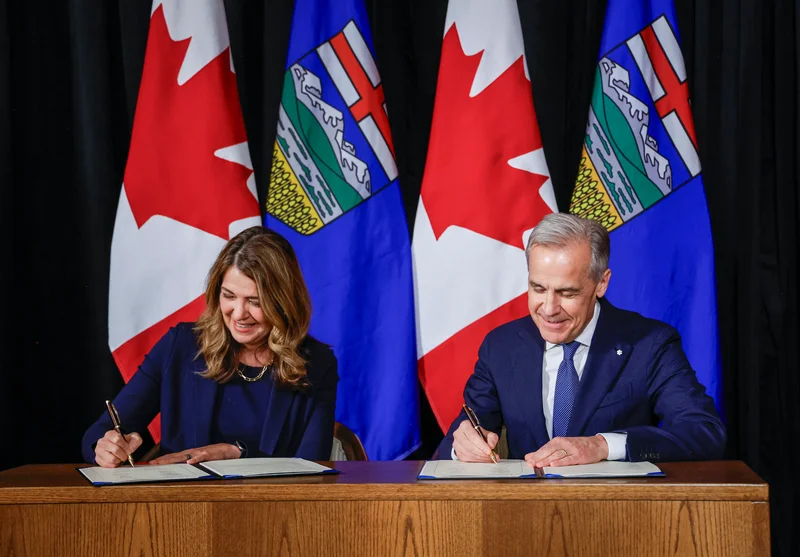
Alberta Premier Danielle Smith on Saturday cautioned against Canada applying retaliatory tariffs as the country’s trade war with the United States escalates, but stopped short of demanding Prime Minister Mark Carney reject the option.
“I know, emotionally, it feels good to retaliate. I get that. But let’s remember what happens when we retaliate,” Ms. Smith said during her regular talk radio appearance on Saturday.
“When retaliation happens, it means everybody who is buying products from the United States are now going to face upwards to 50 per cent tariffs. And they are talking about that being on steel, on dairy, on appliances, on agriculture equipment.”
Ms. Smith kicked off her radio appearance by addressing the federal government’s decision to pull out of trade talks with the United States late Friday evening. Canada was trying to head off the U.S. applying 50-per-cent tariffs on US$20-billion worth of goods. Mr. Carney said Canada would retaliate with dollar-for-dollar tariffs on American imports beginning after Labour Day.
While Ms. Smith agreed with her fellow premiers that the Prime Minister was right to withdraw from the negotiations, her government remains skeptical of retaliatory measures. Her chief of staff, on social media, called countertariffs a “knee-jerk” reaction that would only hurt Canadians.
Ms. Smith has long argued against countertariffs and resisted calls for her government to do more to hit back against the United States. She previously rejected suggestions Canada could strike back by placing tariffs on energy exports, arguing Alberta’s economy would bear the brunt of the economic fallout.
And while her government initially joined other provinces in removing American alcohol from shelves at the start of the trade war, Alberta and Saskatchewan were the first to reverse that policy more than a year ago.
Ms. Smith, however, supported Mr. Carney’s decision to walk away from the negotiating table.
“There were just a couple of key demands from the United States that made it really untenable for us to sign off,” she said on Saturday. “It would have been too painful.”
She also applauded the federal government’s strategy to hold off on countertariffs until after Labour Day. The window, she said, is Canada giving the United States an out.
“That’s the Prime Minister saying: ‘Come on, guys, let’s see if we can figure this out over the next two weeks.’”
The Premier’s political base is in rural Alberta, where she is popular with farmers, ranchers, and those working in the energy industry. She said on her radio program that she is especially worried about tariffs on agricultural machinery.
“We shouldn’t be cheering if our farmers have to pay 50 per cent more for all the equipment that they need to produce our food,” Ms. Smith said. “That is not a success.”
And while Ms. Smith and Alberta’s governing United Conservative Party have argued that Ottawa favours the east’s auto industry over the west’s energy sector, she touted the auto sector as “vitally important” to the Canadian economy and “vitally important” to manufacturing in Ontario.
“I hope that they can get back to the table to negotiate something that’s more fair,” Ms. Smith said about the breakdown in negotiations surrounding autos. “But we have to understand how important that is to Ontario, as an engine of their economy.”
Alberta exported $151.5-billion worth of goods to the United States in 2025, with crude petroleum accounting for $110.8-billion, or 73 per cent, of those exports. By way of context, the province’s global exports hit $176.75-billion in 2025, according to provincial data.
Mr. Trump has avoided slapping tariffs on the oil and gas it imports from Canada.
Ms. Smith noted only about 3 per cent of Alberta’s exports to the United States are exposed to the current tariffs. The provincial government, she said, expects the new tariffs to apply to about $1.5-billion worth of Alberta’s trade with the U.S.
“I worry about the viability of some of those furniture companies and honeymakers,” she said. “I welcome the federal government saying that they’re going to come up with a package of support.”
She did not directly answer a question from the radio show’s host about whether Alberta would create its own support program. Her cabinet is scheduled to meet Tuesday, she said.
The Premier’s chief of staff, Rob Anderson, was more pointed in his criticism of Canada’s negotiating strategy.
“Why would we punch our own Canadian businesses, workers and consumers in the face just because the U.S. is doing so to their own businesses, workers and consumers,” he wrote on social media Friday evening. “Don’t give in to knee-jerk actions that feel good in the moment but only hurt ourselves.
“We need to be smarter not more tough guy-er.”
Mr. Carney risks alienating Ms. Smith and spurring support for Alberta’s separatist movement if Canada uses oil as a negotiating tool in trade talks with the United States. The Premier, along with separatist advocates, blame Ottawa for stymying Alberta’s energy industry, sacrificing the province’s potential in exchange for the east’s economic prospects and political support.
Albertans will vote on Oct. 19 in a province-wide referendum, choosing between staying in Canada or kickstarting the legal process to separate from the rest of the country. Ms. Smith said if the separatist side prevails, she expects a binding referendum on separation could follow in the spring of 2027.