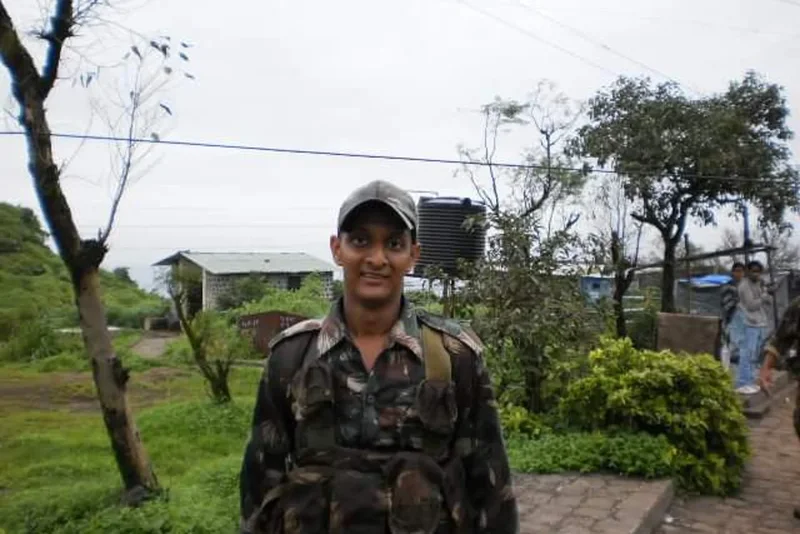
When Pratham Mahale last spoke to his mother, he was calling to give her a routine update on his life at India's top military academy, saying he was excited to be entering an inter-squadron boxing championship.
That he was the last time she ever heard from him. At 11pm that day on 16 October 2023, his parents received a call saying their son had suffered a critical head injury that had required immediate surgery.
They immediately left their home and travelled 650km through the night to the hospital, arriving at 4.30am. Doctors initially told them Pratham was “serious, but the operation was successful”, says his father Gorakh Mahale. They waited, but 24 hours later another call came. “They said he was no more.”
Pratham had grown up in Maharashtra in western India and wanted to become an army officer, a lucrative and prestigious career path that would have set up his family for life. He had already cleared arguably the biggest hurdle on that path by gaining acceptance at the National Defence Academy: over one million people appear for the exam, which is conducted twice a year, but fewer than 9,000 are selected.
His family say they still haven’t received an explanation about the circumstances that led to his death, nor the report from an inquiry they were told would follow.
After his death during training, the family receives a monthly pension of just Rs14,000 (£107) – less than the salary of an unskilled government worker in India. He says the family was told that an NDA cadet is insured for Rs1.5m (£11,563), while Pratham was also eligible for Rs1.2m (£9,250) in one-off compensation.
“A boy who cleared [one of India’s most competitive military exams], how can his life be worth just Rs1.5million?” Mahale asks.
Pratham’s story is part of a wider problem involving hundreds of young people who enter India’s premier military academies but never become commissioned officers.
Serving and former personnel in India’s armed forces receive a robust set of financial protections in case they are injured in the line of duty and deemed unfit to serve by a medical boarded, known as being “boarded out”. Young people who are still in training and yet to be formally commissioned for duty, however, are not eligible for the same support.
According to figures cited in court proceedings, around 500 officer cadets have been medically discharged from India's leading military academies since 1985 after suffering disabilities during training. In the NDA alone, around 20 cadets were medically discharged between 2021 and July 2025.
Ankur Chaturvedi, who himself was boarded out of the NDA in 1996, has spent years campaigning for the cadets. He argues that the problem begins with something deceptively simple: what the government calls the money paid to them.
At the heart of the dispute is a bureaucratic distinction with serious consequences. Injured cadets receive a monthly payment known as “ex-gratia” which is essentially a gesture of goodwill rather than the disability pension available to former service personnel.
“A cadet is given a disability pension but that disability pension is not called the disability pension. It is called a monthly ex-gratia,” he says. “This inane nomenclature is the root cause of all the problems.”
Chaturvedi remembers his own injury with extraordinary clarity. He joined the NDA in January 1993, aged 17 and a half. In his sixth term, he was boxing when a punch struck him in the side of his waist.
He had been sparring with a much taller newcomer who had never boxed before. When Chaturvedi tapped him on the nose, the young man stumbled backwards and instinctively threw a punch.
“I flew up in the air and landed on all four,” Chaturvedi recalls. “The moment that punch hit me, I knew I was hurt very badly.”
But he was the boxing captain. He was training to lead soldiers. He got back up. “We continued with our boxing exercises, and went on a run afterwards.”
About an hour later, he went to the toilet and saw blood in his urine.
He was taken to hospital and spent about four months undergoing tests before doctors told him he was medically unfit to continue his training.
The shock of being told he could no longer become an officer was devastating. “I never thought of doing anything in life other than being an army officer,” he says. “Not being able to do that was like my soul was ripped apart.”
“I just wanted to run away. I did not want to open my eyes.”
Eventually, he rebuilt his life, graduating from Kanpur University and later spending 11 years with Tata Tea before moving into a corporate career. But in 2003, after encountering another former cadet who had lost everything after being boarded out, he began helping others navigate the same trauma.
Today, he mentors medically discharged cadets. “These guys are highly capable people,” he says. “They have been selected through a very rigorous selection process. They’re broken. They just need to be fixed.”
For Shubham Gupta, there was no second career.
He joined the NDA in 2011, shortly after completing Class 12. During his fourth term, he dived into a swimming pool. His neck took the impact and he was left paralysed.
After two years of treatment, he was medically boarded out. His mother, Anupam Gupta, says he is now completely dependent on his parents for basic tasks.
“He is not able to take even his food,” she says. For two years, Shubham was treated at a spinal injury centre in Pune. After returning home to Bathinda, his family says they were left with the costs of medicines, physiotherapy and attendants.
Before recently receiving healthcare coverage through the Ex-Servicemen Contributory Health Scheme, or ECHS, the family spent around Rs 40,000-50,000 (£306-406) a month, they say.
His parents are both retired. His mother is over 60 and his father is 65.
“How much can a retired parent support him?” she asked. “The attendants are also expensive. He is not able to go to the washroom, or even drink water.”
The family still does not describe itself as opposed to military service. Another son serves in the army, and his wife is also in the forces. “The people in our family feel very passionately about the forces,” Gupta says. “But the truth is, the government’s policies are not great.”
Her demand is not for special treatment. “We just want a dignified life for our children.”
For the families, the dispute comes down to a simple plea: they want medically discharged cadets to receive protections similar to those available to former members of the armed forces, including greater financial security and better access to employment.
The government has argued that granting ex-servicemen status to cadets would create administrative and structural difficulties, because they were trainees rather than serving officers.
The Independent has reached out to the Indian defence ministry, as well as the Department of Ex-servicemen Welfare for comment. No response had been received at the time of publication.
The issue has now reached the Supreme Court, which took up the matter in 2025 and questioned whether young people disabled during military training were receiving adequate protection. The court has urged the government to consider better insurance and compensation, and to explore whether injured cadets could be rehabilitated into other defence-related jobs.
The government has since extended lifetime healthcare coverage to medically discharged cadets through the Ex-Servicemen Contributory Health Scheme. But the broader dispute over their status, financial support and future employment remains unresolved.
For Chaturvedi, the number of people affected makes the government's reluctance difficult to understand.
“The total impacted people is around 500 only,” he says. “And the financial outflow… is less than what the ministry spends in tea and snacks in a year.”
Bharati Joshi’s son Kishen Kulkarni joined the NDA in January 2019. During his fourth term, in 2020, he suffered a cardiac arrest.
Joshi was in Karnataka when she received the call. “I did not even know what cardiac arrest is,” she says.
Kulkarni was placed on a ventilator. His mother travelled to Pune during the Covid lockdown, sitting outside the intensive care unit because visitors were not allowed. He eventually returned home. Now 26, he cannot speak, turn himself in bed or communicate when he is hungry or thirsty. His mother feeds him and manages his care.
She took voluntary retirement from her job as a school headmistress after 30 years because managing work and her son's needs had become impossible.
His ex-gratia, she says, is about Rs 40,000 (£300) a month after arrears and revisions, while the cost of nursing, diapers, medicines and physiotherapy continues. “I have to feed him. He cannot even turn on his bed,” she says. “Who will take care of him after me?”
Kulkarni’s mother says she still does not know what caused his cardiac arrest. She recalls a boy who played cricket and kabaddi, who was healthy before joining the academy and who had progressed through his training.
“The officers say the exercises were not that hard,” she says. “I do not know how it happened.”
For Anupam Gupta, Shubham’s disability has transformed what should have been the beginning of his adult life into an open-ended responsibility. “If a son is a martyr [killed in the line of duty], the parents cry, feel broken but eventually accept it,” she says.
But those parents “won’t be with them for the whole of their lives”, she says. “There is nothing acceptable about this,” she says of the years since her son's injury.
Mahale says his son “wanted everyone on his team to win. But he lost to life.”