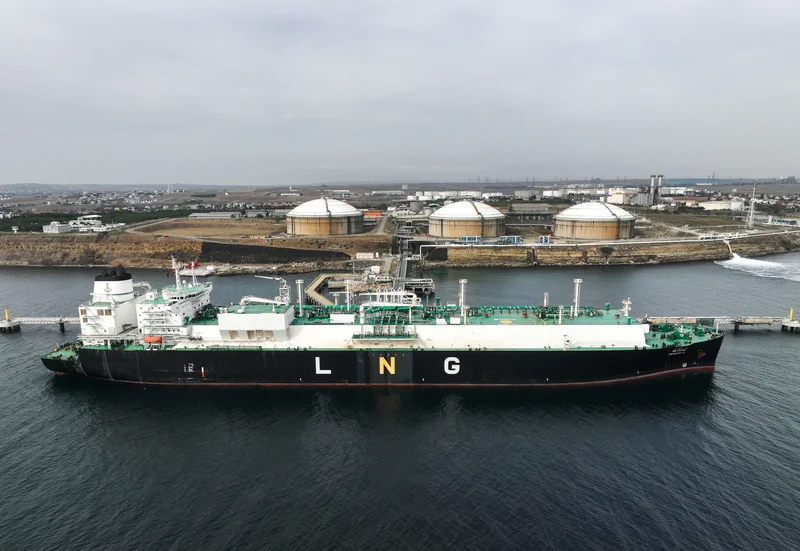
Until just a few years ago, the battle for natural gas in the Eastern Mediterranean primarily revolved around who exactly owned the vast deposits in its depths. The competition to find and exploit these reserves fueled disputes over the delimitation of territorial waters between Turkey, Cyprus, Greece, Libya and Egypt, or between Israel, Palestine and Lebanon. At times, these tensions on the high seas raised fears that there would be an outbreak of hostilities.
Today, however, the race for natural gas in the region has a different angle: it no longer focuses so much on who controls the largest reserves, but increasingly revolves around which countries possess the necessary infrastructure to facilitate energy sales. In other words, the focus is on doing business through various services, such as liquefaction and regasification, pipelines and storage facilities, as well as maritime transport and port operations.
“The history of the Eastern Mediterranean has taken a turn, from ‘Who owns the gas?’ to ‘Who controls the access routes to the market?’” says Cyril Widdershoven, a senior advisor at Blue Water Strategy, a maritime and energy consultancy. “Egypt and Turkey are the clearest contenders,” the expert observes, but “they both play with different cards.”
Egypt’s major advantage in this race to become a gas-trading hub is that it has the only two liquefaction plants in the Eastern Mediterranean: Idku and Damietta, which are designed to export liquefied natural gas (LNG) on a large scale. Competing with these facilities isn’t within everyone’s reach, as replicating such infrastructure is estimated to take nearly a decade, as well as an investment of between $6 billion and $10 billion.
Thanks in part to these two terminals, Israel already exports gas from its two largest fields to Egypt. Last summer, the Egyptian government agreed to increase its imports from the first, Leviathan, and is now negotiating to expand those from the second, Tamar.
Egypt and Cyprus also signed an agreement this year: Cairo will absorb production from Cyprus’s Aphrodite gas field for re-export. And negotiations are currently underway to do the same with the Cronos gas field.
In addition to its LNG infrastructure, Egypt has in recent years invested in chartering floating storage and regasification units (FSRUs), and now has access to six of these flexible vessels. They allow the country to reverse the liquefaction process, converting imported LNG back into its original gaseous state. Under a contract signed in May, the latest of these six floating terminals is shared with Jordan.
Earlier this year, Egypt also began testing this approach when it received a shipment of liquefied natural gas at the regasification unit anchored in Aqaba, Jordan, intended for subsequent re-export to Lebanon and Syria via the Arab Gas Pipeline. In January, Cairo simultaneously signed a preliminary agreement with Beirut and Damascus to supply them with gas.
Although Egypt’s strategy appears very sound on paper, in practice, it faces two major challenges. On the one hand, in recent years, its imports of Israeli gas have been disrupted by repeated outbreaks of conflict in the region. On the other hand, the sharp decline in its domestic gas production and the increase in its domestic consumption are forcing Egypt to dedicate almost all of its potentially exportable infrastructure to meeting internal needs.
“The country’s weakness is also stark: it no longer enjoys a comfortable gas surplus [as it did up until 2023]. Instead, Cairo faces declining domestic production, growing energy demand and disruptions to Israeli flows. All of this has highlighted the vulnerability of its ambition to become [an energy] hub,” Widdershoven points out.
The analyst also notes that “it is very difficult to maximize re-exports while importing LNG to cover domestic shortfalls,” arguing that “in this case, the country’s hub becomes a balancing mechanism rather than a profit center.”
A diversified approach
In the case of Turkey, the strategy to become a regional natural gas trading hub relies less on LNG infrastructure than on a more diversified approach. This includes a broad portfolio of suppliers, increased pipeline flows and local production, massive storage capacity and greater market power.
Widdershoven explains that Turkey’s location, between Russia, Europe and the Middle East, places the country in a privileged position. He notes that its relationships with Russia and Iran — two energy-producing countries with limited market access — give it greater leverage to negotiate, demand more price flexibility and even generate surplus volumes for re-export.
Furthermore, Turkey has five LNG regasification terminals (two of them onshore, with the rest being floating units, like those chartered by Egypt). This allows the country to cover a significant portion of its domestic gas demand. At the same time, in recent years, Ankara has invested in developing its own gas reserves in the Black Sea, further strengthening its position.
Over the past year, as it has sought to further diversify its imports and cement its position as one of Europe’s leading suppliers, Turkey has signed around a dozen major LNG deals. These agreements will reduce its dependence on gas from Iran and Russia while allowing it to store surplus supplies and re-export them when market demand rises.
“If Ankara buys imported gas via pipeline and LNG under competitive conditions, then stores, trades, resells it and establishes a credible price point, the value [of its strategy] lies not only in the physical transit, but also in creating a market,” Widdershoven explains.
However, the analyst notes that this model “depends on transparent rules, third-party access, credible pricing and the trust of European buyers.” He also warns that “Turkey risks being seen as a rerouting hub, particularly for Russian gas,” meaning that its “real challenge is not infrastructure but credibility.”