Sign in. It’s quick, free and it’s up to you.
An account is an optional way to support the work we do. Find out more.
ECONOMICS AND MORALITY make uncomfortable bedfellows at the best of times. For clear examples of this, see many, many businesses related to animals.
You have the obvious ones, like factory farming, where animals are often kept in horrific conditions for the sole purpose of being raised for slaughter. Most people agree this is bad, even though we, as consumers, continue supplying demand for the products.
One step removed from that is more traditional farming, where animals may be raised in good conditions.
This is muddier. Humans could likely find alternative nutrition sources, but once animals are treated well and the food goes to use, the morality is less clear-cut.
Then we come to using animals to make money. There are question marks around horse racing, which we’ll leave for another day.
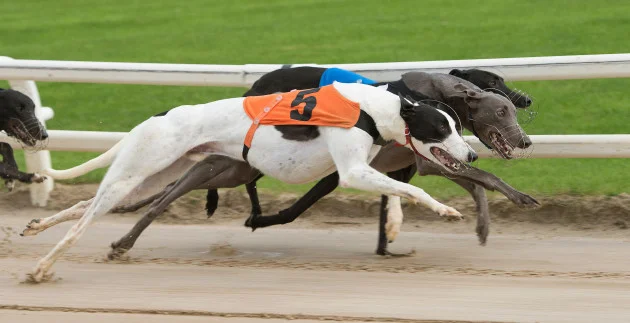
Today, the focus is on greyhound racing. The ethical issues are clear – once dogs are raced for the profit of owners, they become economic units.
If they’re not fulfilling their purpose (running fast enough), they lose their value. This situation has resulted in an industry where apparently thousands of dogs in Ireland are culled (killed) every year, although industry bodies dispute this.
A key point to establish upfront: The Irish greyhound industry is relatively small and has dwindled in popularity over the years.
This is in line with an international movement against greyhound racing in Anglo countries.
The Irish government provides the sector with about €20 million in state funding per year.
As racetrack attendances have fallen, it’s likely that without this money, the industry would cease to exist.
First off, let’s look at this from the business perspective.
The publication most commonly cited around this is a report from economist Jim Power published in 2021. It’s worth acknowledging that it was commissioned by Greyhound Racing Ireland, the semi-state body which oversees the sector.
The report had a few key findings, namely:
As of 2019, the industry “supported” 4,150 full-time and part-time jobs.
Attendance at greyhound races peaked at 1.39 million in 2005, before falling to 463,000 pre-Covid.
On-course gambling at races dropped from €139.5 in 2007 to €26.5 million in 2019.
The Power report optimistically predicted a revival in public interest after Covid, estimating that annual racetrack attendances could rise to 630,000 by 2023. Instead, the decline has continued. At last count, about 352,000 people attended in 2025.
We have an industry that is very small and has steadily declined for two decades. Why fund it?
“The greyhound industry is an important part of the social and economic fabric of rural Ireland. It supports considerable employment directly and indirectly down through the supply chain, and it is an important ‘way of life’ for greyhound owners around the country,” the report says, fairly neatly capturing its central thesis.
So, jobs then. It is a key argument in the Power report, citing the estimated 4,150 positions the sector supports.
However, the word ‘supports’ may be doing some heavy lifting here. Dig into that 4,150 and it’s unclear how many of those positions would disappear without the greyhound industry.
For example, the report says the sector supports 300 jobs at ‘Dog Food Manufacturers’. If the Irish greyhound sector ceased to exist tomorrow, would those jobs vanish too? Or would the businesses pivot, such as selling into other markets?
There are other somewhat questionable inclusions. The industry is also said to “support” 200 jobs in “facilities management/printers/outside contractors” and 750 in “greyhound ancillary products”, which includes everything from vets to dog walkers.
There is little doubt that the sector at least partially ‘supports’ these jobs, but ‘supports’ is a somewhat vague word. The key question is would these roles disappear without the industry? It’s unclear.
Critics have claimed that the sector far overstates its economic value. For example, Sinn Féin Senator Chris Andrews has claimed that greyhound racing generates about €49 million a year in economic activity for the state – much lower than the sector claims. This would make the state’s decision very questionable from a financial perspective. It’s likely that €20 million a year could generate more jobs and economic activity if spent somewhere else.
The business case was already questionable when going by the 2019 figures cited in the Power report.
But it’s also worth noting that attendances have dropped a further 24% since then. That’s less economic activity, further weakening the economic argument in favour of funding.
Meanwhile, the government rarely questions the morality of the sector.
In 2019, RTÉ reported that up to 6,000 greyhounds are killed a year for not being fast enough. The figures came from a confidential report prepared for the Irish Greyhound Board by an outside consulting firm. The industry has since disputed the figures, stating that the level of greyhound euthanasia is “unknown”.
But the numbers don’t look great for the sector.
Figures published in June found that almost 6,000 racing greyhounds born in Ireland in 2021 and 2022 died after leaving the sport. While a greyhound typically lives to somewhere between 10 and 14 years, the average age these dogs died at between 3.5 and 5.5 years – less than half their expected lifespan.
This raises pretty obvious welfare questions about what is causing these dogs to die so young.
These welfare issues are, of course, not unique to Ireland. They’re a concern wherever there is a commercial greyhound racing industry.
Greyhound racing as a commercial industry exists most prominently in Anglo, English-speaking countries.
But most of these countries have now moved to ban the practice.
Parliaments in Scotland and Wales voted to ban greyhound racing earlier this year, while New Zealand officially ended it earlier this month.
Commercial greyhound racing remains legal in just a handful of countries in the world – the UK, Ireland and Australia. While legal in some parts of the US, it’s banned in most states and politicians passed a bill in April aimed at outlawing the remaining few.
Again and again, the reasons for banning the practice are the same: concerns around animal welfare and fatalities.
Like the business case, the moral justification for greyhound racing in Ireland seems weak. The sector has been linked to the deaths of thousands of dogs every year, and almost no other countries in the world allow the practice, mostly due to ethical concerns.
But finally, it’s worth quickly noting the political element to this debate.
Greyhound racing is framed as a sport which plays an essential cultural role in many areas. Again, that’s something the Power report tried to argue.
The state funding allocated to greyhound racing is also directly tied to horse racing. This means that deliberately decoupling greyhound racing has to be a political decision – something decided by a minister. A government that chooses to take this step would expose itself to being accused of ignoring or neglecting rural communities.
But while it may take guts for a politician to do so, it seems it would make sense.
Permitting the practice is one thing, but actively spending €20 million a year on it is another, especially when the practice is in steep decline in terms of public popularity and is connected to serious ethical issues.
It becomes harder to justify every year, especially as bans roll out in other countries.
To embed this post, copy the code below on your site