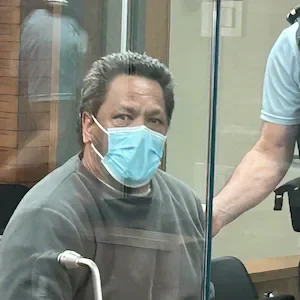
Thomas Pira was sentenced in the Napier District Court to eight years in prison on 27 charges, including attempted rape, unlawful sexual connection and assault in a family relationship. Photo / Ric Stevens
WARNING: This article contains descriptions of the sexual and physical abuse of a young woman by her father and may be distressing for some readers.
A young woman who went to live with her long-lost father, whom she idolised but hardly knew, found herself in a “living hell” when hebegan violently and sexually abusing her.
“With every punch came the following thought – ‘Am I going to survive this?’,” the woman said this week.
“You were supposed to be my father; the one who protects and provides for his family,” she said as she confronted her abuser, Thomas Tama Koroheke Pira, in the NapierDistrict Court.
“Someone I could go to about my problems, someone I could trust with my life. Not someone who is the cause of my problems and makes me feel unsafe and fearful for my life.”
Pira appeared for sentencing after a jury found him guilty on 27 charges, including the attempted rape of his daughter, six counts of unlawful sexual connection with her and numerous charges of assault and threatening to kill.
Some of the assault and sexual connection charges were laid representatively, meaning the offending happened on multiple occasions during several months when the woman lived in his house.
He received discounts from a sentencing starting point of 12 years for his poor health, time spent on electronically monitored bail and his own violent and difficult upbringing, including time in state care.
Pira’s name can be published after his victim applied to the court to have statutory reporting restrictions around her own identity partially eased.
“The shame in this case is my father’s and not mine, and I believe he should be named and his crimes known,” the woman said in her application.
Judge Russell Collins made an order that Pira’s name, relationship to his victim and her age at the time of the offending could be published.
The woman said that Pira had been in “ghost mode” during her childhood and she had met him only once, when she was 7 years old.
One of the reasons he was absent was that Pira served time in prison for a manslaughter committed 20 years ago – a fact that was known to the trial jury because it helped explain the fearful way his daughter responded to his abuse.
Pira was convicted in 2007 of the manslaughter of Edwin Dale Te Haara, a former gang member who was shot while out jogging in Rotorua.
Despite his absence while she was growing up, the woman idolised the idea of her father, looked up to him and talked about him at school, until she got picked on for not having a parent present in her life.
After a period of homelessness and living with a foster family, the opportunity arose when she was 19 to move from another North Island town to live with her father in Hastings.
Judge Collins said that Pira had dominated his daughter “physically and emotionally”, imposed his will on her and used her for sexual gratification.
He noted that Pira continued to protest his innocence, but that carried little weight when, on the violence and threatening to kill charges, there was “absolutely no defence whatsoever” after the woman covertly recorded him abusing her and took photos of her injuries.
The woman’s ordeal was detailed to a jury of six men and six women during a four-day trial in early July.
It was the second time that the woman had taken the witness stand. An earlier trial had to be abandoned when Pira became ill and was admitted to hospital.
Pira’s first sentencing date two weeks ago was also abandoned because he was ill.
When the court was told this week that Pira was once again ill and not at court, Judge Collins adjourned the hearing so that options could be explored to sentence him, even if it required an audio-visual link to his hospital bed.
In the end, that proved unnecessary, as Pira was brought to court in person three hours later, wearing a surgical mask.
Former foster father tipped off police
The jury trial was told the abuse ended after the woman’s former foster father called police out of concern following communication between them on Facebook Messenger.
Officers went to the Hastings house to do a “welfare check” and, when Pira became aggressive, they arrested him.
The young woman then told the police about the abuse she had suffered and how frightened she had become while living at the house.
She played them recordings she had secretly made on her phone of Pira verbally abusing her, calling her a “maggot b****”, and saying he would kill her.
Despite the abuse, the woman wished Pira well as she concluded her impact statement in court.
But turning to face him as he sat in the dock, she said he had lost her respect and the “privilege to be part of my life”.
“One day I hope I can heal over this and have a happy family, but that’s a long time away,” the woman told Pira.
“It’s so hard to block you out of my head,” she said. “It’s scary and traumatising.”
Ric Stevens spent many years working for the former New Zealand Press Association news agency, including as a political reporter at Parliament, before holding senior positions at various daily newspapers. He joined NZME’s Open Justice team in 2022 and is based in Hawke’s Bay. His writing in the crime and justice sphere is informed by four years of frontline experience as a probation officer.
Join the NZ Herald’s Open Justice team for Case by Case, a video and podcast series examining the disputes and decisions making headlines across New Zealand.