Nicaragua · POLITICS
The proposal would strip foreign laws and international rulings of any legal effect inside Nicaragua. But it must pass a second legislative vote before it can take force.
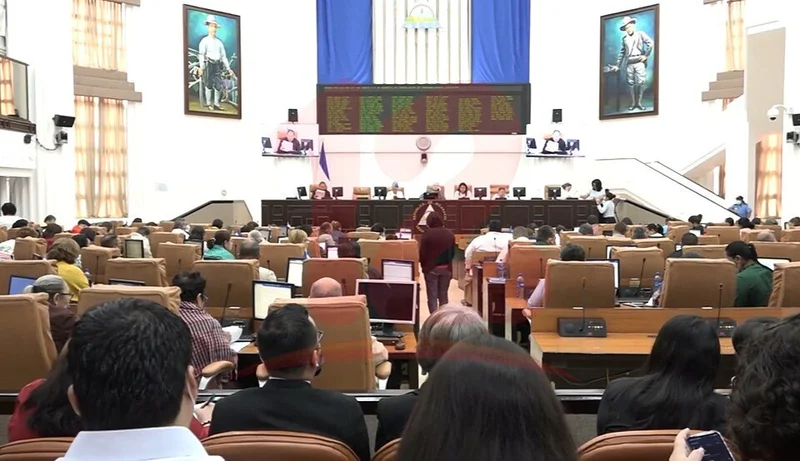
Nicaragua constitutional reform would void foreign laws if it clears a second legislative vote, according to reports from La Nación and Reforma. The National Assembly gave its first approval on 22 August 2026 to amend article 12 of the constitution.
What the Proposal Says
In fact, the proposed wording, read aloud by Assembly president Gustavo Porras, declares that Nicaragua prohibits the extraterritoriality of foreign laws. Moreover, it states that no foreign or international law shall have effect if it disparages Nicaragua’s sovereignty.
In addition, only agreements signed in the name of the Nicaraguan state would apply under the proposal. These are fragments quoted from the floor, not the full consolidated text of the amended article.
The proposal would declare that no foreign law has legal effect inside Nicaragua. However, it also says only agreements signed in the state’s name would apply.
The proposed wording would make foreign laws ineffective inside Nicaragua. However, it does not name any specific law or international body.
Nicaragua Constitutional Reform: First Step
Under Nicaraguan procedure, a constitutional change cannot take effect on a single vote. It must be approved by the National Assembly, then approved again in a separate, subsequent legislature.
Therefore, the 22 August 2026 vote is only the first of two required approvals. The second vote is reported for September 2026, though no specific day was given.
This two-legislature process ensures the change cannot take effect quickly. Meanwhile, the second vote is scheduled for September 2026.
The first-legislature approval is a proposal, not a reform in force. Therefore, it must be voted again in a second legislature.
Not Yet in the Official Gazette
The reform has not been published in La Gaceta, Nicaragua’s official state gazette. Recent issues from 19 and 21 August 2026 do not contain it.
As a result, the consolidated text of the constitution online still shows the previous wording of article 12. The change remains in process, not yet part of the law.
Since the reform is unpublished, its legal status remains pending. In addition, the online constitution still reflects the old article 12.
The reform has not appeared in the official gazette, La Gaceta. As a result, it has no legal effect until published.
Unanimous Approval in the Assembly
The National Assembly press service reported that the reform plan was approved unanimously. No vote count or breakdown was published.
Meanwhile, the Assembly is controlled by the governing Frente Sandinista de Liberación Nacional, led by Daniel Ortega and Rosario Murillo. The unanimous vote shows strong backing from the governing party.
Still, this approval does not make the reform law yet. The vote was unanimous, according to the Assembly’s press service.
Meanwhile, no vote count was published.
Scope of the Proposed Change
In addition, the proposal excludes foreign laws and rules from Nicaragua’s legal order. However, this applies only where they act against independence, sovereignty, or peace.
It names no specific foreign law, court, or international organisation. Instead, it refers only to general categories: other states, groups of states, and international bodies.
This means the text is broad but not targeted at any named entity. The text covers laws, regulations, and rules from other states and international bodies.
However, it does not name any specific entity or law. The proposal covers laws, regulations, and rules from other states and international bodies.
However, it does not target any specific foreign law or court.
Part of a Larger Reform Package
The amendment is part of a package called the ‘Propuesta de Reformas Constitucionales y Legales’. It was drawn up by the Assembly’s Constitutional Commission together with the Supreme Electoral Council.
According to the official gazette’s site, the proposal will be sent to the Presidency for review and authorisation. This shows it is still in the legislative pipeline.
This package also includes changes to electoral participation, according to official sources. As a result, the amendment is part of a broader legislative effort.
The package was drawn up by the Constitutional Commission and the Supreme Electoral Council. In addition, it will be sent to the Presidency for review.
Separate Elections Proposal
In a separate strand, President Daniel Ortega said on 23 July 2026 that there would be no more elections, according to EFE. This was part of a speech at the commemoration of the Sandinista revolution’s anniversary.
However, official documents describe reforms that restrict opposition participation and extend mandates, not a technical abolition of all elections. No published reform eliminating elections has been found.
Ortega’s remarks on elections were reported on 23 July 2026, 30 days before the article 12 vote. Meanwhile, the elections package focuses on restricting opposition participation, not abolishing all elections.
Ortega’s remarks were reported on 23 July 2026, 30 days before the article 12 vote. Still, no published reform eliminating elections has been found.
Timeline of the Two Tracks
Overall, Ortega’s remarks were reported on 23 July 2026, and the article 12 vote took place on 22 August 2026. They were 30 days apart.
These are two separate reform tracks that happen to share a reported September voting date. Neither caused the other in any source on this sheet.
So, it would be wrong to see them as directly linked. The two proposals are separate and not causally linked in any source.
Therefore, they should be viewed as independent legislative efforts. The two reform tracks are separate and not causally linked in any source.
Therefore, they should be viewed as independent legislative efforts.
What Happens Next
If the proposal passes a second legislature in September, it would then need publication in La Gaceta to take effect. Until then, it remains a proposal, not a constitutional reform in force.
In short, the Nicaragua constitutional reform would void foreign laws only after these steps are completed. For now, it is a first-step approval with a conditional future.
After a second vote in September, the reform would still need gazette publication. Until then, it remains only a proposal with conditional effects.
If the proposal passes a second legislature in September, it would then need gazette publication. Until then, it remains only a proposal with conditional effects.
Frequently Asked Questions
What does the Nicaragua constitutional reform propose?
The proposal would amend article 12 to declare that foreign laws and rules from international bodies have no legal effect in Nicaragua. It would apply only to those that disparage the country’s independence, sovereignty, or peace.
Has the reform already taken effect?
No, it has only passed its first legislative vote on 22 August 2026. It requires a second approval in a later legislature, expected in September 2026, and publication in the official gazette.
What is the role of the National Assembly in this process?
The National Assembly is Nicaragua’s single-chamber parliament. It gave unanimous first approval to the proposal.
Does the reform target any specific international body?
No, the proposed wording names no specific court, law, or organisation. It refers only to general categories like other states and international bodies.
This article was produced by The Rio Times’ automated newsroom system. How we use AI · Report an error