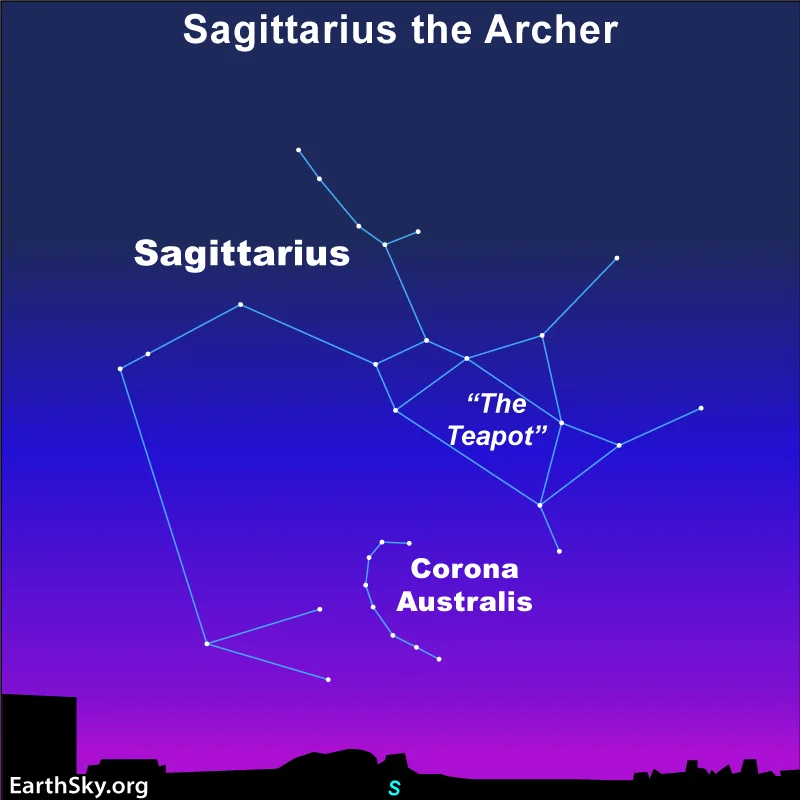
If you’re outside on an August or September evening, you can glimpse the zodiacal constellation Sagittarius the Archer. From our northerly latitudes, it never climbs high in the sky. Yet when you’re looking toward Sagittarius, you’re looking in the direction of one of the most wondrous places we can imagine: the center of our own Milky Way galaxy.
Plus, Sagittarius is fairly easy to spot if you have a dark sky. Its brightest stars form an asterism in the distinctive shape of a Teapot.
How to find Sagittarius
You’ll want a dark, rural location to see and enjoy Sagittarius. In August or September, when you’re outside camping or ending a picnic on a summer evening – any place away from light pollution – simply look up. You’ll notice the starlit band of the Milky Way. It’ll appear as a hazy band stretching all the way across the sky. The haze is really countless stars.
From the Northern Hemisphere, the starlit trail of the Milky Way seems to bulge just before it reaches the southern horizon (from the Southern Hemipshere, this bulge is high in the sky). This bulge marks the approximate location of the Milky Way’s center.
Here’s another way to find Sagittarius. If you’re familiar with the Summer Triangle asterism, draw an imaginary line from the star Deneb and through the star Altair to locate Sagittarius near the horizon. At mid-northern latitudes, the Summer Triangle hangs high in the south to overhead on late summer and autumn evenings.
Deep-sky wonders in the Archer
So Sagittarius points to the heart of our Milky Way galaxy. But we can’t see all the way to the center. Why not? Because it’s so far away, 26,000 light-years. And because of the huge plethora of stars, star clusters, nebulae and dust that block our view.
On the other hand, the stars, star clusters, nebulae and dust are themselves worth viewing! And you don’t need to know what you’re seeing to enjoy them. Just take binoculars with you, next time you know you’ll have access to a dark sky on an August or September evening. Look up! And aim your binoculars along the starry path of the Milky Way.
Here are some deep-sky treasures in Sagittarius: Sagittarius Star Cloud (Messier 24), globular cluster Messier 22, Lagoon Nebula (Messier 8), Trifid Nebula (Messier 20) and Omega Nebula (Messier 17).
Sharp-eyed people can even see these deep-sky objects with the unaided eye. Binoculars let you see them better. And a small telescope would give you a beautiful view.
Modern stargazers have difficulty making out the Centaur in Sagittarius. But the Teapot is easy to see, once you learn to look for it. Find the Teapot, and it’ll help you on your star-hopping adventures to deep-sky marvels.
Photos of the Teapot
The Teapot is the central region of Sagittarius. Once you’ve learned to trace the Teapot’s shape in the sky, it’ll become easier to spot. Check out the photos below to learn its shape and then try to spot it yourself.
The stars of Sagittarius
The brightest star in Sagittarius is the star marking the bottom right corner of the teapot, Kaus Australis. Also known as Epsilon Sagittarii, this magnitude 1.8 star lies 143 light-years away.
The next brightest star is at the opposite end of the teapot, the top star in the handle, Nunki. Also known as Sigma Sagittarii, this 2.1-magnitude star shines from a distance of 228 light-years.
Most of the other stars in Sagittarius are of 2nd and 3rd magnitude. The star marking the top of the teapot’s lid is Kaus Borealis, a magnitude 2.82 star lying 77 light-years away. The stars marking the top of the spout are Alnasl, which marks the tip of the spout at magnitude 2.98 and is 96 light-years away, and Kaus Media, which marks the spout’s connection to the pot at magnitude 2.72 and is 306 light-years away. The star at the bottom of the handle where it connects to the pot is Ascella, a magnitude 2.60 star lying 89 light-years away.
Sagittarius in mythology
The constellations Sagittarius and Centaurus are both supposed to represent a centaur, a creature with the upper torso of a man and the body and legs of a horse. Historically, centaurs might have really been like cowboys, using horses to round up cattle in ancient Greece.
According to Greek myth, the centaurs were the offspring of Ixion and the cloud nymph Nephele. Apparently, Sagittarius’ drawn-out bow and arrow originated from the Mesopotamian archer god. So this constellation might not have always represented the centaur Chiron.
It’s said that the Greeks associated Sagittarius with Crotus the satyr, another type of monstrosity, a man with horse ears and tail and goat legs. Quite possibly, the Romans first identified the constellation Sagittarius with Chiron, the wise and kindly centaur.
Here’s something that distinguishes Sagittarius the Archer from the other 13 constellations of the zodiac. The sun shines in front of this constellation on the December 21 solstice.
Also, the ecliptic – the sun’s yearly pathway in front of the backdrop stars – intersects the galactic equator in Sagittarius.
The constellation versus the sign
In our modern times, the sun passes in front of the constellation Sagittarius from about December 18 to January 20. These dates are off by about a month from what you read on the horoscope page. The sun moves through the sign Sagittarius from about November 21 to December 21.
Yes, there is a difference between an astronomical constellation and an astrological sign! Keep in mind that we’re talking about the constellation Sagittarius in this article. The horoscope is referring to the sign Sagittarius.
By definition, the sun enters the sign Sagittarius whenever the sun is precisely 30 degrees west of the December solstice point. Then, on the December solstice, the sun enters the sign Capricorn.
While the signs remain fixed relative to the solstices and equinoxes, the solstices and equinox points move 30 degrees westward in front of the constellations – or backdrop stars – in about 2,160 years.
The constellation boundaries were formally defined by the International Astronomical Union (IAU) in 1930. Based on the present IAU boundaries, the December solstice point moved into the constellation Sagittarius in the year 131 BCE and will move into the constellation Ophiuchus in 2269 CE.
Bottom line: Look for the constellation Sagittarius on an August or September evening. The brightest stars in Sagittarius form the distinctive shape of a teapot. And the spout of the Teapot points to the center of the Milky Way galaxy.