Please refresh the page or navigate to another page on the site to be automatically logged inPlease refresh your browser to be logged in
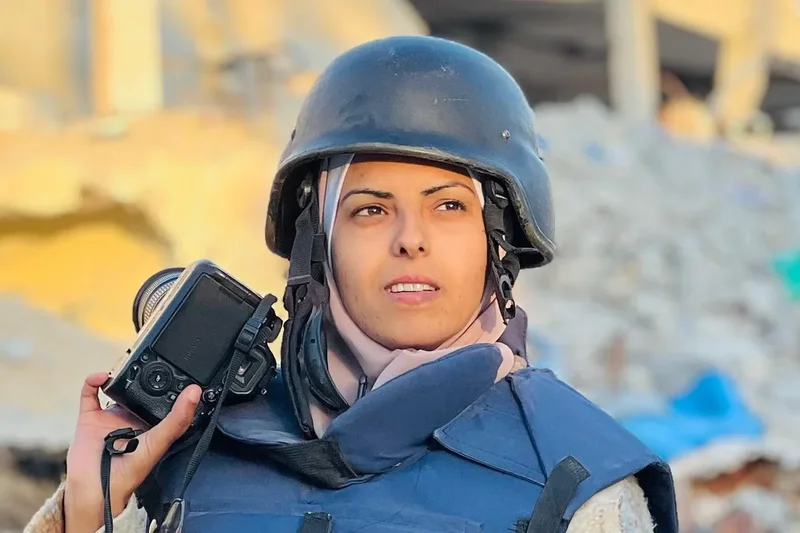
Journalist Mariam Abu Dagga was killed in the 25 August 2025 double-tap attack on Nasser Hospital in Gaza. Based on dozens of witness testimonies, whistleblowers and visual analysis, this is the most comprehensive reconstruction yet into the strike
9.30am, 25 August 2025
Against the deadly drumbeat of Israeli tank fire, Mariam Abu Dagga is eking out the last of her precious coffee supplies with close friend, flatmate and journalist Baraa Lafi.
It's another Monday in this relentless slaughter.
The 33-year-old journalist, who works for Independent Arabia and the Associated Press, is sitting in the partially destroyed building she shares with other female reporters in Khan Younis, south Gaza. Israeli military bulldozers had, at some point earlier in this war, punched through the side of the wall, which the owners had patched up with rubble, cement and rocks. And so the room is "crushed and deformed", Baraa says. But it is home - for now.
Together the two women, who bonded over their passion for work, are discussing their latest joint report about overcrowding in Nasser Hospital, located just across the street. They had interviewed their friend, Canadian-Palestinian emergency nurse and international volunteer Amanda, whose surname is coincidentally Nasser.
They are interrupted by Baraa's mother calling to check on them. They reassure her they are both fine.
Truthfully, Mariam hasn't been good for weeks. She deeply misses her only child: 14-year-old Ghaith she had managed to send out of Gaza to the UAE last year. She is still grieving the loss of her mother, who in the middle of the bombing in May 2024 died of cancer, in part due to a lack of treatment. Her father, to whom she had donated one of her kidneys before the war, wasn’t doing well either. The family had, like so many in Gaza, lost their home in Khan Younis, been forcibly displaced multiple times and survived starvation.
Surrounded by death, she had secretly left a will for her son with Baraa. Three days earlier, she had also sent a voice note to Hadi Torfi, her editor at Independent Arabia, warning that she might be forced to flee for the fourth time. The staff at Nasser Hospital had told journalists, following a well-worn pattern of Israel striking, encircling and laying siege to hospitals, that Nasser and the surrounding area would be next.
"I hope you are still tracking me, right?" she says in the voicenote, breaking off into deep, chest-wracking coughs. "I don't know where to go. I have nowhere to go," she trails off.
Inside the hospital, Amanda Nasser, who is volunteering with the Canadian medical charity GLIA, is frustrated that she has to leave her work to get in a convoy. All the international medics at Nasser had been told the night before that they must attend mandatory World Health Organisation (WHO) training about gender-based violence (GBV), off campus.
The stifling wards, thick with the smell of death and decay, are over capacity, and so any medic leaving the hospital seems excessive. "Usually we can get [training] through some sort of lesson we can do remotely online," she recalls. "GBV is a problem happening as well. But obviously we're in the middle of a genocide."
Another international GLIA volunteer, anaesthetist Dr Travis Melin, is equally bemused. Today is his last day in Gaza: why would he need to do this training now?
"They usually plan things in advance. What felt funny to us was that all of a sudden, they said, 'Hey, there's mandatory training now,'" he remembers.
Outside, the courtyard of the hospital, now a bustling tent city, is waking up in the blistering heat of the summer morning. Civilians who have fled their flattened homes across the 40km-long enclave have set up camp in the grounds of a complex that, under international law, is supposed to be protected. An ecosystem has sprung up: by the main gate there are people selling what meagre supplies are available; among them is Ali Abu Latifa.
The biggest tent within the courtyard is long, topped with bright blue tarpaulin, and stretches alongside the eastern side of the compound. It is reserved for the journalists, also displaced, who effectively live here too.
9.45am
Inside this tent, freelance journalist Abdallah al-Attar, 27, and videographer Moaz Abu Taha, are resting between reports. Abdallah is drifting in and out of sleep against the persistent whine of Israeli surveillance drones overhead.
Also sheltering from the heat is veteran Ghad TV correspondent Ibrahim Qannan who, at 53, is widely seen as a father figure among the younger correspondents.
He is speaking to Reuters cameraman Hussam al-Masri, 49, a father-of-four, who is worried about the harsh sun overheating his camera and interrupting the live feed on the external stairwell on the eastern side of the hospital. Hussam leaves to go and adjust it, while Ibrahim prepares for his 10am live broadcast just opposite. The friends bid one another farewell.
Hussam makes his way across the street to the eastern external concrete "emergency" stairwell, which, capped by a wooden shelter, has become the known hangout spot for reporters to do their live stand-ups, have a cigarette or get mobile phone signal during the frequent power blackouts. A week and a half prior, a photo taken and posted by Mariam shows Hussam standing next to his camera which is draped in a green-and-white prayer rug to shield it from the heat. Mariam also spent most days there, checking her social media posts and filing her reports.
In fact it is Mariam who apparently appears in Israeli surveillance footage, taken four days beforehand, according to screenshots obtained by The Independent. Head bent, she is seen hunched over her phone sitting next to the tripod and camera. Rafael Hayun, an Israeli civilian who says he monitors the situation in Gaza, provided an image to The Independent, declining to give its source and saying it showed the Hamas camera endangering troops. The Israeli military did not reply to a request for comment.
But Reuters later confirmed the camera was their live feed of Khan Younis and that the Israeli military knew they had teams working in Nasser Hospital. The British news agency says in the days prior to the strike the feed had been capturing footage of Israeli military bulldozers demolishing parts of southern Gaza.
10.09am
Samaher, 39, Hussam al-Masri's wife, calls her husband as he stands next to his camera on the stairwell. She has just managed to locate and buy some vegetables at an extortionate price, so needs him to transfer funds into their account. Hussam sounds tired and worn out. Recently, Samaher, who is fighting ovarian cancer in the besieged territory where there is no treatment, has been worried her husband is becoming too morbid.
"I just want to rest. I want to be martyred so I can finally rest," he tells her again in despair.
Their conversation is cut short. A massive explosion erupts and the line goes dead.
Ghad TV correspondent Ibrahim Qannan is standing by the eastern entrance to the complex, preparing to go live, when two deafening blasts rip open the skies.
One projectile crashes into the northern side of the hospital, tearing through what has been nicknamed "the Titanic": a communal area, flanked by large windows, near the operating room, where medics rest between surgeries.
The second smashes through the eastern external stairwell on the fourth floor.
Through his viewfinder, Ibrahim can see a metre-wide hole clawed out of the stairwell exactly where his friend Hussam had been standing moments before. In his place is a cloud of ash and dust.
Ibrahim immediately messages the Ghad TV main studio in Cairo to come to him now. "The hospital is being bombed," he repeats in shock.
Journalists Abdallah al-Attar and Moaz Abu Taha are shaken awake inside the journalist tent. Abdallah doesn't even have time to put on proper shoes as, together with Moaz, he runs in the direction of the explosion. Ibrahim asks them what is happening as they run past. "Hussam, Hussam, Hussam," is all Moaz can reply.
The explosions also rock the buildings opposite. Baraa grabs her press jacket and, quicker than Mariam, rushes out of the flat still in slippers. Just as she is leaving, she calls back to her friend who is still getting her things together, "I'm heading out ahead of you, ok?"
Hatem Omar, another Reuters contractor, is also sprinting to the scene of the explosion, filming the crowds going both towards and away from the bomb site. Ahmed Abu Aziz, a stringer for Middle East Eye, in a black bucket hat, crosses in front of him in the melee. He too is filming on his mobile.
In the chaos, the journalists unwittingly split into two groups. Hatem, Ahmed, Moaz, Mariam, as well as Palestine TV cameraman Jamal Badah and Mohamed Salama, who works with Al Jazeera, start to ascend the stairwell towards Hussam's body. Others, including Mohamed Salama's younger brother Ibrahim, also a journalist, and Baraa, are filming the ground-floor entrance to the ER.
From his stall by the entrance, Ali Abu Latifa sees a group of displaced civilians living in the complex have made it to the fourth floor shouting: "There are martyrs, there are martyrs!” He instinctively joins them to ferry down the wounded, a well-worn practice all in Gaza have learned to do.
When he gets there, a man in a sleeveless vest and flip-flops is holding out to the crowds below the remains of what appears to be Hussam’s destroyed camera and live-feed devices.
In the confusion, people begin to notice an Israeli quadcopter overhead and someone shouts, "There is another plane, they might bomb, go down!” Terrified of another imminent strike, Ali rushes down the stairwell, crossing paths with his neighbour and friend Mariam, who is intensely focused on reporting. She is wearing a white headscarf and black coat.
Mariam is, as usual, one of the first on the scene.
10.10am to 10.16am
Dr Mohamed Sakr, the director of nursing at Nasser, had just been shaken out of a reverie by this enormous boom that he describes as "an earthquake". He looks out of the window of his office in a different block, to see smoke billowing from the northern and eastern side of the Yassin Building. It houses three of the most critical departments in the whole hospital: the ER, the operating room and the ICU. He scrambles to check on his staff.
On his way into the ground-floor reception, he runs into Saja, one of his medical students, drenched in blood and staggering down from the fourth floor. On the northern side, one of the projectiles had punched through the walls, injuring medics as they worked.
Saja has been injured in the head; she hands her blood-stained scrubs to the nursing director, who takes them downstairs to show the waiting journalists and the world.
Baraa and others are filming with their mobiles as Dr Sakr steps into frame, holding the scrubs. "This belonged to a nurse waiting inside the operating department. She was targeted," he says in horror.
A few hundred metres away, at the local civil defence HQ, the team is starting its 24-hour shift. In charge is the unflappable veteran first responder and fire department chief, Major Raed Saqr. He arrives at the scene with ambulance drivers Ahmed Siam, Bassem Abu Nimr, and Osama Musbah, as well as Imad Al-Shaer who was just finishing his shift but joins in to help anyway. The group reaches the fourth floor stairwell less than five minutes after the strike. Apart from Imad, all of them are in distinctive high-visibility orange vests. They start retrieving body parts, which, Ahmed explains later, are "scattered everywhere" in a pool of blood.
There is now confusion with well over 20 people on different levels of the stairwell and more still on the ground floor. It is being filmed live, and from multiple angles, with journalists reporting for some of the biggest news agencies in the world. A rescue operation is clearly in full swing.
Reuters’ Hatem Omar (known professionally as Hatem Khaled), in a red T-shirt and jeans, is at the very top of the stairwell next to Mohamed Salama. The walls behind them are etched with the high-velocity impact pattern of shrapnel, emanating out from the epicentre like a mandala of teardrops. With his stills camera around his neck, Hatem deftly moves between photographing what is happening and filming the bloody scenes on his mobile. His camera picks up Mohamed as he begins walking down the stairwell towards Mariam, Ahmed Abu Aziz, Moaz Abu Taha, and civil defence worker Osama Musbah, in a hardhat, who are one level below.
Switching back to his mobile, he starts carefully walking down towards the rescuers to get a closer shot.
Major Saqr calls down to his team on the ground for more body bags.
10.17am
Two deafening explosions - so close together they meld into a single deadly heartbeat - crack open the sky, the air, sound and light itself.
Ibrahim's live stream is engulfed in a fist of dust, concrete, splintered metal and wood. In shock, he screams incomplete sentences live on air. "Oh God. The civil defence, gone. They killed people. Civil defence, gone."
Hatem's mobile phone, which keeps rolling, is swallowed into the explosion. The ghost of an arm in an orange visibility vest appears to the left of the screen. The audio is chillingly silent.
It is now seven to eight minutes after the first blast: just long enough for medics, first responders and journalists to gather en masse at the site.
Jamal Badah comes to but can't hear or see anything for 30 seconds. The pain is so blindingly intense he is convinced his legs have been blown off. When he can finally open his eyes, he sees Mariam lying motionless at his feet. Mohamed Salama has been struck on the back of his head and is vomiting. On one side Ahmed Abu Aziz is bleeding out. Nearby, Moaz Abu Taha has lost half his head.
Jamal begs anyone for help.
First responder Ahmed Siam, disorientated and unable to see or hear properly, can't understand where his teammates have gone.
"I saw pitch darkness, heard the noise, smelled explosives, wood, concrete, the scent of corpses, the smell of blood," he says.
Confused, he crawls over what he later finds out is the dead body of his colleague Imad, thinking he is dragging himself to safety.
In fact, as the dust clears, he is filmed live on air reaching through the destroyed side of the stairwell and inching out into a four-storey void.
"I was on the verge of falling from the top of the stairs, had it not been for the crowd below shouting for me to take a step back.”
He has shrapnel embedded in his eyes and so cannot see; the pain is unbearable. He calls out to his colleagues using their nicknames: "Abu Mahmoud, Abu Ahmed, where are you? Abu Ahmed, are you okay?"
He only hears a journalist who was slightly above him reply, "I'm here, I hear you."
"Then the sound vanished. I asked him, 'Where are you?' But the sound had cut out."
Downstairs on the ground floor, journalist Ibrahim Salama is in shock and injured. Chunks of concrete and shrapnel showered down on the emergency department, killing people above and below; body parts were scattered across the area. His first and only thought is of his brother, Mohamed, whom he had just seen on the now-destroyed stairwell.
Blind, Ahmed Siam stumbles down the stairs with a young man beside him.
"I asked him, 'What are we walking on?' He replied, 'Nothing at all.' But I realised quickly we were stepping over body parts, over dead people.”
There were over a dozen bodies in this narrow space. Major Saqr is also filmed staggering down the stairwell, administering first aid to himself. Rescue teams are too afraid to go back up in case Israel strikes again.
Mohamad Ghadour, another of Mariam's editors at Independent Arabia, is on annual leave when the news of the double-tap strike on Nasser Hospital bleeps up on his phone.
He is in Lebanon looking after family members, because Israel, locked in another war with Lebanese militant group Hezbollah, has destroyed his childhood home in the south of the country. A few days before, Mariam had messaged him to check with him: she profoundly understands the unique pressure of caring for a family under decades of Israeli fire.
Nasser Hospital is where Mariam lives, Mohamad realises, with growing panic.
"I started sending her messages but there was no response. I'm sending messages but there is no connection," he explains.
With Mariam unreachable, and no confirmed information, Hadi, the assistant editor-in-chief, is also furiously calling her. He sends another correspondent from Gaza City to try to work out what happened.
Both pray for a miracle.
The emergency rooms are packed, with bleeding, wounded people staggering in, calling for help.
Panicked family members are desperate to find their loved ones. Ibrahim is looking for his brother Mohamed Salama, certain he must have been killed in the attack. But he is not in the ER or the morgue.
Baraa, whose trousers are soaked in her own blood, is looking for Mariam with Mariam’s brother. Despite people warning of Israeli quadcopters hovering “unnaturally close”, sparking fears of a third strike, Baraa climbs the stairwell to find out.
The side of it has been completely obliterated, the slats of the wooden canopy blasted open.
"The stairs were covered in blood, body parts and scattered flesh lying everywhere. When I reached the fourth floor, I met two young men. One of them looked at me and said, 'Are you looking for your friend? We just brought her down as a martyr.'
"I completely collapsed."
At his live camera position opposite the hospital, Ibrahim Qannan begs the Ghad TV studio to let him go and look after the younger journalists he feels responsible for.
"I could not hold myself together, I was the oldest, most experienced."
Inside the emergency department, he finds Baraa and others weeping uncontrollably, still unable to find Mariam. In one corner, Hatem Omar is drenched in blood, in shock. Jamal Badah has had a foot amputated and is being taken out of the ICU.
There are bodies everywhere. The room is "a scene from the day of judgement," one eyewitness later describes.
In the north-west corner, Ibrahim sees one unattended body, covered by a hospital sheet.
"I asked one of the doctors, is the person under the sheet a woman?"
Ibrahim’s stomach drops as the doctor nods, and he asks for permission to uncover her face.
It is Mariam.
"Imagine a person who you have been talking to 24 hours a day, a friend, someone who was standing in front of you just minutes ago ... dead."
At the gender-based violence training about a 20 minute drive away, news reaches the international medics that Nasser Hospital has come under attack shortly after they were all required to leave. As many as 22 people are dead including five journalists and five first responders and medics.
"When I heard Mariam was one of them I lost it. I kept saying, 'No, we have to go back to the hospital now,'" says Amanda.
But the organisers of the training ruled it was too dangerous for the foreigners to return that night, perhaps worried about another strike, perhaps worried the local community might think the internationals knew in advance and had deliberately left.
"I was crying for an hour straight. I was so overwhelmed with emotions, fear, anger.
“It’s very clear what happened, why we were lured out so the hospital could get hit. It felt like a warning: they could do whatever they want.”
The movement of international volunteers should have been coordinated with the Israeli military as part of deconfliction protocol, she adds. The military must have known, she says.
"They follow our every move."
The world had watched in real time as Israel carried out a double-tap attack on journalists, first responders and doctors, at a hospital, in broad daylight. Even if the international community had become indifferent to slaughter in Gaza, there was uproar.
The Israeli military initially put out a statement claiming it was launching yet another investigation, adding it "regrets any harm to uninvolved individuals" and that it "does not target journalists as such”.
The Israeli prime minister Benjamin Netanyahu - who has an ICC arrest warrant against him for war crimes, including the crime against humanity of murder - called it a "tragic mishap", claiming Israel “values the work of journalists, medical staff, and all civilians”. (Netanyahu denies the charges against him).
But as Ibrahim Qannan put it, Mariam was killed "in an execution carried out live on air, witnessed by the entire planet”.
And the evidence gathered by The Independent tells a different story to that offered by Israel. The Israeli military later said that the Golani Brigade, one of Israel’s elite infantry brigades, identified a camera "that was positioned by Hamas" to observe troops.
But again Reuters had confirmed it was their live position - which was also corroborated by half a dozen journalists, two members of the local community and international medics working at the hospital who spoke to The Independent. An image of the camera, covered in a prayer blanket, was taken and posted by Mariam herself in the days before. Reuters said the Israeli military knew they had teams inside the hospital.
Dr Sakr, head of nursing, told The Independent that Israel was in direct contact with the hospital staff and could have easily raised any issue they had with any camera.
"They know our numbers. If they had reservations about anything, they would have contacted us as they usually do, and we would have dealt with any problem that bothered them."
The Israeli military released the names of six men whom it said were "terrorists" killed in the strikes on the hospital.
Among the names released by the military was “Omar Abu Teim”. But Ismail Al-Thawabta, the head of the Hamas-run government media office in Gaza told Reuters that he was not killed in 25 August 2025 attack on Nasser Hospital. The Independent reached out to Al-Thawabta but has not received a reply.
The Israeli military also listed Imad al-Shaer, who was named by multiple members of the civil defence team as operating at the scene, as part of their rescue team. The Independent also visually identified him in multiple videos clearly assisting the emergency response. After the second strike, footage shows his body hanging off the ledge on the fourth floor where he had been working.
Nasser Hospital's own Facebook page identified a third individual named by Israel as a hospital worker.
Reuters said it spoke to the family members of two of the other men listed, who said they were visiting patients at the hospital and were taking part in rescue efforts when they were killed in the second strike. The Independent was unable to locate the family members.
The Independent spoke to seven witnesses at the scene of the attack who had registered seeing surveillance drones flying over the area immediately after the first attack. Khaled Shaath, a freelance journalist The Independent interviewed, filmed one just a few minutes after the first attack. Everyone The Independent spoke to felt that they were being closely watched as the groups gathered on the stairwell to help and report.
The Independent spoke to two Israeli whistleblowers, both reservists who served in south Gaza. One who served in a tank unit told The Independent that the nature of the attack showed it was not only "deliberate" but that "this looks like something very planned”.
Both said that taking out a camera was "standard protocol", and it did not require additional authorisation. But shooting a hospital multiple times would have required sign-off at battalion level or higher from the Southern Command. "So many people would need to be involved in the decision-making process to choose this target and this particular firing method,” the first whistleblower said .
The individual said the "special fire method of two tank shells" around 10 minutes after the first attack, meant "they definitely saw the crowd", bolstering the belief it was an intentional double-tap.
"One shell is supposed to break the shelter, the second one kills the people," the individual added: standard protocol to cause maximum human damage. When tanks fire, the whistleblower continued, they are looking directly at their target through the gunner’s sight.
This whistleblower concluded that this all came as part of a "culture" to encourage “the most lethal outcome”.
"It's not a mistake, the whole environment is not a mistake. It's a deliberate method that is used by our government … that blurred everything, made it very confusing, more chaotic and more lethal,” the individual said.
That was particularly the case in Khan Younis where this tank officer served and felt that the Israeli military kept them there without a clear mission “for so long just to make this kind of chaos”.
The other whistleblower said not only is there a “light finger on the trigger” but “there is no accountability whatsoever”.
A freeze-frame from one of the wide camera shots of the strike shows two projectiles hitting in quick succession, too close together for it to be a single tank fire. Again suggesting coordination.
Earshot, an NGO that conducts audio investigations for human rights advocacy, carried out an in-depth acoustic analysis, triangulating the footage from at least five cameras filming the second round which killed Mariam.
Lawrence Abu Hamdan, Earshot’s founder, told The Independent they believe it was likely a 120mm M329 tank shell, made by Elbit Systems, and that one of them was set to anti-personnel mode with six submunitions or bomblets, “creating a kind of lethal blast zone”.
Analysis of the sound, the flight path of the projectiles, and the distance between impact and the sound of the muzzle blast meant they were able to estimate the distance and location of the tank that fired it: 2.5km north east of the hospital.
The Independent examined satellite imagery provided by Planet Labs on 25 August 2025, which showed the presence of a tank base, complete with berms, 2.5km north of the hospital. There are multiple tanks positioned there.
The Independent also interviewed two other weapons experts, Chris Cobb-Smith and N.R. Jenzen-Jones, the director of arms munitions consultancy Armament Research Services. Both identified fragments found at the scene, which were pictured by Associated Press, and concluded they were parts of an Israeli 120mm tank shell. N.R. Jenzen-Jones said the footage at the scene “also indicates the use of high explosive or ‘multi-purpose’ projectiles, as would be expected by tank gunfire targeting personnel in buildings.”
Kevin Jon Heller, a professor of international law at the University of Copenhagen's Centre for Military Studies, told The Independent after examining all the evidence, a prosecutor could "reasonably conclude” that the perpetrators had committed the war crimes “of intentionally attacking civilians and of launching a disproportionate attack, particularly with regard to the second attack".
“There was, for example, no attempt to warn the hospital at all,” he continued. “There's absolutely a duty in International Humanitarian Law to give a warning to the hospital, to give the reasonable time to address whatever the alleged problem is.”
Proportionality was an issue given the small military advantage of Israel’s claimed aim of taking out a camera compared to the huge collateral civilian damage in a double-tap attack. “ Do you really need two high explosive tank shells to take out a camera?” he asked.
And this does not happen in a vacuum.
The Committee to Project Journalists (CPJ) has said Israel has killed more than 200 Palestinian media workers since 2023: more journalists than any other government since it began collecting data in 1992. Previously the CPJ has that warned the Israeli military has launched smear campaigns against journalists, accusing them of being militants - like Al-Jazeera journalist Anas Al Sharif who was killed in a targeted assassination a few weeks before the Nasser attack - to "manufacture consent to kill them”.
“By silencing the press, Israel is silencing those who document and bear witness to what human rights groups and UN experts agree is a genocide,” the CPJ said.
In multiple statements to The Independent over the years, the Israeli military has repeatedly denied it targets journalists or that its troops have committed war crimes or that its actions amount to genocide. The Israeli government has made similar denials.
But UN Special Rapporteur Francesca Albanese, who is currently investigating attacks on Palestinian journalists, said the Nasser Hospital double-tap killings came within the pattern of "targeting and killing journalists that suggests a clear intention to silence Palestinian journalists in all possible ways."
"The investigations I have conducted for my upcoming report strongly suggest that journalists have been intentionally targeted so that they will not report on the crimes committed against the Palestinians in the context of the ongoing genocide,” she told The Independent.
"There are statements of Israeli leaders and soldiers, referring to the voice of journalists as a weapon, as a threat."
"Journalists have to be protected during conflict. But Palestinian journalists in Gaza feel that for them wearing the press vest makes them a deliberate target."
The Independent shared all its findings with the Israeli military and asked for comments on each point. The military declined to respond, adding only “the review is still ongoing under the General Staff Fact-Finding and Assessment Mechanism.”
One year on and there has been no justice for Mariam or the others whose lives were taken.
There has been no one held accountable for what the CPJ has classified as the murders of the journalists - no answers for Mariam’s family and no end to the slaughter which continues in Gaza despite a nominal ceasefire.
And no guarantees that those journalists who survive in Gaza won’t be the next.
“For anyone who didn't know her, she was deeply, genuinely human—not just a journalist,” says Baraa, Mariam’s friend, who had to deliver Mariam’s will to her shattered teenage son.
“Every story Mariam went to film, she felt the pain of the people living it.
“She was someone beyond description. Everyone who knew her - young or old - loved her. She was the best of us.”
**Additional reporting by Matan Cohen and Doaa Alshaikh Eid *
Please refresh the page or navigate to another page on the site to be automatically logged inPlease refresh your browser to be logged in