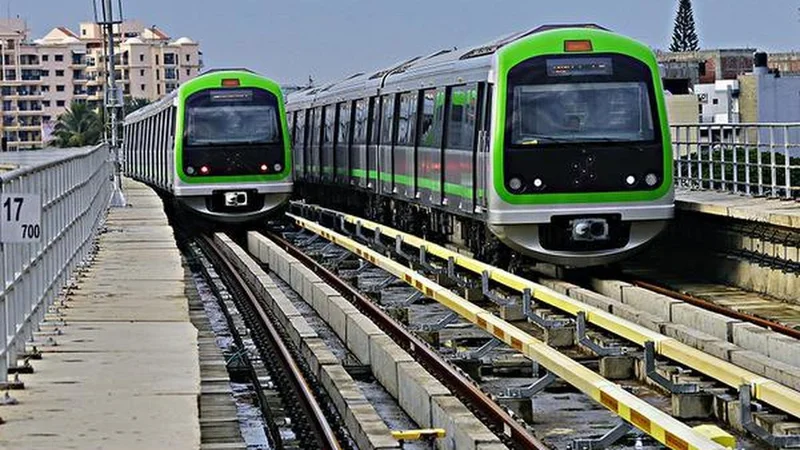
: Bengaluru’s Namma Metro network experienced repeated technical disruptions over a 10-month period, with services affected 15 times between September 2025 and July 2026, according to data.
The incidents were reported across the Purple, Green and Yellow lines and involved failures in signalling systems, traction power equipment, train-control components and rolling stock. The disruptions resulted in operational delays, trains being withdrawn from service, altered train movements and, in some cases, short-loop operations.
Bengaluru Development Minister Krishna Byre Gowda, while responding in the Karnataka Legislative Council, said that the technical problems included signalling failures that affected braking and train-reversal arrangements, interruptions in traction power supply, train-control faults and failures in systems responsible for confirming that train doors had been securely closed.
Cascading impact on Metro operations
Such failures can have a cascading impact on Metro operations. When trains are unable to receive the required signalling or traction-power clearance, services may have to be slowed, regulated or temporarily suspended. This can lead to longer waiting times, bunching of trains, overcrowding at stations and platforms, disruption to passenger connections and delays across adjoining sections of a line.
On the Purple Line, five technical incidents were reported during the period. On September 13, 2025, a signalling malfunction near Pattandur Agrahara caused repeated unintended brake applications. On October 30, a failure involving the main contactor supplying traction power inside a train at Vijayanagar forced the train to be taken out of service.
A signalling power-supply relay failure in the Indiranagar interlocking area on March 15, 2026, interrupted operations for around 25 minutes. On June 3, a fault in the door-closing status system at Seetharampalya prevented traction power from being switched on. Later, on June 23, damage or failure of a third-rail support insulator near the Cubbon Park-MG Road section caused a down train to lose traction power.
The Green Line, stretching 33.46 km between Madavara and Silk Institute, accounted for the largest share of the incidents listed in the response. On May 5, a train near Doddakallasandra could not operate in Automatic Train Operation mode after a communication failure between the driver control system and the Automatic Train Control cubicle, linked to a faulty SWI card.
At Chickpete on May 11, a door-closing status signal failed to reach the main train controller, preventing traction power from being energised. On June 11, an incorrectly activated protection circuit caused a third-rail power supply failure near the Jalahalli-Nagasandra/BIEC stretch. Train services were regulated, with short-loop or single-line operations continuing for 51 minutes.
A third-rail support insulator failure near Peenya Industry on July 4 resulted in another traction-power loss. On July 9, a DMC-2 cab-door locking mechanism fault at Banashankari prevented the required door status from reaching the main train controller. An onboard signalling and Automatic Train Protection fault between Yeshwanthpur and Jalahalli on July 21 prevented a train from running in normal mode and delayed following services.
The Yellow Line recorded three incidents. A signalling problem on September 22, 2025, disrupted the reversal arrangement and prevented a train from reaching Bommasandra terminal. On March 31, 2026, a contactor coil in a train’s air-conditioning system burnt while the train was operating near HSR Layout-Bommanahalli, after which it was withdrawn to the depot from Bommanahalli. Another signalling fault on May 18 affected train reversal between Bommasandra and Electronics City.
Root-cause investigations
To reduce repeat failures, BMRCL conducts detailed failure and root-cause investigations following major incidents. Based on these assessments, faulty components are replaced or upgraded, while corrective and preventive measures are introduced, according to the minister.
“The corporation is also strengthening preventive inspections and maintenance and increasing surveillance of critical signalling, train-control and traction systems. Engineering modifications are being carried out wherever required, with the effectiveness of these interventions being assessed through failure and recurrence trends,” the reply stated.
Mr Gowda said that BMRCL would also coordinate with the Bengaluru Metropolitan Transport Corporation (BMTC), when necessary, to arrange additional or alternative bus services during major Metro disruptions. “Where feasible, short-loop services would be operated on either side of affected stations, while station personnel would assist commuters with information and alternative travel arrangements,” he added.
Published - August 23, 2026 05:01 pm IST