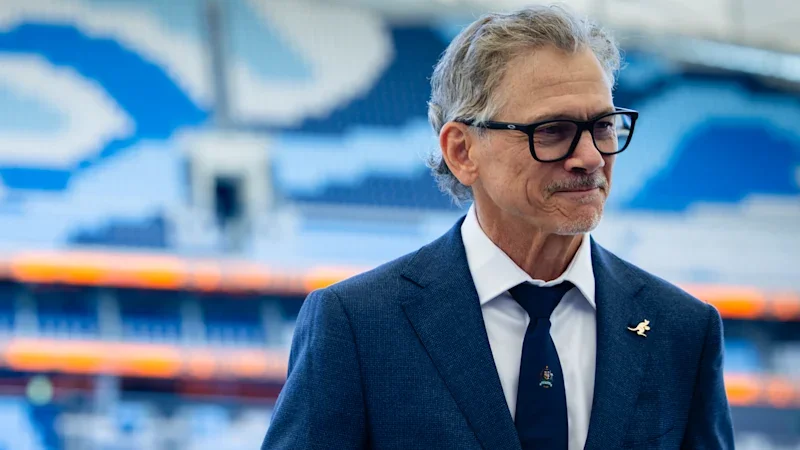
New Wallabies coach Les Kiss struck the right balance after unveiling his first Wallabies squad on Thursday.
He showed respect to the work Joe Schmidt and Laurie Fisher had done to build the Wallabies’ “foundations”, but there was also an unmistakable eagerness to get his hands on the players to put his stamp on the role.
It is a little concerning that there are only two Australian coaches in the six-man Wallabies set-up - perhaps a topic for another day - but Kiss has identified areas he needs to improve.
Thankfully, there was little talk about building towards the World Cup - winning now is the priority. And Kiss is no fool - he will know Japan coach Eddie Jones has assembled a giant group of second-rowers and back-rowers: Warner Dearns, Harry Hockings and Ben Gunter will provide a stern physical challenge in Tokyo on August 8.
So, what should Kiss’ priorities be?
Unleash the attack
The most important clue that Kiss gave this week related to the type of player that Australia produces naturally: blokes who are at their best when they are “free” and playing what’s in front of them.
There is a real danger of labelling Schmidt’s style as too structured and conservative - the Wallabies produced 27 offloads during July, four fewer than the All Blacks and the fifth-most of the 12 Nations Championship teams.
However, there is a gap between the Wallabies’ attack and other countries - some of whom arguably don’t have the same quality of athletes.
Look at the inventory that will be available to Kiss between now and the World Cup: Max Jorgensen, Joseph-Aukuso Suaalii, Zac Lomax, Mark Nawaqanitawase, Dylan Pietsch, Treyvon Pritchard, Tom Wright ... just for starters.
The strength of this Wallabies side is in the outside backs and the French emphatically showed in Brisbane that there is enough room in modern Test rugby to use your weapons.
“More to give,” was Kiss’ assessment of the Wallabies players, and he was right - particularly as the forwards have size, a roll-up-the sleeves attitude and the technical ability to provide a good platform.
The athleticism in that Wallabies backline must dictate how they play. They’ve got the players who should worry any team.
Rethink the McReight-Tizzano combination
Schmidt was never fully sold on the merits of having openside flankers Fraser McReight and Carlo Tizzano on the field at the same time.
But again, this is a question that really goes to the core of the Wallabies’ identity - and what other teams would not like to come up against.
We all know the Wallabies have a proud history of producing No. 7s, so much so that David Pocock and Michael Hooper ended up playing in the same side.
McReight and Tizzano represent a gilt-edged opportunity to lean into that, because Tizzano is too good to be sitting outside the 23-man squad.
It’s probably a bridge too far to start McReight and Tizzano, but they would be tough to play against in the final quarter of a Test. Tizzano’s ball-carrying and all-round muscularity has improved to such an extent that the Wallabies wouldn’t lose much physicality with him coming off the bench.
The lineout would be shorter, but there is always a trade-off.
Stick or twist with Suaalii
Suaalii can still work as a No. 13. The Reds used an attacking shape that brought the best out of centre Josh Flook because there were so many options for the ball carriers at the line.
When they got it right, the ball carrier (often the No. 12) went to the line and had the pullback pass option or the chance to hit the outside centre running the hard line.
If the Wallabies play that way, it would be an opportunity to get Suaalii into some space.
But the time is probably coming when Kiss has to decide on Suaalii - to stick with him in the midfield or put him in the back three.
But the big consideration here is the sheer amount of talent that already exists in the outside backs - who would you leave out?
To my mind there is still scope for a tall, fast, attack-minded No. 13 to cause some major damage. France’s Fabien Brau-Boirie is the perfect example.