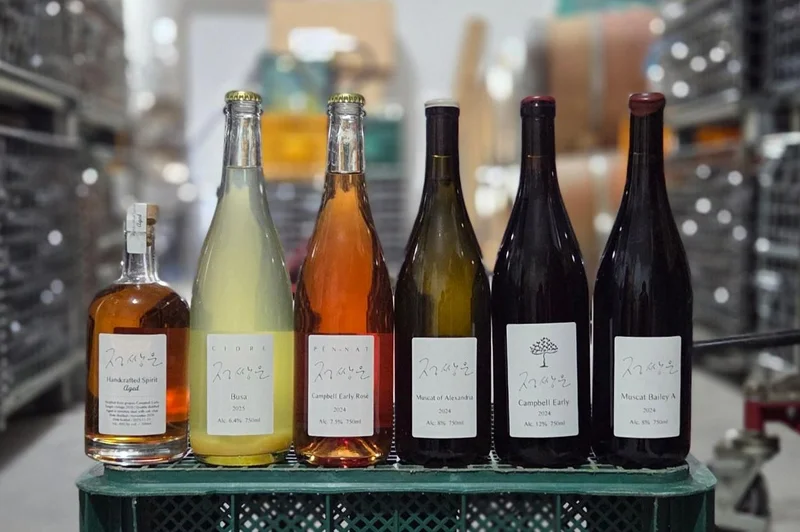
Winery in remote provincial town follows approach to making Korea's traditional rice-based alcohol
In the quiet mountain village of Ungyang-myeon, Geochang County, South Gyeongsang Province, sits a modest country home. Beside it are a small winery and a vineyard spanning about 18,000 square meters.
Compared with the vast vineyards of Europe’s famous wine regions, the place feels more like a humble Korean grape farm than a grand vineyard.
Yet the organically grown grapes harvested here are transformed into Jeong Ssang-eun Wine, a natural wine that has wine lovers across Korea lining up to get their hands on.
The winery, run by first-generation grape farmers Jeong Ssang-eun and Lim Hye-sook and their son, second-generation winemaker Jeong Gyu-song, produces only about 9,000 bottles a year due to its small scale. Despite the limited supply, their wines often sell out soon after they become available.
Hankook Ilbo visited Jeong Ssang-eun Winery on Aug. 14 to explore the family’s approach to making natural wine and its vision for Korean wine.
Breaking stereotype of 'sweet' Korean wine
For first-time drinkers, perhaps the most striking characteristic of Jeong Ssang-eun Wine is what it lacks: sweetness.
The difference can be particularly noticeable for consumers whose experience with Korean wine has largely been limited to products commonly found in supermarkets, convenience stores and neighborhood shops. Many Korean wines on the market have traditionally been made with relatively high levels of added sugar, a practice known as chaptalization, resulting in pronounced sweetness that can mask the natural character of the grapes.
Jeong Ssang-eun Wine, by contrast, is almost completely dry. Although its alcohol content is not particularly high, the wine offers fresh fruit aromas, a subtle salty minerality and refreshing acidity that highlight the character of the grapes.
Jeong Gyu-song, 40, who oversees everything from grape cultivation to winemaking, attributes these characteristics to Geochang’s “terroir” — the combination of natural environmental factors, including soil and climate, that influence grape growing.
“Most of the soil in Geochang is granite. Granite contains a lot of iron, which helps increase the acidity of the grapes. At elevations of around 300 meters, grapes can struggle to ripen because of heat stress. But here, at 550 meters, it is cooler, and the large difference between daytime and nighttime temperatures gives the grapes a more concentrated flavor.”
The family also learned an unusual lesson from a relative who lives nearby and is known locally for making excellent “makgeolli,” Korea’s traditional rice-based alcohol.
“My aunt is famous around here for making the best makgeolli. I asked her how to make good alcohol, and she told me that makgeolli turns out best when the average temperature is around 18 degrees Celsius. Around here, that happens in May and October. She said that if you make alcohol then, it will always turn out well. So I tried it, and it really did taste good.”
In other words, a secret to making good makgeolli became part of the family’s approach to making good wine.
Is Korea really unsuitable for winemaking?
Jeong’s praise of Geochang’s terroir runs counter to the widespread belief that Korea’s climate is unsuitable for growing wine grapes.
Wine grapes generally thrive in dry, relatively cool climates, leading many to assume that Korea’s hot and humid summers make it an inherently poor wine-producing country. The pronounced sweetness found in many Korean wines has also been attributed partly to Korean consumers’ preference for sweet fruit wines, as well as the need to compensate for grapes lacking sufficient flavor.
Jeong, however, believes the bigger problem lies not in Korea’s climate but in the way grapes are distributed.
He points to “field selling” or “field buying,” in which merchants purchase an entire vineyard and harvest its grapes at once.
“Not all the grapes can ripen at exactly the same time, but when an entire field is purchased, all the grapes are harvested together. Some are underripe while others are overripe. Merchants sell the grapes that have ripened well and use the rest for juice or alcohol. If you make wine with those grapes, of course it isn’t going to taste very good, so you have no choice but to add sugar. The wine industry cannot develop under that kind of system.”
He argues that many of the country’s outstanding wines are made by wineries that grow their own grapes and therefore have control over the entire process.
“It’s not that making good wine in Korea is impossible because of the climate. If you can control the entire process, from growing the grapes to making the wine, I believe you can make very good wine here, too.”
Organic grapes, natural winemaking
Jeong Ssang-eun Wine is made exclusively from organically grown grapes.
Jeong said the family began farming organically because of his father’s sensitivity to agricultural chemicals.
“My father’s skin was very sensitive to pesticides, so my parents have always farmed organically. We’ve never farmed using pesticides, so this is simply the only way we know.”
The winery has also embraced natural winemaking, using minimal intervention in the production process. It does not add sulfites, which are commonly used to stabilize and extend the shelf life of the wine.
When asked why they do not use sulfites, Jeong said his mother simply responds with, “Would you put sulfites in the makgeolli you make for your family to drink?”
That attitude reflects the family’s determination to keep the entire process as natural as possible — from organically grown grapes to minimally processed wine.
Making wine without chemical additives can make it more difficult to achieve a desired flavor profile, but Jeong compensates through meticulous control of the winemaking process.
Although he has never received formal winemaking training, he continually experiments with new techniques in pursuit of better wine. He regularly reads books about winemaking and watches YouTube videos, while also reaching out through social media to winemakers in countries such as France and Japan to ask about their techniques and experiences.
When Jeong's parents began growing grapes 36 years ago, the family never imagined that they would eventually sell wine.
At the time, they simply made wine for themselves because some grapes were too imperfect to sell commercially.
But word of the family’s unusually good homemade wine spread beyond the mountain village. Eventually, a county government official contacted them and suggested turning their winemaking into a business.
With support from Geochang County, the family acquired production equipment and later obtained a liquor manufacturing license. In 2007, they began selling their wine under the name “Geochang Grape Wine.”
The winery took its current form about six years ago, after the couple's son joined the family business.
Jeong had returned to his hometown about 10 years ago and worked for four years at the Geochang Agricultural Technology Center. During that time, he realized that farming was his calling. He eventually left his government job and returned to the family vineyard, where he began taking a more active role in winemaking.
Under his direction, what had once been a single Campbell grape red wine expanded into a portfolio of 10 wines and one brandy, now sold under the Jeong Ssang-eun Wine name.
Jeong spends virtually every season of the year focused on growing grapes and making wine. His goal is simple: to make better wine that ordinary people can comfortably afford and enjoy.
“Someone once asked me whether my goal was to make a ‘big wine’ or something more popular and accessible. I told them I just want to make an easy wine that ordinary people can buy and drink.”
“But I do want to make better-tasting wine. As long as my palate can tell the difference, I want to keep making better wine. That means growing better grapes, too. That’s what I’m working toward year by year. I don’t have any big ambitions.”
This article from the Hankook Ilbo, the sister publication of The Korea Times, is translated by a generative AI system and edited by The Korea Times.
Explore More
- Q.
- Q.
- Q.