- See more Daily Mail on Google - save us as a Preferred Source
A third of spiking victims who report attacks to police are now men while the total number of cases recorded has quadrupled since 2020.
The proportion of reported spiking offences where the victim was male has risen steadily since 2021, from around 23 per cent to a third last year.
And since the pandemic the number of spiking cases reported to police has more than quadrupled, from around 2,000 in 2020 to about 9,000 in 2025.
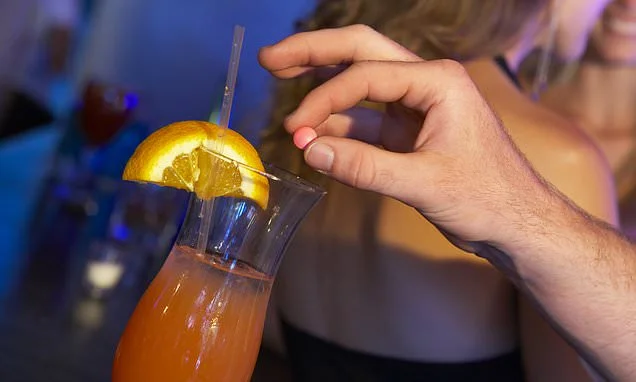
Spiking is giving someone alcohol or drugs without them knowing or agreeing, for example in their drink, with a needle or by lacing a vape.
According to Police UK most spiking attacks do not result in sexual assault or theft – as is thought common – but it can cause 'severe distress, emotional harm and anxiety'.
The authority added spiking could put victims at greater risk of injury, theft or assault and officers treating reports 'as seriously as those of violent, physical attacks'.
Women still form the majority of these reports and were the victim in more than 5,000 of last year's spiking reports – around 1,000 victims' genders were unspecified.
However it is still believed just over a fifth of spiking victims report their experiences to police.
A third of victims reported spiking attacks to police are now men, data has shown
Good Morning Britain's Ranvir Singh has previously said she was left 'unable to hear or walk' after her drink was spiked, leaving her with 'no memory of getting home'
It is unclear why more men are reporting attacks, though the founders of Spike Aware UK – who visit secondary schools and university freshers' events to raise awareness – said they had seen a notable increase in young men wanting to know more about spiking and how to protect themselves.
Colin and Mandy Mackie, both 64, formed the charity after their son Greg died aged 18 six weeks into a media course at Edinburgh College in 2017.
After a night with friends at his halls of residence where Greg, from near Glasgow, only drank Coca-Cola because of an early supermarket shift the following day, he died with the equivalent of five ecstasy tablets in his system.
Mr and Mrs Mackie believe it was a prank by a friend, though no one was ever prosecuted after Greg's death.
'We tell Greg's story to make people realise spiking is not just a joke - people can die from it,' Mr Mackie told The Times.
He added he had spoken to a Scottish man in his mid-thirties who was spiked by a hand stamp while entering a club in Boston, where he had travelled for the World Cup this summer.
The victim remembered drinking a quarter of a pint but no more – friends told him he had become aggressive and been taken back to his hotel room.
Mr Mackie said: 'We often have men calling up for reassurance. Mostly they're just trying to figure out why they were targeted — lots of them don't report it because they're confused and just want to move on.'
The Metropolitan Police have introduced technology to tackle spiking, including vape test kits which can detect drugs such as THC and spice
Spiking victims who report their assault have an average age of 27, according to the National Police Chiefs' Council (NPCC), and one in five suspects identified by police last year were female.
Earlier this month Adina Mihai, 31, was jailed for 17 years after posing as a sex worker and spiking four men in their homes, two of whom died.
She stole belongings including Rolex watches, aftershave and jewellery after the attacks.
Almost 90 per cent of UK adults thought drinks were spiked to commit sexual assault or rape, according to a survey by Drinkaware with Anglia Ruskin University.
Next most common as a perceived motivation was theft followed by physical assault.
However no further crime is reported in 55 per cent of spiking cases, leaving experts unsure of many perpetrators' motivations.
Women were more likely to be sexually assaulted when another crime was committed while men were more likely to be robbed or blackmailed.
Last year it was reported spiking incidents had risen by almost 10 per cent in London but only one in 20 led to a charge.
The Metropolitan Police received more than 2,700 reports of spiking between December 2024 and November 2025, with 125 per cent more charges brought compared to the year before.
However it reiterated the belief that only a fraction of cases were ever reported.
A series of high-profile spiking cases were reported in the months before, including an alleged case by an MP at a House of Commons bar.
Good Morning Britain presenter Ranvir Singh said she had been left unable to hear or walk after half a glass of spiked wine.