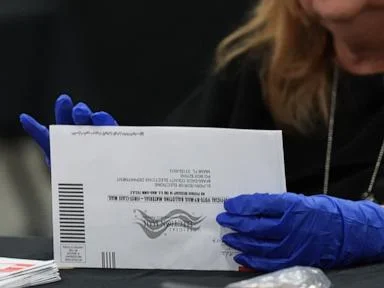
USPS makes new rules for mail-in ballots
The changes would not go into effect until the court lifts its injunction.
The United States Postal Service (USPS) has released a new rule adding verification requirements to all mail-in ballots.
These changes will not go into effect until the court lifts its current injunction. The mail service said the changes would occur immediately if given the go-ahead.
Under the proposed change, states would be required to collect and report basic voter information, like a voter's name and home address, attached to a unique barcode on every mail-in ballot distributed.
State election authorities would then be required to input this information into a "federal ballot mail portal" before the ballot is accepted into the mail stream.
The USPS said it would not deliver ballots to any state not in compliance with these changes.
The move comes after months of attempts by the administration to collect voter information in the name of election integrity. Some experts are concerned that consolidation of that information into federal hands undermines the Constitution's system of state-run elections.
"If the administration can determine who is American enough to register to vote, who can prove it sufficiently, then they would have a lot of power to shape the electorate," said Jonathan Diaz, director of voting advocacy for the bipartisan nonprofit Campaign Legal Center.
The new requirements fall short of demands from President Donald Trump, whose March executive order on mail-in ballots would have established statewide voter citizenship lists from Social Security or immigration databases, established uniform ballots, and had the USPS "coordinate with the USPS Office of Inspector General and the Department of Justice for investigation of suspected unlawful use of the mail involving Federal election materials."
Most of these demands are included but watered down in the USPS' final rule, ultimately creating a system that would track eligible voters by name and address, but keep citizenship largely out of it.
"No other voter information, such as birthdate, social security number, or other voter registration details, will be uploaded to the Portal," the USPS said. "The Postal Service will not play any role in determining voter eligibility, maintaining voter rolls, or counting ballots."
This rule is not a mail-in ballot ban, nor does it include the military, disability, illness, and travel exceptions requested by the president.
The USPS says there are clear lines between the data collected and statewide voter rolls, though the rule does say data collected "will help to facilitate enforcement of federal law."
"It will provide federal law enforcement with a list of individuals to whom states planned to mail a ballot (and who may potentially use the mail to vote), along with the associated barcode data," the USPS included in its rule.
The rule comes alongside months of gridlock for the SAVE America Act, the GOP's signature piece of election reform that would require photo ID and proof of citizenship to vote.
"To Vote a person must show PHOTO VOTER I.D., PROOF OF CITIZENSHIP, AND THAT THERE WILL BE NO MORE CROOKED, CORRUPT, & DESTABILIZING MAIL-IN BALLOTS (EXCEPTIONS for Military, Disabled, Illness, and Travel!)," the president wrote on social media. "THE SAVE AMERICA ACT’S non-passage is CRAZY, and a serious threat to any politician who votes against it!"
The president has long demanded the bill make it through Congress, even calling on the termination of the Senate filibuster to make it easier to pass, though Democrats and some Republican lawmakers say the rules would disenfranchise too many American voters. The White House did not immediately respond to a request for comment.
"Alaska’s 20-year struggle to implement REAL ID demonstrates just how incredibly difficult the enforcement of federal mandates can be and how unlikely it is that the SAVE America Act could be effectively implemented on an expedited basis," Alaska Republican Sen. Lisa Murkowski said in a statement.
"Free and fair elections are the cornerstone of our democracy. As doubt is cast on their legitimacy and public trust erodes, we would do well to avoid partisan reforms that sound good on paper but may work very differently in the real world," she added.
The USPS said it received "more than 200,000 comments" on the change and recognized concerns in its rule Friday.
"While the Postal Service acknowledges the range of disagreement on this point, the incidence of voter fraud does not impact the proposed rule’s legal grounding," the USPS said. "Such enhanced visibility will help identify potential issues that would have otherwise gone undetected; at the very least, it will provide increased assurance that any potential issues are more capable of being effectively identified and investigated."
The USPS said the rule will be officially published on Aug. 26. A U.S. appeals court upheld the district judge's injunction in July, keeping any changes to mail-in ballots on hold while litigation continues.