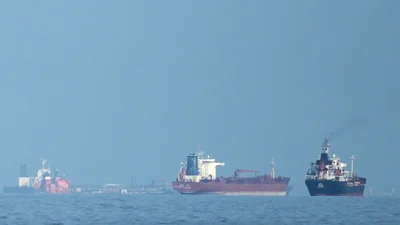
At least 15 Indian-flagged vessels are currently stranded west of the Strait of Hormuz chokepoint after the United States announced a blockade of Iranian ports and coastal areas following failed ceasefire talks, triggering sharp disruption in one of the world's busiest energy shipping corridors.
The situation escalated after US Central Command said enforcement would begin on Monday, covering Iranian ports across the Arabian Gulf and Gulf of Oman. While transit between non-Iranian ports through the Strait of Hormuz has not been formally stopped, shipping movement slowed sharply after the announcement, with early tracking reports noting a sudden drop in crossings.
Amid the disruption, the Indian Navy has moved to maintain close coordination with merchant vessels operating in the region. At least six Indian naval ships are currently positioned near the Persian Gulf, assisting with communication, monitoring and safe passage advisories for commercial traffic.
One vessel, LPG tanker Jag Vikram, crossed the Strait of Hormuz on April 11 and is now en route to Mumbai with an estimated arrival on April 15. The ship is carrying around 20,400 tonnes of LPG and has a crew of 24. It is currently in the Arabian Sea under Indian Navy escort.
Officials tracking maritime movement said 10 out of 25 Indian-flagged vessels operating in the wider region have already cleared the Hormuz strait safely. The stranded group includes LNG and LPG carriers, crude oil tankers, container ships, a dredger and a chemical tanker.
Despite the heightened tensions, there has been no change in Indian Navy deployment patterns or operational protocols in the region. Surveillance and escort operations continue under existing standard operating procedures, with the situation being monitored continuously through maritime security agencies.
Security agencies have flagged nearly 30 incidents in the wider Gulf region in recent weeks, with 23 vessels reportedly targetted in separate episodes, underscoring the volatility of the maritime environment.
India is also coordinating real-time maritime intelligence with 28 countries to ensure uninterrupted monitoring and safer passage for commercial shipping through the Gulf and adjoining waters.
The escalation followed the inconclusive US-Iran ceasefire talks held in Pakistan, after which Washington moved to tighten maritime pressure on Iranian ports. The US directive allowed continued passage for non-Iranian commercial traffic but warns of strict enforcement against vessels entering or leaving Iranian ports.
The Strait of Hormuz is a critical global energy chokepoint, handling 25 per cent of the world's maritime oil trade. Any disruption in the waterway has immediate implications for global energy flows, shipping insurance and freight movement.
Meanwhile, Iranian officials have warned the US of retaliation, saying any attempt to restrict maritime access would be met with countermeasures, further raising the risk of escalation in the region.
Mohsen Rezaei, a military adviser and a former Revolutionary Guard Commander, wrote on X that the country's armed forces had "major untouched levers" to counter a Hormuz blockade. He said Iran would not be coerced by "tweets and imaginary plans" of US President Donald Trump.
- Ends
Published By:
Sahil Sinha
Published On:
Apr 13, 2026 13:01 IST