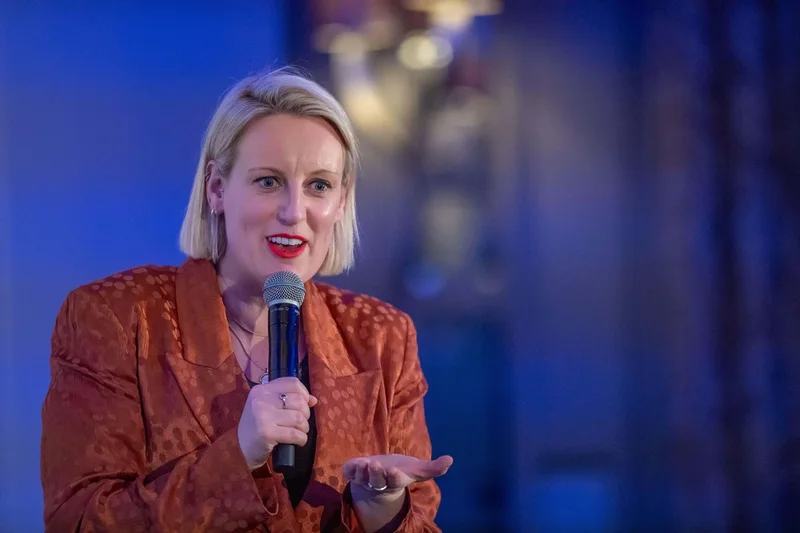
Steph McGovern is annoyed. Not about something that’s happened to her, but something that doesn’t happen to millions of young people every year.
The TV presenter, who hosted Steph’s Packed Lunch on Channel 4 for three years and was a business presenter for BBC Breakfast, is cross because despite their skills keeping the nation functioning day-in day-out, youngsters who get vocational qualifications rarely get any recognition for their hard work and success, unlike university graduates, or even young people who do well in their GCSEs and A-levels.
“I guess I’ve been annoyed that we celebrate academic qualifications, so we all see the photos on the front of the newspapers of people getting their GCSE or A-level results, but you never see that for vocational qualifications,” McGovern observes.
“And yet these are the people who make up so many important jobs and trades, the people we need, the people that the pandemic proved we absolutely cannot live without, but we don’t give them the same credibility, the parity of esteem, that we do with academics.
“We think academic education is superior to vocational education, if you look at how it’s portrayed in the media and how lots of people talk about it. But vocational training is just as important, if not more, in lots of professions.”
And the lack of recognition for young people who follow a vocational path rather than an academic one is something McGovern, 44, is very qualified to comment on, as she’s tried both the academic and vocational routes herself.
She was an award-winning engineering apprentice at Black+Decker for a year before going to university, and says: “I’m someone who’s done both vocational and academic education, and that’s because I really see the value in learning on the job and people learning different ways.”
She says her apprenticeship was “my best learning”, and explains: “I learned more from that than I think I’ve ever done in anything else in my education.
“Certainly, it’s helped me in every step of my career, because from a young age I was learning about how workplaces actually function, what’s needed from you, and how to have that banter between different people of all ages.
“It just takes you out of that academic setting into actual real-life tangible work, and so I’ve always been really supportive of that.”
McGovern believes part of the reason there are so many young people Not in Education, Employment, or Training (NEET) in the UK – the latest data shows 1.1 million young people, or 13.5% of the youth population aged 16 to 24, are NEET – is because from a young age they’re told whether they’re smart or not, based on their academic ability.
“I think we have a real problem,” she says. “We don’t really show people that they’re skilled in other ways and that they can learn in other ways, and it’s not all about pure, GCSEs, A-levels, and degrees. It’s about way more than that.
“A lot of the people from tough backgrounds don’t have the structure at home to do well academically, but my God, they’ve got resilience and agility. They understand risk more than lots of other people who’ve had an easier path in life, and yet we don’t really show people that, whereas vocational education often does. That’s why I think it needs more of a light shining on it.”
And the broadcaster isn’t just talking about the issue – she’s doing something about it too, by hosting the first Vocational Celebration Day on August 6.
The day, organised by the former Sector Skills Council Enginuity and awarding organisation EAL, will involve McGovern hosting a live event streamed on YouTube and social media platforms incorporating celebrations from workplaces and colleges throughout the UK, and featuring young learners, employers, educators and government leaders.
It’s designed to shine a light on the important contributions of vocational training and skilled trades to the nation’s prosperity, highlighting a wide variety of jobs ranging from skilled tradespeople and technicians to carers and culinary professionals.
“We’re talking everything from carers and chefs to electricians to engineers – there’s so many different trades that have a vocational element,” she says.
She explains that Vocational Celebration Day will look at all the different ways young people can learn and earn, including apprenticeships, part-time study, and work-based training, and celebrate all the people involved.
“I get a lot of messages from parents to say things like ‘Thank God my kids are getting recognised’,” says McGovern.
“There’s loads of people like them who just haven’t got the recognition they deserve, so it’s about going ‘Hey, if you’re thinking about what to do next, here are some of the options, and also let’s give a massive shout out to these people who are doing it, and how important it is for our economy’.”
McGovern’s daughter is only six, so it’ll be many year before she’ll be making a choice about going to university, choosing vocational training, or neither.
But when the time comes, McGovern says she’ll tell her: “Don’t think you’ve got to go to uni to do well, and you certainly don’t have to go now, you could go later in life.
“I would go on whatever she wants to do, but my hope is she does the vocational route, because that’s what worked for me, and that’s why I’m so passionate about it.
“I’d say she’s quite similar to me, even though she’s only six, but I recognise some of my traits in her, so I would encourage her, but obviously if she was absolutely adamant she wanted to go uni, I’m not going to stop her.
“But I think the world will have moved on in the 12 years before she’ll be thinking about it, and AI is going to change things. People will be learning in different ways – there might be a way of learning that doesn’t even exist yet.”
So what would McGovern say to parents whose children will soon have to make the choice about what to do after they leave school?
“Parents need to know to be open to all the options. We shouldn’t silo kids as saying they’re either academic or not – they probably just learn in a different way to other kids.
“As parents, don’t just feel kids have to do the traditional academic route in order to do well in life. If anything, given the cost of uni and also the fact that graduates are coming out and struggling to get jobs, having work and doing an apprenticeship or sometimes vocational training from when you’re 16 or 18 is going to really set you apart from other kids, and get you those good jobs.”
She points out that she regularly interviews CEOs and entrepreneurs, and says: “More often than not, they’re people who didn’t do well at school because the education system didn’t fit their way of learning and thinking.”
And she stresses: “If you want your kids to have a happy career, don’t think that’s only through academia. It could be way more fruitful looking at the vocational route.”
Steph McGovern is hosting Vocational Celebration Day on August 6.