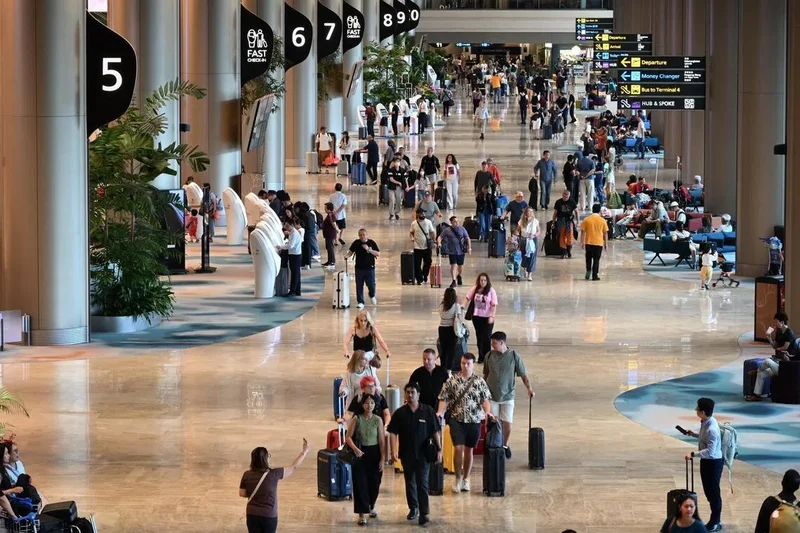
Changi Airport passenger traffic on S-E Asia routes dips 5% in Q2 amid spike in jet fuel price
SINGAPORE – Changi Airport passenger traffic for South-east Asian routes dipped 5 per cent between April and June as airlines trimmed regional flights to cope with a spike in jet fuel prices and supply constraints linked to the Middle East war.
However, Singapore’s air hub remained resilient despite the disruptions in global energy supply chains brought on by the conflict, with about 17.2 million passengers passing through Changi in the second quarter of the year.
That translated into a 1.5 per cent dip in numbers, compared with the same period last year.
Overall passenger traffic for the first half of 2026 grew 0.4 per cent year-on-year, according to the latest Changi Airport Group (CAG) numbers on July 24.
Aircraft movements, including landings and departures, fell by 1.3 per cent year-on-year to 92,400.
For the first half of the year, the total number of aircraft movements stood at 188,000, which CAG said was similar to the same period in 2025.
There was an 8.7 per cent increase in traffic between Changi Airport and Europe. Traffic on South-west Pacific routes – like Australia and New Zealand – also grew, but by a more modest 3 per cent.
CAG said the gains were the result of some airlines adding capacity on these routes to optimise operations.
Changi’s top five markets for the quarter were China, Indonesia, Australia, Malaysia and India.
Vietnam and China stood out for maintaining “strong growth momentum”, having recorded year-on-year increases of 18.5 per cent and 8.3 per cent respectively. Japan also recorded year-on-year growth of 7 per cent.
The top five busiest routes were Kuala Lumpur, Jakarta, Bangkok, Denpasar, and Tokyo.
Lim Ching Kiat, CAG executive vice-president for air hub and cargo development, said the group is encouraged by the sustained demand for travel, especially to and from Europe and North-east Asia, even as airlines are adapting to evolving operating conditions.
Fuel prices across the world spiked since the outbreak of the Iran war on Feb 28, which led to disruptions to shipping through the Strait of Hormuz, where a fifth of the global oil and gas supplies flows.
Some airlines pared back flights in response to higher costs. Middle Eastern carriers also cancelled flights between Asia and Europe because of instability in the region.
Said Lim: “With jet fuel prices having eased from their March peaks, we are in active discussions with our airline partners to restore some of the services that were suspended earlier.”
Beyond the restoration of routes, new passenger services took off at the airport.
In April, China Eastern began flying to Dalian, while budget carrier Scoot started flying to the Indonesian destinations of Belitung in May, and Pontianak in June.
Two new airlines also started operating from Changi Airport. On June 10, Shanghai Airlines began operating daily flights between Singapore and Shanghai.
On July 2, Oman Air started four weekly flights between Singapore and Muscat.
Changi Airport handled 567,000 tonnes of air freight in the second quarter of the year, 9.8 per cent more than the same period in 2025.
The top five cargo markets were China, the United States, Australia, Hong Kong and India, with the strong performance driven by robust artificial intelligence or AI-related semiconductor and electronics shipments.