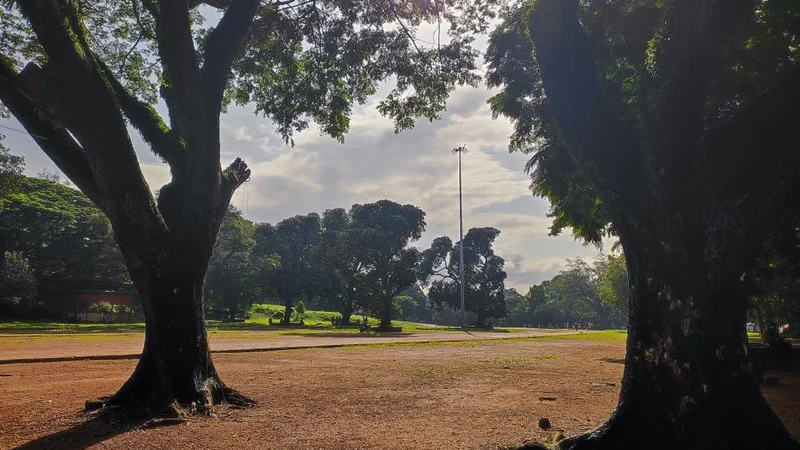
The Kerala High Court’s recent order prohibiting political meetings at Thekkinkadu Maidan in Thrissur has transformed one of Kerala’s most celebrated public spaces into the centre of an intense debate over democracy, secularism and citizens’ right to assemble. The Cochin Devaswom Board (CDB) has called for an all-party meeting to discuss the future course of action on Saturday (July 25, 2026).
In an unusual convergence cutting across political and ideological lines, leaders from the Left and the Congress, writers and cultural personalities are calling for a united legal and political response, arguing that the verdict threatens the democratic character of the iconic maidan that has, for generations, served as Kerala’s foremost venue for political, social and cultural discourse.
The High Court recently ruled that political gatherings cannot be held at Thekkinkadu Maidan and that the CDB cannot permit State government departments to organise programmes there.
Not a mere temple ground
Encircling the historic Sree Vadakkunnathan Temple, Thekkinkadu Maidan is widely regarded as the heart of Thrissur. Besides hosting Thrissur Pooram and major cultural events, it functions every day as a vibrant public square.
Every evening, hundreds gather there to walk, exercise, play chess and cards, read, converse or simply spend time under its sprawling canopy. The spaces such as the Students’ Corner, Labour Corner and Nehru Mandapam have long nurtured political debates, public speeches, and ideological exchanges.
The maidan has witnessed speeches by Mahatma Gandhi, Jawaharlal Nehru, C. Achutha Menon, E.M.S. Namboodiripad, Indira Gandhi, Atal Bihari Vajpayee, Narendra Modi and numerous other national and State leaders. It has also served as a stage for trade union struggles, student movements and social reform campaigns that shaped Kerala’s political consciousness, said eminent writer and social activist K. Aravindakshan.
“Thekkinkadu Maidan has been a cradle of Kerala’s labour movement and democratic struggles,” he pointed out.
‘Assault on democratic spaces’
Calling the judgment deeply worrying, Mr. Aravindakshan said the issue extended far beyond the conduct of political meetings.
“Thekkinkadu Maidan is a public space for socio-political and cultural discussions. The move to ban political meetings amounts to an encroachment upon public spaces meant for debate and discussion. It aids a fascist attempt to shrink spaces for democratic dissent,” he said.
He argued that democracy thrives on open public engagement rather than exclusion. Mr. Aravindakshan has written a letter to the Chief Justice of Kerala citing the need for revoking the order.
‘A place of solace’
Eminent poet K.G. Sankara Pillai described the maidan as an inseparable part of Thrissur’s collective identity.
“Thekkinkadu Maidan is a place of solace for the people of Thrissur. At any hour of the day, one finds people walking, reading, sleeping, playing, sitting alone or in groups. Often they gather to listen to speeches from one of its many platforms,” he said.
Prof. Sankara Pillai expressed concern over what he described as a gradual shift in the identity of the space.
“This beautiful public space has now become the centre of a controversy. Calling it as the Vadakkunnathan Temple Ground subtly transforms everyone’s public space into one identified primarily with a single religion. It weakens the emotional bond that thousands of people from different communities have shared with this secular public space.”
He warned that the restriction reflected a troubling hierarchy between religion and politics.
“The suggestion that religion is sacred while politics is impure is deeply problematic. What is far more dangerous today is not democratic politics but communal politics driven by hatred. Attempts to convert shared public spaces into exclusive religious spaces must be resisted legally, politically and culturally.”
He added that democratic society must preserve plural public spaces where differing ideologies can coexist.
Call for challenging verdict
Communist Party of India (Marxist) [CPI(M)] Thrissur district secretary K.V. Abdul Khader urged the State government to challenge the verdict before the Supreme Court.
“Political and social gatherings have been conducted at Thekkinkadu Maidan for decades without disrupting temple rituals. These events have also generated revenue for the Cochin Devaswom Board. Both the ruling and Opposition parties should unite on this issue,” he said.
Communist Party of India (CPI) leader and MLA K.K. Vatsaraj said the issue had implications far beyond Thrissur.
“Thrissur Pooram and Thekkinkadu Maidan reflect Kerala’s secular spirit. They should not be surrendered to communal forces. The State government should convene an all-party meeting immediately and take steps to retain the maidan as a public space,” he said.
Thrissur District Congress Committee (DCC) president Joseph Tajet also backed a united response.
“Thekkinkadu Maidan is an emotion for the people of Thrissur. It has witnessed many historic struggles and public meetings. It should continue as a public space without affecting the interests of devotees. Thrissur has no other venue capable of accommodating such large public gatherings. Spaces like these are indispensable to democracy,” he said.
What has emerged is an uncommon consensus among political rivals and cultural voices that the debate is no longer confined to a single ground.
As political parties prepare legal options and the CDB seeks a collective response, Thekkinkadu Maidan has become the latest symbol in a larger contest over the future of democratic public spaces in Kerala.
Published - July 24, 2026 05:03 pm IST