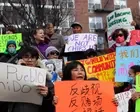
On Main Street in Flushing’s Chinatown, shoppers weave between fruit stands, restaurants and family-run businesses that have served the New York City neighborhood for decades. But behind the bustle, many residents fear the working-class immigrant community is under threat from an $8bn casino development that could displace thousands of renters and force small businesses to close.
“A predatory project is being dumped in our community that disproportionately harms our people,” said Jack Hu, 37, a Flushing resident and member of the No Casino in Flushing Meadows Corona Park campaign. “This community is really upset about this project and how it was pushed through without our consent.”
Metropolitan Park is a casino and entertainment project backed by the New York Mets owner, Steve Cohen, and Hard Rock International through Queens Future LLC. The development would turn parking lots next to Citi Field at Willets Point into a casino, hotel, restaurants, an entertainment district and a public park between the Flushing and Corona neighborhoods.
Chinese immigrant communities have higher rates of problem gambling than the general population, studies have found. This is due to a number of issues, including cultural beliefs around luck and fortune, immigration-related stresses and isolation, barriers to accessing mental healthcare, and casino marketing targeting Chinese-speaking clients.
In Flushing, the community is already burdened by gambling addiction, and a casino on its doorstep could make things worse, especially among its elderly populations, said some residents.
“This is a working-class community and the Metropolitan Park casino is also going to extract wealth from the most vulnerable,” said Hu, who says his father has a gambling addiction, which he developed soon after immigrating to the US. “Casino operators use things like meal coupons, free bus vouchers, free gambling vouchers to lure working-class Asians into casinos so that they can take their money.”
In a statement to the Guardian, a spokesperson for Metropolitan Park said: “We take our responsibility to be a good neighbor and a good partner seriously. Metropolitan Park includes over $1bn in community benefits. This includes a community impact fund and specific funding for responsible gaming, addiction and mental health services.”
The project has also signed memorandums of understanding with local organizations such Elmcor Youth & Adult Activities; Hamilton-Madison House, which provinces clinical mental health services; Korean Community Services; and the Korean American Family Service Center to create “culturally sensitive and community-adapted addiction services”, the spokesperson said.
According to the Urban Institute, a DC-based thinktank focused on economic and social policy research, the Metropolitan Park proposal could displace almost 16,000 renters who spend more than half of their income on housing in Corona and Flushing due to rising rents.
“It will make the whole town worse. Gambling is not a good thing, people get addicted to it,” said Xiang, an employee of a bakery who moved to Queens from China seven years ago. “Tourists might bring money, but the casino could also bring trouble here.”
The Metropolitan Park spokesperson said: “A comprehensive environmental impact study (EIS) was conducted, finding that Metropolitan Park will not directly displace any existing businesses or residents. This study was reviewed and accepted by the city planning commission.”
Many business owners in the community have recently been affected by the Trump administration’s sanctions against China, making imported goods more expensive. If commercial rents were to rise as a result of the casino, many of these businesses could also be displaced, said some residents.
Residents also said they were skeptical that casino visitors would patronize Flushing’s independent businesses, noting that the resort will have its own restaurants and amenities. As evidence, they pointed to the limited spillover from nearby Citi Field and the US Open, which they said have brought few sports fans into the neighborhood.
“If you look around here, you’ll see just locals,” said Hu. “There’s nobody that comes here and drops a load of money at a local restaurant. These events do not pull business into Flushing.”
A new poll, shared exclusively with the Guardian, found that 61% of likely Democratic voters in New York’s sixth congressional district oppose the project, compared with 20% who support it. The remaining 19% were undecided.
The poll was conducted by Public Policy Polling in June. It was commissioned by the Democratic congressional candidate Chuck Park as part of a broader survey conducted during his campaign for the Democratic nomination to challenge Grace Meng, the incumbent representative in New York’s sixth congressional district primary, in June. Park ultimately lost the nomination to Meng, who has represented the district in Congress since 2013.
Separately, Park said he knocked on the doors of 6,000 residents during his campaign, many of whom raised their objections to the casino with him.
“We heard over and over and over again that people did not want the casino. This spanned from really socially conservative first-generation immigrants who thought that the casino would bring crime, human trafficking, and lead to major quality-of-life concerns,” said Park. “We also heard from young progressive leftist activists that this casino is a giveaway of public land to a billionaire who just wants to make himself even richer.”
During the project’s public approval process in March 2025, the casino’s backers told the New York City council that Metropolitan Park had “actively engaged with community leaders” and that community involvement had been central to the proposal. The project won one of New York’s three downstate casino licenses in December 2025.
“With nearly four years of community engagement, over 30 public meetings and approvals from six community boards, the city council, the state legislature, the community advisory committee and the gaming commission, Metropolitan Park has undergone one of the most rigorous and transparent public reviews of any project. The community has been heard, and their message is clear: they want Metropolitan Park,” said a spokesperson for the project.
“Metropolitan Park will be an economic gamechanger for the local community, bringing over 23,000 new jobs, a dedicated Queens vendor food hall and over $100m in anticipated local spending annually.”
The casino developers highlight they have adopted a “community-first” approach on the Metropolitan Park project’s website, and claim the project will provide jobs, green space and entertainment for residents.
“Casinos are the worst form of aggressive tax,” said Park. “They lure in low-income members of local communities. They get them addicted to gambling, and then they just milk money.”
The casino project received a major boost from the state senator John Liu, who introduced Senate Bill S7121A, known as the “parkland alienation” bill, last year, which allows a local government to sell or repurpose public parkland for non-park uses. Without the legislation being signed into law, Cohen’s project may never have been realized, critics say. Liu was able to introduce the bill because a small area of the proposed project falls in the 16th senate district he represents.
In exchange for the parkland alienation bill, Cohen pledged to build a bridge, similar to Manhattan’s High Line, connecting downtown Flushing to Willets Point, which Liu has called “Flushing Skypark”.
“Given the inevitability of three casinos in NYC resulting from the 2012 state referendum, all within a stone’s throw of Senator Liu’s district, he appropriately turned his focus toward mitigating potential harms and maximizing public benefits to his constituents,” said Liu’s spokesperson. “Senator Liu appreciates the passion with which some advocates oppose the casino, but he has received far greater demand to allow the bid to be submitted for consideration by the gaming commission.”
Public campaign finance records show that Liu received a $5,000 donation from the New York Hotel and Motel Trades Council committee on political education political action group in 2025. The Pac receives the majority of its funding from the Hotel and Gaming Trades Council (HTC) labor union.
“Senator Liu has been proud to receive substantial support for over two decades from a union that has been particularly successful in fighting for record-breaking wage and benefit increases for its members, mostly immigrant women of color,” said his spokesperson.
Liu’s move was met with backlash, including protests from the community. In 2024, one year earlier, Liu penned an op-ed in Daily News, stating the three New York casino projects would exact “disproportionate harm” on “this historically marginalized and increasingly vulnerable community”.
“It’s clear they have Asian-Americans squarely in their sights,” Liu said of the casino developers in the article.
The spokesperson for Liu said: “Senator Liu has been clear about his opposition to casinos and gambling in general anywhere, but if they are in fact going to be sited downstate (a decision made by voter referendum in 2012), the maximum amount of public benefit must be provided. That is what Senator Liu negotiated, under the assumption that casinos will be sited downstate – whether at the Mets site or the others, which are all in close proximity to the Asian community.”
Having watched his father struggle with gambling for more than three decades, Hu fears that a casino in his neighborhood will deepen his father’s addiction.
“He wants to retain a little bit of hope to become wealthy,” said Hu, whose parents moved to Flushing from Guangzhou in the 1980s. “It’s like you’ve grown up your entire life with nothing. You come here seeking to build a better life for yourself and for your family, and it’s these types of people that fall victim to these predatory businesses that tell you that you can get wealthy quickly.”