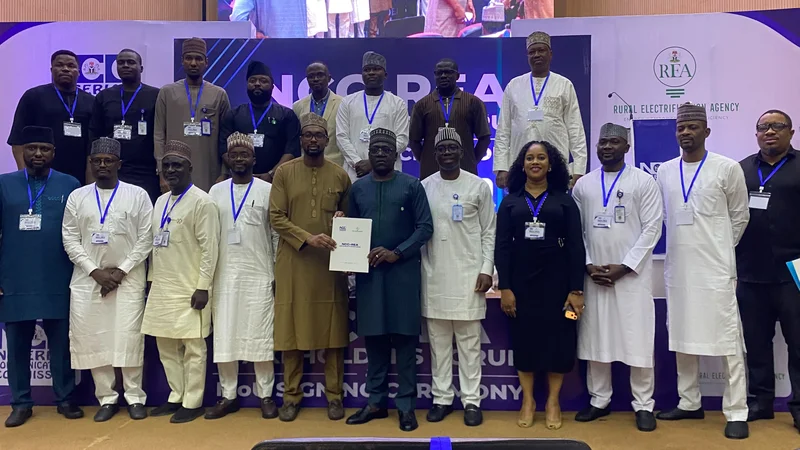
The Nigerian Communications Commission, NCC, and the Rural Electrification Agency, REA, have entered into a Memorandum of Understanding (MoU) to enhance collaboration between Nigeria’s telecommunications and energy sectors.
The MoU was signed during a high-level stakeholder workshop titled ‘Unlocking the Energy–Telecoms Nexus for Scalable Digital Infrastructure in Nigeria,’ which took place in Abuja on Friday.
This event convened senior government officials, telecommunications operators, tower companies, renewable energy developers, financiers, development partners, and investors to discuss practical strategies for expanding digital infrastructure through renewable energy solutions.
In his opening Speach, the Executive Vice Chairman of the NCC, Dr Aminu Maida, noted that when a community is provided with fast and reliable connectivity, it brings about development, inclusion, and opportunities.
“Reliable electricity and digital connectivity are not two separate development goals. They both share mutually complimentary objectives that produce an inclusive and productive economy,” he said
“A community without power struggles to sustain connectivity infrastructure, and a community without connectivity struggles to fully benefit from the power it receives. Over recent months, the Commission and the REA have worked together to develop a collaborative framework for integrating Nigeria’s digital and energy infrastructure development.
“In concrete terms, this means that REA will be sharing geospatial data on electrified, newly electrified and planned electrification projects (mini-grids, solar home system clusters e.t.c) with the Commission.
“And on the other hand, the Commission will be sharing its own data on existing and planned Universal Service Provision Fund deployments, so that both institutions are working from a single, integrated map of connectivity and energy gaps rather than two disconnected ones…”
Following the MoU signing, Engineer Abraham Oshadami, the Executive Commissioner for Technical Services at the Nigerian Communications Commission, addressed journalists, emphasizing the significance of the MoU and its potential benefits for Nigeria, particularly in rural areas.
“This is highly advantageous, and I would like to summarize it in a manner that everyone can understand. We recognize the critical role of electricity and the importance of mobile phone communication. Therefore, our collaboration today aims to ensure that we can fully benefit from both services,” he stated.
“To put it simply, for your phone to function, the base stations must be operational. They require electricity. You need electricity to charge your phone. Additionally, electricity is necessary to power the base stations for them to operate effectively.
“At home, if you wish to recharge your electric meter, you need a mobile phone to do so, correct? This illustrates how essential both services are for the development of our nation and the digital economy, which is now the foundation of every economy. Thus, it is evident how vital this collaboration is.
“The MOU will enable both thel REA and the NCC to fully leverage the resources available from both parties, particularly in areas with mini grids. This MOU allows us to pinpoint base stations that are in proximity to these mini grids, facilitating the supply of electricity from the nearest sources.
“In this manner, the rural regions, where electricity access poses a significant challenge, will benefit from the deployment of mini grids, both those currently operational and those planned for the future, thereby ensuring seamless connectivity.
“The base stations will remain operational as we can draw electricity even in the absence of national grid power supply to these areas; the mini grids will sustain connectivity in these locations and assist rural communities that typically struggle to access electricity for their daily activities.
Additionally, Engr. Umar Umar, the Executive Director of Technical Services at the REA, remarked that the MOU creates a formal framework for collaboration between the two agencies, concluding years of independent operations despite their aligned objectives.
He elaborated that the partnership will depend on data sharing, mapping of telecommunications and power infrastructure, and the formation of an NCC-REA Collaboration Committee to determine priority areas for deployment.
“The MOU holds great significance because, prior to this moment, both agencies, the NCC and REA, have been functioning in isolation. They have made substantial progress in the telecommunications sector and have also achieved considerable advancements in the power sector. However, with the signing of this MOU, we have united under a common agenda, ensuring that our efforts will complement one another through our various projects and initiatives.
“We have set targets. By signing this MOU, we are establishing the institutional framework for our collaboration, which will heavily rely on mapping and data, as the leadership of both the REA and NCC places great importance on specifics and data-driven decision-making.
“So we are already looking at the different maps, both showing coverage in telecoms and showing coverage in power, so that we overlap them against each other, and we see sites that are viable. And we also established a committee that’s the NCC-REA collaboration committee, which kind of having this forum is making a bigger committee, so that other stakeholders will come in and critique and evaluate work that that committee is doing.
“And at the end of this committee work, we are going to give you precise solutions and pilots on how we are going to move forward.”