The World Cup has always been a cultural event that extends far beyond the pitch. But the 2026 tournament made the connection between sport and sound more explicit, and more measurable, than any before it. Between TikTok fan edits, Instagram content from team and player accounts, FIFA's own programming, and a first-ever halftime performance, this year's tournament didn't just crown a champion. It rewired how millions of fans experience music in real time.
The numbers back it up. According to Spotify, soccer and football related playlists generated more than 172 million global streams during the 2026 tournament window (June 12 to July 14), averaging 5.2 million streams per day. That's nearly four times the volume of the 2022 tournament, which totaled 46 million streams over its run, a 275% increase. For context, that kind of growth curve is the sort labels typically chase for a major album rollout, not a month of sporting events.
What changed between 2022 and 2026 is worth unpacking, because it says as much about the state of music marketing as it does about football. Short-form video has matured into the primary discovery engine for sports fandom, and TikTok fan edits, in particular, have become the connective tissue between a goal, a chant, and a chart position. A viral 15-second clip of a stadium singing along to a track can now translate into a measurable streaming spike within hours. FIFA's own content strategy, along with a wave of player, team, and brand accounts posting in near real time, meant that music was no longer a backdrop to the tournament. It was part of the storytelling, packaged and distributed at the same speed as the match highlights themselves.
The Unofficial Anthem Effect
Unofficial anthems, the songs fans adopt organically rather than the ones officially licensed by tournament sponsors, were central to this year's listening patterns. That distinction matters for marketers. These aren't tracks that were pushed through a sponsorship deal. They're songs that earned their moment because fans chose them, which makes the resulting streaming data a more honest signal of cultural resonance than a curated campaign ever could be.
England's adoption of Oasis's "Wonderwall" is the clearest example. The track hit number one on Spotify's Global Chart on July 16, a remarkable feat for a song released in 1995. Its rise wasn't a single event but a series of compounding spikes tied directly to match outcomes, most notably a 306% surge versus average in the United Kingdom following England's win over Mexico on July 6. The Beatles' "Hey Jude" followed a similar pattern, climbing 282% versus average in the U.K. after England's victory over Norway on July 12. Two catalog tracks, both decades old, outperforming most new releases during the same window, is a reminder that nostalgia and communal identity can move numbers just as effectively as a new single with full marketing support behind it.
Norway's fandom took a different shape. Erling Haaland and Kygo's "Kygo Jo (feat Lyng) - Kygo Remix" went number one on Spotify's Daily Top Songs Norway chart on July 9, with "Vikingblod (Norway Row Chant)" by Oljeberget and Katastrofe close behind at number two. The pairing illustrates two distinct anthem categories working in tandem: a polished, artist-driven remix tied to a marquee player, and a raw, crowd-originated chant. Both charted. Both mattered to fans. For marketers, it's a useful signal that authenticity and production value aren't competing forces in this context. They can coexist on the same chart.
In the United States, John Denver's "Take Me Home, Country Roads" surged 100% versus average following the team's win over Bosnia and Herzegovina on July 1, extending a tradition that has followed American sports fandom across multiple codes for years. And Paraguay delivered the single largest team anthem lift of the tournament: "Soy Albirrojo" by Los Albirrojos rose 1,170% globally compared to its pre-tournament baseline. Norway's "Alt For Norge" by Drillos and Jørn Lande wasn't far behind at 1,005% globally, followed by Mexico's "Cielito Lindo" by Mariachi Vargas de Tecalitlán at 540% and Argentina's "Pa' la Selección" by La T y La M at 270%.
What ties these together is scale of identity. National anthems in the literal sense are formal and fixed. These songs are something else: chosen, informal, and renewed by each generation of fans. The streaming data essentially maps which songs a country's fans have collectively decided represent them in this specific tournament cycle, and that map shifts from year to year based on which artists lean into the moment and which tracks catch on through fan-made content rather than official promotion.
Egypt’s Victory Lap: A Case Study
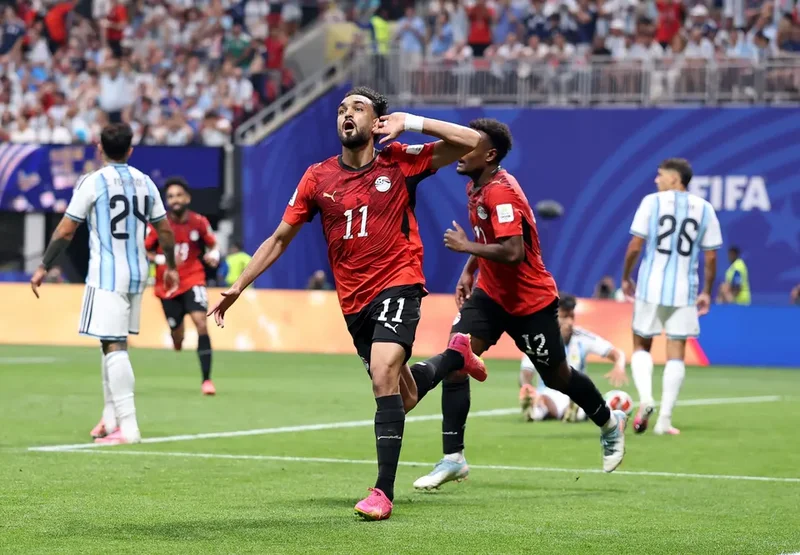
No single national response captured the emotional intensity of tournament fandom quite like Egypt's. Following the country's win against New Zealand, streaming data compiled by Spotify and CairoScene showed a wave of patriotic listening that outpaced nearly every other market. Hamada Helal's "Amalouha El Regala" surged 4,300%. Mohamed Hamaki's "Om El Donia" rose 1,500%. Loay's "Baladna" climbed 775%. Hussein Al Jasmi's "Boshret Kheir," a song with a long history as an unofficial national celebration anthem, increased 230%, and Sherine's "Mashrebtesh Min Nilha" rose 210%.
Those figures aren't just impressive on their own. They demonstrate how quickly a national catalog can be reactivated by a single result. None of these tracks required new marketing spend or a coordinated campaign to spike. They required a win and a population primed to celebrate through music that already carried emotional weight. For an industry that spends enormous resources trying to manufacture moments like this, Egypt's numbers are a reminder that the most effective campaigns are sometimes the ones that already exist in a culture's memory, waiting for the right trigger.
The Halftime Show Solidifies Music’s Growing Influence In The World Cup
This year's tournament also marked the first time a halftime performance was integrated into the World Cup, a format borrowed directly from the Super Bowl playbook. The significance goes beyond novelty. It signals that FIFA now views music not as an accessory to the tournament's broadcast but as a driver of its own viewership and engagement numbers. A halftime slot instantly becomes one of the most-watched performances of the year, and for an artist, it functions the same way a Super Bowl slot does: a guaranteed audience of hundreds of millions, converted into streams, searches, and social content within minutes of the final note.
Pairing that performance with FIFA's own content, along with the surrounding ecosystem of player accounts, brand partners, and fan edits, effectively turns the tournament into a month-long, multi-platform rollout. Every match becomes a potential trigger for a streaming spike. Every celebration becomes shareable content. Every anthem becomes a data point that labels and marketers can study for the next cycle.
What It Means Going Forward
For the music industry, the 2026 World Cup offered a clear case study in how sports and streaming intersect at scale. The tournament didn't rely on manufactured hits or heavy-handed sponsorship placements to move the needle. Instead, the biggest gains came from songs fans already loved, activated by real moments, and amplified by short-form video and team, player, and brand content moving at the same speed as the news cycle.
The 275% increase in soccer-related streaming compared to 2022 suggests this is a growth trend, not a one-off. As short-form platforms continue to shape how fans engage with live events, and as more properties experiment with in-broadcast music integration the way FIFA did with its first halftime show, the line between sports marketing and music marketing will likely keep blurring. For an industry built on finding the next cultural moment, the World Cup just proved that some of the biggest moments are the ones fans create themselves.