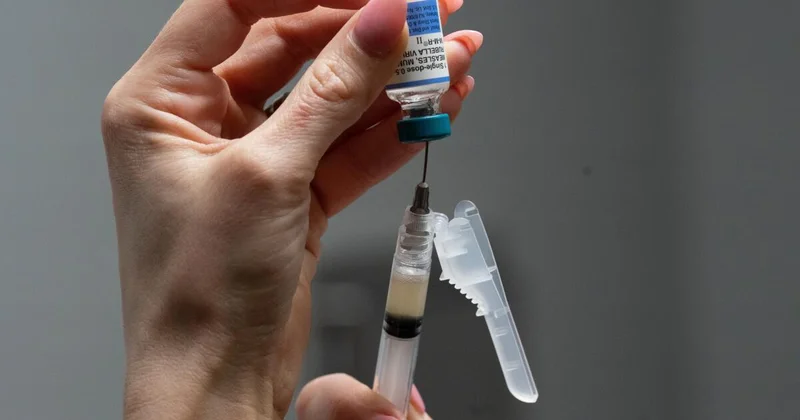
Measles cases hit U.S. record not seen since 1991
- Click here to listen to this article
Measles cases have hit a record in the United States not seen since 1991, nearly a decade before the viral disease was declared eliminated.
The grim milestone comes amid a generational setback in controlling the highly contagious disease, which prior to the vaccine era caused millions of infections a year, and annually left 400 to 500 people dead, 1,000 with swelling of the brain, and 48,000 hospitalizations.
Last year, the U.S. recorded three measles deaths — the first deaths since 2015, and the first among children since 2003. The deaths last year were two unvaccinated school-age children in Texas and an unvaccinated adult in New Mexico.
So far this year, there have been 2,318 measles cases reported nationwide, according to the U.S. Centers for Disease Control and Prevention. That’s higher than in any other calendar year since a significant nationwide measles epidemic between 1989 and 1991 led to 55,365 cases over the three years — 17,914 in 1989; 27,808 in 1990; and 9,643 in 1991.
“Halfway into 2026 the U.S. is experiencing the worst year for measles since 1991. We are witnessing an avoidable crisis that disproportionally hurts children,” Dr. Andrew Racine, president of the American Academy of Pediatrics, said in a statement Friday. “These thousands of cases represent real people in communities across the country, including babies hospitalized with pneumonia.
“After keeping measles under control for decades, the country has now experienced continuous outbreaks since January 2025. We should not accept this as our new normal. Unless we reverse this trend, America’s children will continue to pay the price,” Racine said.
Health experts expect that the U.S. will lose its status of having “eliminated” measles from the nation, a status that was achieved in 2000, which refers to the absence of ongoing disease spread for more than a year. Canada lost its status last year, and, according to the World Health Organization, Mexico is among the top 10 countries worldwide with measles outbreaks.
Nationally, measles vaccination rates have been declining, dropping below the 95% threshold experts say is needed to prevent widespread outbreaks. During the 2024-25 school year, just 92.5% of kindergartners had received the measles vaccine, down from 95.2% during the 2019-20 school year, according to the CDC. More than half of states saw declines in measles vaccinations compared with the year before, the CDC said.
California’s measles vaccination rates among kindergartners remain higher than the 95% threshold. In the 2024-25 year, 96.1% of California’s kindergartners were vaccinated against measles. But there are some counties in which vaccination rates are below the goal; in Southern California, they include San Diego and San Bernardino counties, which have measles vaccination rates of 93.7% among kindergartners, and Kern County, with a rate of 89.3%.
Other counties with rates below 95% are Calaveras, Del Norte, El Dorado, Glenn, Humboldt, Nevada, Santa Cruz, Shasta, Sierra, Sutter and Tuolumne.
Of the measles cases reported nationally this year, 93% have occurred among people who were unvaccinated or had an unknown vaccination status, the CDC said. Of those infected, 49% were age 5 to 19 and 20% were under age 5. More than 150 measles patients this year have had to be hospitalized.
Several outbreaks have spread measles in California this year: one in Riverside County, involving three people infected in a single family; one in Shasta County, infecting nine people among a church group; and an outbreak in Sacramento County and neighboring Placer County.
The surge in measles comes as the nation’s top health agency, the Department of Health and Human Services, is led by a vaccine skeptic, Robert F. Kennedy Jr.
Earlier this year, Kennedy defended his record, telling a congressional committee that “there’s a global measles epidemic. We’ve done better in preventing it than any country in the world.” His critics have charged that Kennedy’s messaging has fueled public skepticism of vaccines.
“The anti-vaccine rhetoric you ran on and the anti-vaccine actions you have taken over the last year clearly correlates with the dramatic increases, again, in preventable diseases,” Rep. Linda T. Sanchez (D-Whittier) told Kennedy at a House committee hearing.
Kennedy has said he is not anti-vaccine.
The American Academy of Pediatrics has accused federal leaders of downplaying the risk of measles and offering misinformation about the vaccine that protects against measles, mumps and rubella.
“Since early last year, federal leaders have dismissed measles as benign and unavoidable and have spread misleading information about the MMR vaccine,” Racine said. “Today, I want to remind parents that measles is not just a rash. The virus can interrupt the immune system’s memory, leaving a previously healthy child significantly more likely to get sick from any type of infection.
“Skipping or delaying the MMR vaccine is risky because pediatricians can’t predict which children will have serious symptoms from measles or who might end up in the hospital,” Racine said.