It’s now five months since President Trump launched his war on Iran in cahoots with Israel.
He has precious little to show for it – bar growing frustration at the Tehran regime’s resilience; the despair of America’s allies in the Gulf region and elsewhere; a teetering global economy; rising petrol prices at US forecourts; and personal approval ratings plummeting faster than US munitions are being depleted.
When US and Israeli air strikes began their bombardment of Iran at the end of February, Trump claimed it would all be over in a matter of weeks. The Iranian regime would be humbled, perhaps even deposed. Its missile and drone arsenals would be destroyed, its ability to develop nuclear weapons crippled for a generation, perhaps for ever.
Monday will mark 150 days since February 27, when Donald Trump gave the order to proceed with Operation Epic Fury. Since then, none of those ambitions has materialised. The regime is certainly battered and bruised. But it is still standing – more hardline than ever.
Iran’s military resources have been degraded. But it is still capable of raining down missiles and drones on American military bases and US allies in the region.
Tehran’s ability to develop nuclear weapons has suffered serious setbacks. But it still has the capability to start all over again should it be so minded.
No progress has been made, on the battlefield or in ceasefire talks, to ensure Iran renounces its nuclear ambitions, supposedly the fundamental reason for starting the war in the first place.
Now Iran has something perhaps even more precious than the Bomb, something it did not possess before war broke out: a stranglehold on the Strait of Hormuz, the global economy’s most crucial chokepoint, through which so much oil, gas, fertiliser and other essential commodities used to flow before hostilities broke out. Tehran’s refusal to give up control of this vital waterway is the main reason all peace efforts to date have floundered.
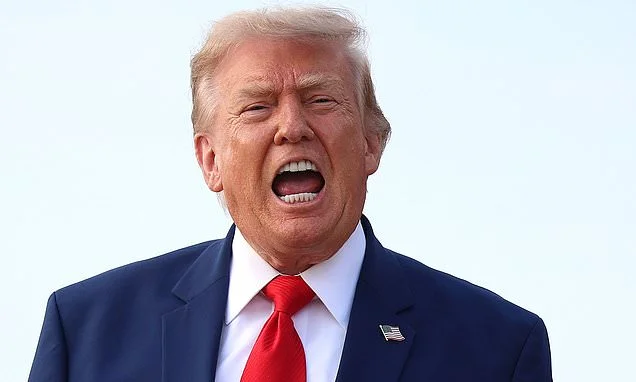
Donald Trump is said to be 'in decline' both physically and mentally, and he is reportedly so frustrated with the war in Iran that he has entered 'revenge mode'
The war isn’t just consuming Trump’s presidency. It’s taking its toll on the President himself. During a recent meeting in the Oval Office, he ranted against Iran’s leaders, calling them ‘scumbags’ and ‘lunatics’ in an expletive-ridden diatribe. There is growing concern for his physical health and mental stability.
‘Donald is deteriorating before our very eyes,’ I was told in Washington this week by a close confidant who sees him regularly. ‘His physical and mental health is in decline. Those around him don’t know what to do about it. It can only get worse. He’s 80 – and it’s showing.’
But it’s not just age – or the decline in cognitive capabilities that can afflict those entering their ninth decade. Trump is lashing out at all and sundry in frustration at the lack of any good options now facing him.
The hardliners in Tehran are now so cocky they even rebuffed a secret US attempt to get the peace process back on track this week.
So the White House is dialling up the rhetoric – Trump is said to be in ‘revenge mode’ – and the President himself sounds ever more bellicose, saying on Thursday that he was ‘close’ to deciding on a ‘massive attack’.
Even senior aides in the White House don’t know what this would mean. The number of influential voices in Washington who think even ramped-up air strikes –as I write, we’ve just had the 14th consecutive night of renewed US attacks on Iran – will cow Iran into submission are now passing few. In truth, nobody around Trump really knows what to do next – or what he will do.
This week two new intelligence reports landed on their desks to add to their despair – which was further increased by their fear that the President has given them scant attention. Their contents were certainly unlikely to improve his mood.
The first, based on analysis from various US intelligence agencies and drawn together by the CIA, concluded that the Iranian regime would not be cajoled into rejoining peace talks by ramping up US air strikes. The US, it said, had underestimated Iran’s ‘staying power’ – that hitting Iran harder was unlikely to make it more ‘compliant’.
The risk now was ‘indefinite limbo’ between peace and war. In other words a stalemate, yet another low-level ‘forever war’ which Trump was elected to avoid.
Or more bluntly, in the terminology used during the Vietnam War almost 50 years ago, a quagmire.
The second intelligence report, involving US and Israeli intelligence, was even more depressing. Drawing on extensive satellite imagery, it revealed that Iran was rebuilding its devastated missile and drone bases far more quickly than either the US or Israel had anticipated.
Missile arsenals were being reconstituted inside mountains. Bridges, ports and military production facilities were being repaired with speed. Even the northern supply lines through which Russia channelled aid to Iran – and which Israel thought it had disrupted – had been ‘restored’. Iran, Israeli intelligence reported, had shown an ‘impressive ability to reconstitute its military capabilities.’
Iran rebuilt its missile bases more quickly than the US or Israel had anticipated. (Pictured: A missile being launched towards US targets in Jordan, Kuwait and Bahrain)
Although there has been talk from Washington about seizing Iranian territory, no conceivable US deployment could suppress Iran for long, says Andrew Neil
The sound of war drums is once again emanating from the White House. The media is being briefed on the renewed ‘surge’ of US forces to the Gulf. There are already 17 US warships in the region, including two aircraft carrier strike groups and a marine corps expeditionary group.
They are being joined by more fighter jets and special forces. Bombers stationed at US bases in America and Britain are back on high alert. Even 150 medics have been rushed to a base in Germany which deals with Middle East casualties. All told, including US bases in the region, deployments for the launch of the war back in February plus the latest top-ups, America now has more than 50,000 troops in the region.
But for what purpose? This week in America I listened to several influential figures close to Trump mull over the options. The assumption was that some sort of ground incursion was inevitable. That is certainly the new vibe coming out of Washington.
They talked of seizing Iranian territory on the northern shores of the Gulf to wrest control of the Strait of Hormuz from Tehran. They raised the prospect, again, of invading Kharg Island, from which Iran dispatches most of its oil exports.
There was, thankfully, no talk of a full-scale attack along the lines of the invasion of Iraq in 2003. Iran is four times bigger than Iraq, with a much larger population, a disciplined, well-armed 190,000- strong guard bolstering the regime and terrain tailor- made for guerrilla war. No conceivable US deployment could suppress Iran for long.
But there was, much more worryingly, talk of using tactical nuclear weapons to ‘send a message’ to Tehran and ‘concentrate its mind’ on peace. This took me aback.
‘Do that,’ I snapped ‘and you destroy America’s reputation and standing for the rest of the century. You’ve also paved the way for President Putin to do the same in Ukraine.’
This war with Iran is already the most unpopular war since US polling began, observes Andrew Neil, and it does not benefit from a scintilla of bipartisan support
I was met with silence. There is much desperate talk in Trump circles these days. As it happens, I do not believe Trump will resort to nuclear weapons. I’m not even sure he will embark on a major ‘boots on the ground’ escalation, even if that is the growing consensus in Washington. US forces could certainly take Kharg Island. But then what? They’d be sitting ducks for Iranian missile and drone attacks.
Occupying the north side of the Strait of Hormuz would be a far bigger task, requiring more troops than America is currently assembling in the region. The topography lends itself to Iranian guerrilla attacks. Ships transiting the Strait would still be vulnerable to missile and drone attacks launched from further inland.
US forces might then be enticed to go after these sites. That’s how you get suckered into a morass. It’s striking that current US reinforcements to the region do not include a big increase in troop numbers, which a major land attack would require. That’s one reason I remain sceptical of a major ground incursion. The other is US domestic politics.
It took six years for the Vietnam war to become as unpopular as Trump’s war on Iran has become in under six months. Vietnam hit a net approval rating of minus 30 per cent after six years and a mounting death toll with no end in sight. Trump’s war already has the same negative approval rating – and that’s without a monstrous bodybag count.
So far only 18 US military personnel have lost their lives in the current war. Each one, of course, a personal and family tragedy. Even so, it is already the most unpopular war since US polling began. It benefits from not a scintilla of bipartisan support. It has a net approval rating of minus 84 per cent among registered Democratic voters and minus 52 per cent among independents.
Surprisingly, it still enjoys a 72 per cent approval rating among Maga Republicans, despite their contempt for ‘forever wars’. But over half are only ‘somewhat’ supportive rather than ‘strongly’. I would expect that tepid support to evaporate if pictures of bodybags started to dominate broadcast news.
The war has already taken its toll on Trump’s popularity. Almost two-thirds of voters disapprove of his handling of the war, with only a third approving. More than
Trump’s war on Iran is at risk of defining his presidency, like the Vietnam war defined President Lyndon Johnson’s, our columnist warns. (Pictured: Johnson with President Nguyen Van Thieu)
60 per cent don’t expect any truce he makes with Iran to hold. Almost 80 per cent want him to end the war now. Trump’s overall job approval rating is now under 40 per cent and falling. Iran has proved to be a major drag on his standing. His approval rating on perhaps the most important political metric of all – his handling of the economy – is under water at below 30 per cent.
Much of that reflects the fact petrol prices at the pump are now over $4 a gallon again, which especially hurts Americans now that the summer driving season is underway. Petrol prices dropped when the ceasefire was agreed and it looked like the Strait of Hormuz was open again for business. Now they could be heading for $5 or more – a prospect that terrifies Republican Party managers in the run up to early November’s mid-term congressional elections, when Trump’s control of the House and Senate is at stake.
The resumption of hostilities has effectively closed the Strait of Hormuz. Shipping there has all but halted since July 15. So oil prices have started to soar again.
The benchmark price of Brent crude oil hit $100 a barrel on Thursday. It’s likely to go even higher. This week, urged on by their Iranian paymasters, Houthi rebels in the Yemen hit two Saudi tankers loaded with crude and oil products in the Red Sea.
The Saudis have been piping oil to Yanbu, a port on the Red Sea, to bypass the Strait of Hormuz. If this escape route is now in jeopardy then oil prices will spike much further.
In fact, it is not the price of crude that is the real worry. It is the price of the products refined from it – diesel, petrol, jet fuel. All three are already spiking. Jet fuel, for example, at around $150 a barrel in Europe and America, is now almost twice what it was before this misbegotten war began.
The global economy is now on the brink of a major energy squeeze. It has been staved off to date because major economies such as America, China, Japan and South Korea drew on their strategic oil reserves.
Ways round the Strait of Hormuz (like that pipeline to Yanbu) were used. China cut its crude oil imports by almost two-fifths. All these buffers have now been exhausted.
Nor is the problem just Trump’s Iranian adventure. That has reduced the supply of refined products by around 3million barrels per day (b/d) from the Gulf, on which Europe depends for diesel and jet fuel. On top of that Ukrainian drones have taken out another 2million b/d of Russian refining capacity while China has cut back on its export of refined products, perhaps by another 3million b/d to conserve its own supplies.
It amounts to a triple whammy for the global economy, a perfect storm – and a harbinger of severe shortages of vital refined products to come, which is as yet only vaguely understood.
If, as is the talk in Washington, Trump starts to bomb Iranian power plants and civilian infrastructure – and Tehran inevitably retaliates by hitting the pipelines, ports and even desalination plants of the Gulf States (which depend entirely on these plants for water) – then the word ‘morass’ will not do justice to what’s in store for us during the second half of this year.
I end where I started: Trump has no good options. If he tries to slink away from the mess he’s created, all the vainglorious rhetoric he can muster will not hide the fact that he has presided over the greatest humiliation of America in modern times. But if he doubles down and recklessly raises the stakes with a major military escalation, he risks merely making matters worse – for him, for his party, for America, for the Gulf, for the global economy, for us.
Trump’s war on Iran is now at risk of defining his presidency just as the Vietnam war defined Lyndon Johnson’s all those years ago. It is not a legacy any president should wish to emulate. But, through a mixture of stupidity and bravado, Trump looks like doing exactly that. We will all be the poorer for it.