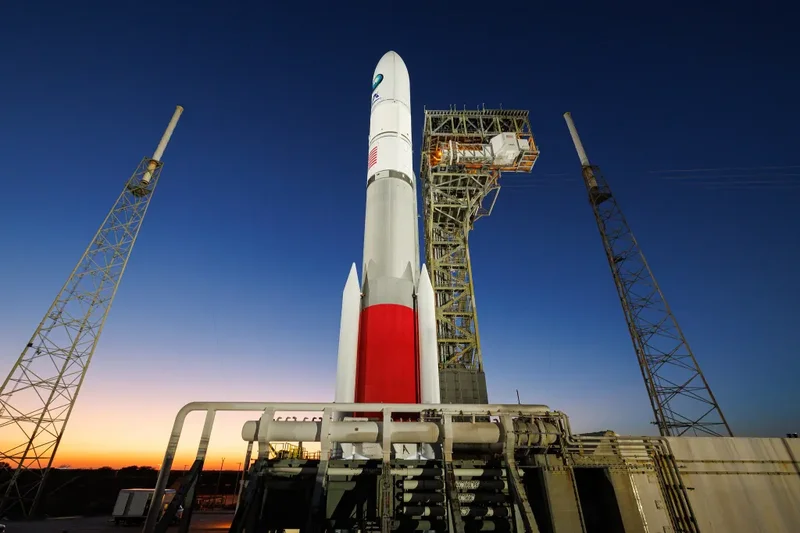
WASHINGTON — United Launch Alliance’s corporate parents have guaranteed a loan to the company as it addresses “financial challenges” caused by the grounding of its Vulcan Centaur rocket.
In a Securities and Exchange Commission filing about its second-quarter financial results July 23, Lockheed Martin revealed that it provided a bank guarantee for a loan taken by ULA during the quarter. Lockheed owns 50% of ULA, while Boeing owns the other half.
“During the first quarter of 2026, ULA’s Vulcan Centaur rocket experienced performance challenges that are negatively affecting ULA’s financial condition and results of operations,” Lockheed stated in the filing. “In the second quarter of 2026, we agreed to guarantee certain ULA borrowings under which maximum potential future payments amount to $500 million.”
“The fair value of the guarantee obligation we recognized in the second quarter of 2026 amounts to $64 million and our investment in ULA has increased by a corresponding amount,” it added.
The “performance challenges” that Lockheed mentioned involved an anomaly with one of the solid rocket boosters on a Vulcan launch in February. The vehicle was still able to successfully complete its mission, delivering a payload for the U.S. Space Force on a mission designated USSF-87, but Vulcan has not launched since then as ULA and Northrop Grumman, the manufacturer of the solid rocket motors, investigate the incident. A similar anomaly took place on the second Vulcan launch in October 2024.
In a statement to SpaceNews, ULA confirmed it took out a loan with the backing of Lockheed Martin but did not disclose details of the financing.
“In Lockheed Martin’s second quarter earnings release, they shared that they have committed to a bank guarantee to assist with ULA’s near-term financial challenges,” ULA stated. “ULA’s financial position has been impacted due to the performance challenges associated with the anomaly with the solid rocket booster nozzle experienced on two of the Vulcan launches.”
Neither Lockheed nor ULA said whether Boeing, the other owner of ULA, also participated in the loan guarantee. Industry sources said they expect Boeing to have contributed based on its ownership stake. Boeing, which will release its second-quarter financial results July 28, did not immediately respond to questions on the topic.
“We and Boeing expect to provide additional financial support to ULA to support its liquidity or ongoing operations and could incur impairment and operating losses if the Vulcan Centaur rocket does not perform consistent with ULA’s assumptions,” Lockheed stated in its SEC filing.
ULA entered this year with expectations to sharply increase the launch rate of Vulcan, which had flown only three times. At a briefing in February, two days before the USSF-87 launch, the company said it expected to perform 18 to 22 launches in 2026, including four Atlas 5 launches and up to 18 Vulcan launches.
Vulcan has not flown since the USSF-87 mission. Atlas 5 has flown three times this year, all carrying Amazon LEO satellites, most recently July 2. The remaining Atlas 5 rockets are reserved for launches of Boeing’s CST-100 Starliner commercial crew spacecraft, which has suffered its own technical challenges that have made its schedule of future launches uncertain.
ULA has not announced when it expects to resume Vulcan Centaur launches. Northrop, in its July 21 earnings call, said it had redesigned components on the motor that have been confirmed in a static-fire test but added that the company may not begin deliveries of the redesigned motors until the end of the year.
Space Force officials said in April the service was considering changes to its manifest of launches using Vulcan to move forward missions that do not require any solid rocket boosters. However, it has not announced any specific plans to do so since then.
Despite ULA’s current challenges, both the company and Lockheed remain optimistic about Vulcan in the long term.
“While this is a challenging time bringing our Vulcan rocket up to its optimal launch rate, ULA is well positioned for the future and continues to be laser focused on our customers’ needs and achieving a reliable and sustainable manifest,” ULA stated, citing a backlog of more than 80 launches.
Mark Kvasnak, vice president of investor relations at Lockheed Martin, said in the company’s July 23 earnings call that the company had reduced the profit forecast for its space division, which had been between $1.385 billion and $1.415 billion, to between $1.34 billion and $1.38 billion “due to reduced ULA equity earnings because of the ongoing technical investigation of the Vulcan launch anomaly experienced earlier this year.”
But, he added, “the second half of 2026 will be stronger than the first half.”