Gen Z anglers form society to document Singapore’s fish
AI generated
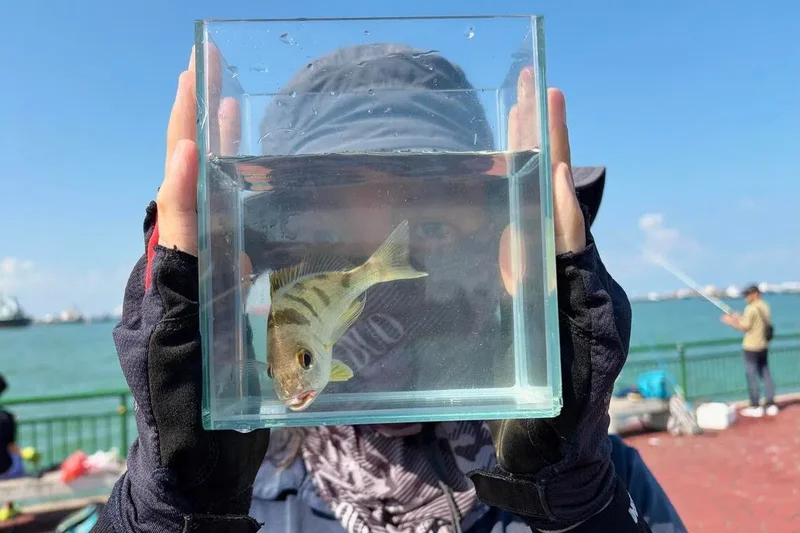
SINGAPORE - When the authorities announced that preparatory works for reclamation off East Coast Park will begin end-2026, four anglers in their 20s formed a fish interest group to document the species at fishing hot spot Bedok Jetty before works start.
Student Lin Jiayuan, 24, and three of his friends founded the Ichthyological Society of Singapore on July 6. (Ichthyology is the scientific study of fish.) The interest group, which has grown to over 80 members, aims to document the biodiversity that remains along the Republic’s rapidly developing coastlines.
They do so by noting down all the species they catch. While most fish are released, a select few are preserved to provide scientific data on their behaviour and habitats, which aids in long-term conservation.
After reading the environmental study for the Long Island reclamation works - which will result in some 800ha of land created along Singapore’s East Coast - the co-founders discovered that the diversity of fish they had encountered at Bedok Jetty over the years did not appear in the study. On public database iNaturalist, the vicinity of the jetty has yielded 200 species.
Collectively, the four co-founders say they have caught and recorded some 500 of Singapore’s estimated 700-plus marine and freshwater fish species in the waters around the mainland and its offshore islands.
“We acknowledge that reclamation may be necessary, but if we’re going to change our coastline, we want the habitats and species that are actually there to be properly recognised,” said Lin, a bioengineering student at Nanyang Technological University.
While he is not a fish scientist, Lin has authored more than 25 biodiversity records published by the National University of Singapore’s Lee Kong Chian Natural History Museum. He has also contributed to local fish-related organisations like Pasarfish and the now-defunct Marine Stewards Singapore.
“We aim to at least document what we had. If they are wiped out locally, we can at least say that they were once there,” he added.
The founders bonded over “species hunting,” a hobby where anglers aim to find the widest variety of fish rather than landing the biggest catch.
Lin and Andriel Cheong, a 24-year-old Singapore Management University (SMU) student, have fished together since secondary school. They eventually connected with students Aidan Raphael Keh, 20, and Brian Sng, 22, through Instagram, where Singapore’s small species-hunting community help one another identify rare catches.
Through their experiences fishing at East Coast Park, as well as consulting scientific literature and local fish researchers, the group realised that beneath the silty waters lay a string of microhabitats, from muddy patches hosting gobies to rocky crevices hiding eels.
Recent environmental assessments often overlook these silty seabeds and fail to use a wider variety of survey methods, such as fish traps and even hook-and-line fishing, that give a more comprehensive picture of an area’s marine biodiversity, they said.
“We are the generation that will be the most impacted by the Long Island plan in the future,” said Cheong, a sociology and political science student.
“Being young is exactly why we should fight for this space, not a reason to sit out of the conversation.”
The society hopes to bridge the gap between academic research and citizen science, and contribute to policymaking.
Going forward, the society plans to bring together marine life enthusiasts, like recreational anglers and divers, to identify and document marine life.
Beyond submitting feedback on the study for the Long Island preparatory works, which is open for public comments until July 28, the society is testing a citizen science mobile app developed by Sng, who studies software engineering at SMU, and his peers.
The SGFish app uses a computer vision model trained by Sng to identify and log fish species found in Singapore’s waters. Currently in beta testing, a bot on messaging app Telegram made with his friends has already gathered about 1,600 observations covering some 400 species.
The society’s logo is the Dussumier’s thryssa, an anchovy with a distinctive moustache, designed by Keh.
Said Lin: “The final design represents both the scientific diversity of Singapore’s waters and the cultural significance of anchovies in local cuisine.
“It is part of the anchovy family that has many undiscovered species, much like Singapore’s waters.”