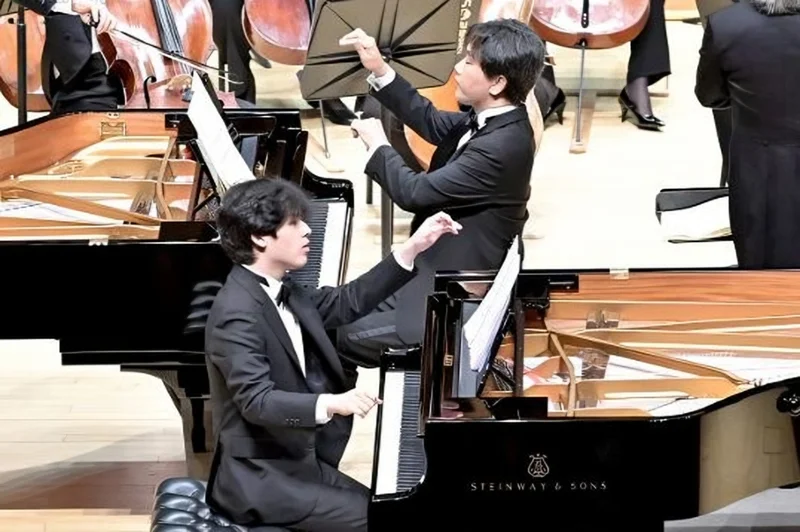
The seating arrangement of the two pianos was the same as at their duo recital a year ago, but this time pianist Yunchan Lim, 22, and his teacher Sohn Min-soo, a professor at the New England Conservatory in Boston, took the stage not simply as teacher and student, but as artistic partners.
At the KBS Symphony Orchestra's special concert marking its 70th anniversary at Lotte Concert Hall in Seoul, July 22, Lim stood at the center of the performance, revealing a more flexible and profound musical maturity, supported by Sohn's steadfast presence.
Led by Japanese conductor Masato Suzuki, the orchestra also departed from its usual stage setup. The second violins were placed on the far right of the stage, while the cellos were moved beside the first violins to create a more spatially defined sound.
The concert opened with the overture to Mozart's "Don Giovanni," an opera with historical significance for the orchestra, which performed it during the National Opera of Korea's first Korean production in 1962. The orchestra's nimble and energetic playing immediately set a celebratory tone.
The highlight of the evening followed with Mozart's Concerto for Two Pianos No. 10 in E-flat major (K. 365), where the two pianists' mature musical rapport dominated the stage. Sitting close together at two lidless pianos facing one another keyboard to keyboard, the pair appeared to share every subtle breath and gesture. As they effortlessly exchanged phrases, the boundary between their individual voices seemed to dissolve, conveying their pursuit of the same musical ideal.
Lim displayed remarkably delicate and refined touch, shaping Mozart's elegant architecture with grace. Floating transparent melodic lines over Sohn's broad and solid sonority, he performed with striking freedom. Throughout the performance, Lim visibly enjoyed sharing the stage with his teacher, swaying rhythmically from side to side almost constantly.
The concerto's second movement, built around an intimate musical dialogue between the two soloists, became the emotional centerpiece of the performance. Suzuki, who also collaborated with Lim during Camerata Salzburg's recent tour of Korea, provided meticulous support that allowed the pianists' duet to unfold naturally.
The encore left an equally lasting impression. As stagehands placed two chairs in front of the piano where Lim had been seated, audible excitement spread through the audience. Sitting side by side at a single keyboard, the two performed a four-hand arrangement of Bach's Cantata No. 106, "God's Time Is the Best Time." Even the angles of their upper bodies mirrored one another as they shared the keyboard, creating a striking sense of unity.
The second half featured Dvořák's Symphony No. 8, in which the KBS Symphony demonstrated an entirely different musical character. While the orchestra had employed restrained string vibrato in the first half to produce a clear and refined sound, it embraced rich sonorities and explosive energy after intermission. The orchestra's robust lower strings, one of its greatest strengths, stood out in particular, while the brass section blazed brilliantly in the third movement like a festive fanfare.
Clearly pleased with the orchestra's performance, Suzuki lightly leaped onto the podium with a broad smile and offered the finale of the fourth movement as an encore.
Lim and Son will reunite on July 26 at the Verbier Festival in Switzerland, where they will perform the same Mozart concerto with the Verbier Festival Orchestra under conductor Lahav Shani.
Lim is set to perform Mozart's complete piano sonatas, together with Mozart's two Fantasias (K. 397 and K. 475), over four recitals at Carnegie Hall during the 2026-27 season, as part of his Carnegie Hall recital series.
This article from the Hankook Ilbo, the sister publication of The Korea Times, is translated by a generative AI system and edited by The Korea Times.