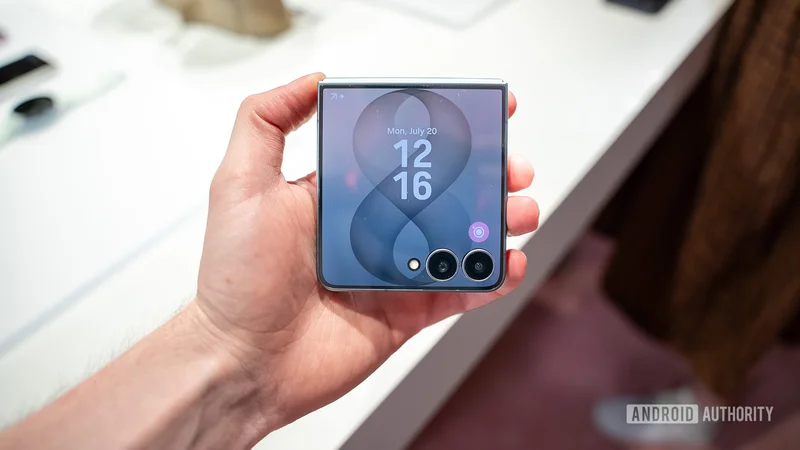
The Galaxy Z Flip 8's best upgrade on paper is the one that worries me the most
Jul 25, 2026 — 5:00 AM ET
With the Galaxy Z Flip 7, Samsung made the controversial choice to ship the foldable with its in-house Exynos 2500 chip everywhere in the world. To many, the shift from Snapdragon to Exynos was viewed as a downgrade, especially in a year when Qualcomm’s Snapdragon 8 Elite had a breakthrough moment. Motorola put a Snapdragon 8 Elite chip inside the Razr Ultra 2025 in the same year, padding its lead over Samsung and the Galaxy Z Flip 7 on the spec sheet and in most benchmarks.
Samsung changed course with the newly announced Galaxy Z Flip 8, which runs on the Snapdragon 8 Elite Gen 5 for Galaxy chip in North America. It’s easily the biggest Galaxy Z Flip 8 upgrade on paper, considering the displays, battery capacity, and cameras haven’t materially changed.
After using the Galaxy Z Flip 7 on and off for a year, I’m puzzled as to what problem the Snapdragon 8 Elite Gen 5 for Galaxy chip solves. Instead, the Galaxy Z Flip 8’s chip change could introduce new issues, such as overheating or subpar battery life.
Are you excited about Snapdragon 8 Elite Gen 5 in the Samsung Galaxy Z Flip 8?
The Snapdragon 8 Elite Gen 5 chip worries me
We’ve seen a bunch of phones launch with Qualcomm’s Snapdragon 8 Elite Gen 5 mobile platform so far, and we have a general idea of how it will perform. Samsung’s own Galaxy S26 lineup serves as a preview of what we can expect from the Galaxy Z Flip 8. Both the Galaxy S26 and Galaxy Z Flip 8 use the Snapdragon 8 Elite Gen 5 for Galaxy in some regions and the Exynos 2600 in others. Compared to the regular Snapdragon 8 Elite Gen 5 chip, the “for Galaxy” variant features an overclocked prime core running at up to 4.74 GHz.
From the very beginning, one thing about the Snapdragon 8 Elite Gen 5 has been consistent: it runs hot. The OnePlus 15 had major overheating issues tied to the chip, and it required a post-launch fix to address the thermal issues. The REDMAGIC 11 PRO literally uses liquid cooling to sustain the Snapdragon 8 Elite Gen 5 chip’s peak performance during a stress test. And the Snapdragon 8 Elite Gen 5 for Galaxy inside the Galaxy S26 Ultra does indeed suffer from thermal throttling, as our GPU tests showed.
One thing about the Snapdragon 8 Elite Gen 5 has been consistent — it runs hot.
Every phone integrates Snapdragon chips a little differently. In a device like the Galaxy Z Flip 8, the tight chassis means there’s less room for a large cooling system. The vapor chamber can only do so much, and I wouldn’t be surprised if the Snapdragon 8 Elite Gen 5 powering the Galaxy Z Flip 8 runs using a different thermal curve than the Galaxy Z Fold 8 Ultra or Galaxy S26 Ultra.
All this is to say that while we don’t know exactly how the Galaxy Z Flip 8 will perform using Snapdragon 8 Elite Gen 5 for Galaxy, there are reasons to be concerned.
By now, you’re probably wondering why I’m even talking about topics like thermal throttling or GPU stress tests — this is a flip phone, after all. People aren’t buying a Galaxy Z Flip 8 to do hardcore mobile gaming. That’s precisely the point. We didn’t need a Snapdragon 8 Elite Gen 5 for Galaxy chip powering the Galaxy Z Flip 8. The Exynos 2500 in the Galaxy Z Flip 7 did just fine, and the last-gen Snapdragon 8 Elite chip inside the Motorola Razr Ultra 2026 is also going strong.
New processors are overrated, and if we’re not going to use the Snapdragon 8 Elite Gen 5 for Galaxy to the fullest, why even have it? At best, it’s a pointless upgrade that may have contributed to the Galaxy Z Flip 8’s $100 price hike. At worst, it’s detrimental to the user experience, leading to overheating and shorter battery life.
New processor, same battery
The decision to bring the Snapdragon 8 Elite Gen 5 back to the Galaxy Z Flip line doesn’t align with other Galaxy Z Flip 8 changes. Samsung finally started using silicon-carbon batteries for its foldables, including the Galaxy Z Flip 8. These batteries are denser, allowing manufacturers to fit higher-capacity batteries into phones without increasing their footprint or thickness. Or, they could shrink the size of a smartphone’s chassis while keeping battery capacity the same.
Samsung chose the latter, and I just don’t get why. The Galaxy Z Flip 8’s silicon-carbon battery has the same 4,300mAh capacity as the traditional lithium-ion battery inside the Galaxy Z Flip 7. As a result, Samsung made the new foldable 13% thinner and 4% lighter than the old one. The difference between the models translates to six-tenths of a millimeter and eight grams. It’s not much.
Making the switch from Exynos to Snapdragon without increasing the Galaxy Z Flip 8's battery capacity is a risk, plain and simple.
I love thin-and-light phones as much as anyone, but a bigger battery would’ve been a perfect match for the power-hungry Snapdragon 8 Elite Gen 5 for Galaxy processor. Technically, the new chip is more efficient than its predecessor because it provides faster speeds while drawing roughly the same power. The tricky part is that we don’t know whether it will be more or less efficient than the Exynos 2500 in the Galaxy Z Flip 7. It’s a wild card.
Motorola offers a prime example of what Samsung could’ve done with the Galaxy Z Flip 8. The Razr Ultra 2026 has a last-gen Snapdragon 8 Elite chip but a larger 5,000mAh battery. It’s not as sleek or thin as the Galaxy Z Flip 8, although that may be the price you have to pay to fit Elite performance in a clamshell. The one thing that the Razr model gets wrong is the price, but the Galaxy Z Flip 8 doesn’t get it right either.
Making the switch from Exynos to Snapdragon without increasing the Galaxy Z Flip 8’s battery capacity is a risk, plain and simple.
Don’t buy a Flip 8 just for Snapdragon
The Galaxy Z Flip 8 is an incremental upgrade that costs $100 more than the Galaxy Z Flip 7 at launch. This is a $1,200 flip phone, and the only spec bump that stands out here is the Snapdragon 8 Elite Gen 5 for Galaxy chip. Call it into question, and the Galaxy Z Flip 8’s entire value proposition falls apart.
The Exynos 2500 inside the Galaxy Z Flip 7 served me well, and the Snapdragon 8 Gen 5 (non-Elite) powering the Motorola Razr Fold does a great job as well. These are just two examples of older or weaker chips actually proving to be better than the newest flagship processors. They’re cheaper, cooler, and more efficient while still being plenty fast. Meanwhile, the Galaxy Z Flip 8 is more expensive, likely runs hotter, and could come with worse battery life.
We’ll see how the Galaxy Z Flip 8 performs soon enough, but as you weigh a potential pre-order, don’t let the Snapdragon 8 Elite Gen 5 for Galaxy chip sway you.