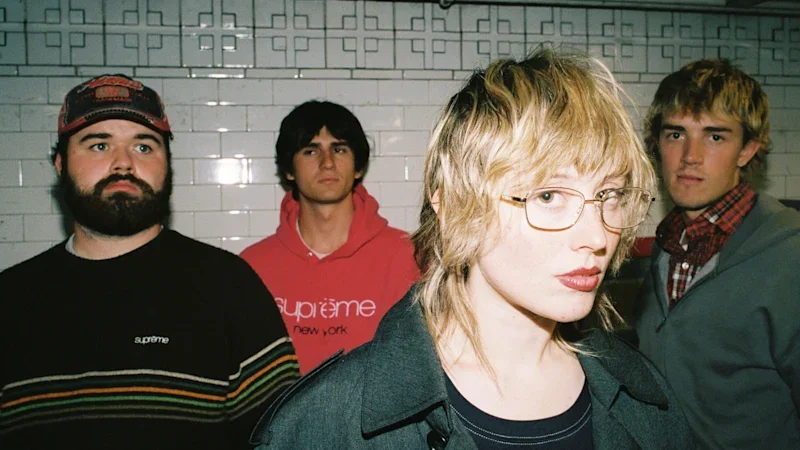
Swapmeet, Mount Zero
★★★
“Mount Zero is a place you pass but never go,” Swapmeet’s Maxwell Elphick says of the mountain that looms as the northernmost point of the Grampians.
The band would pass by the cryptically named mountain again and again while journeying from their hometown of Adelaide to Melbourne to play gigs.
These long, empty road trips have become part of the much-hyped indie rock group’s mythology – their first-ever show in Wollongong was packed full of devoted Adelaideans who’d made the trip across the border in support.
It’s appropriate, then, that their debut album stretches and turns like one of these trips. There’s the propulsive thud of single and opener I Know!, the messy dirge of Seeds and the breeziness of standout Sand, while smatterings of horns and shrieking guitars slap exclamation marks on Personal (Don’t Take it) and Halfway.
Band members Maxwell Elphick, Venus O’Broin, Jack Medlyn and Josh Doherty swap instruments and vocals throughout the album, which they pieced together in a Port Noarlunga pad that had a ping-pong table overlooking the ocean.
Despite the musical chairs, Mount Zero is a remarkably focused and even debut album, with its icy atmosphere recalling ’90s alt-rock – and a solitary drive on an empty highway. Jules LeFevre
Frost Children, Tweaker Poem
★★★★
NYC-via-Midwest sibling duo Lulu and Angel Prost have seen their star rise exponentially since last year’s Sister, their sixth album in as many years, and their production work with the likes of Kim Petras and Ninajirachi. With that increasing profile has come a major label record deal and unwanted attention of the parasocial kind.
Following an encounter with an overzealous fan (the EP’s eponymous “tweaker”), the duo fled New York and decamped to Tokyo, where – jet-lagged and sleep-deprived – they recorded this EP inspired by the entire ordeal. In songs that quote Madonna’s stalker Robert Dewey Hoskins and Rhonda Saunders’ book Whisper of Fear: the True Story of the Prosecutor Who Stalks the Stalkers, the pair scrutinise the encounter with emotional detail.
The result, somehow, isn’t dark or dour but life-affirming and warm, veering away from the brash indie sleaze they’re known for and further towards the pop aspirations and melodic melancholy that marked the best parts of Sister.
Satellites and Light Leak match their hyperpop experimentalism with the sort of chart-topping emo-EDM that poured out of dorm rooms in the mid-2010s (think the Chainsmokers, Zedd, et al.), while the sparkling synths and serrated choruses of Creep and Afterlife lie somewhere between Dance Dance Revolution and Midwest emo.
You’ll find yourself euphorically chanting “We never die, ain’t no cyanide!” over a frantic gabber beat like it’s a mantra. Robert Moran
To read more from Spectrum, visit our page here.