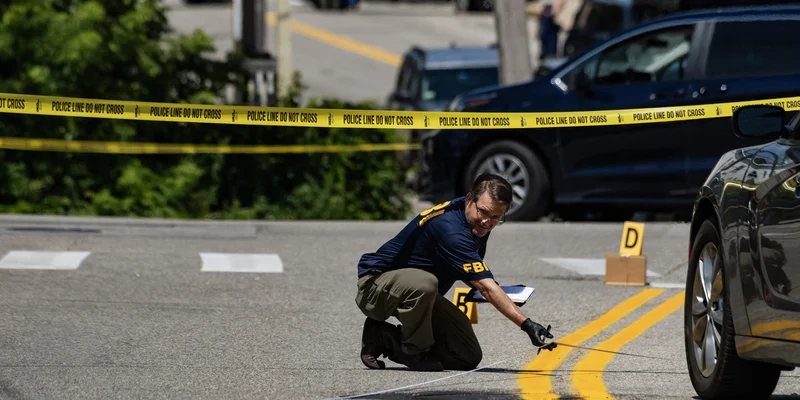
Less than two weeks ago, following a pair of fatal shootings by immigration officers in Texas and Maine, U.S. Immigration and Customs Enforcement ordered a halt to vehicle stops nationwide.
The directive was initially passed down through ICE field offices on the evening of July 13 — just hours after the Maine shooting — followed by an official agencywide memo that made the rounds the next morning.
Then, on July 15, President Donald Trump took to his social media platform Truth Social and directed ICE to resume its vehicle stops, presumably reversing the orders announced the day before by ICE internal leadership.
Despite Trump’s apparent reversal of the ICE directive, immigration enforcement officers in at least 4 so-called areas of responsibility — ICE’s regional jurisdictions — did not resume vehicle stops, according to officials who spoke with The Intercept.
“I follow policy that comes down the appropriate channels,” said one ICE official, who works in a southern regional office and requested anonymity to avoid retaliation. “The president says one thing but in reality we all follow established policy.”
A second ICE official, who operates in the Western U.S., told The Intercept, “Following the orders of the guys I’ve worked with in the field and have my back vs the head of an administration that treats me like a meme? It’s a no brainer.”
Three other ICE whistleblowers from areas of responsibility in the Midwest, South, and Northeast also told The Intercept that vehicle stops did not resume in their areas of responsibility over the past week.
Now, however, a new official vehicle stops policy has been passed down through the proper channels at ICE’s Enforcement and Removal Operations division.
An internal agencywide email, sent on July 22 and obtained by The Intercept, ordered the resumption of vehicle stops, with new guidelines that change how deportation officers will engage with vehicles moving forward.
“ERO law enforcement officers are authorized to conduct vehicle stops,” says the email. “Officers must continue to coordinate with their immediate supervisors regarding any enforcement activities.”
Killings in Maine and Texas
The pair of deadly ICE shootings, just six days apart in the second week of July, both involved officers traveling in and engaging with vehicles. The killings — of Lorenzo Salgado Araujo in Houston, Texas, and a Johan Sebastián Durán Guerrero in Biddeford, Maine — sparked nationwide outrage and catapulted ICE back in to the news cycle.
ICE quickly came under pressure from both the public and government officials to hold the officers involved in the shootings accountable and offer more transparency about ICE’s tactics when engaging with vehicles.
One glaring issue that arose was the fact that, according to the Department of Homeland Security, the officers involved in both shootings were not wearing body cameras.
In the case of the Maine shooting, The Intercept previously reported, officers on the scene were wearing multifunctional devices designed to work as body cameras, but they were unable to record video on the devices because they didn’t have a required cloud-based subscription service.
The new ICE vehicle stops policy addressed the apparent failure in Maine and Texas to capture the incidents on video. Now, according to the new policy, at least one officer involved in a vehicle stop must be wearing “an issued and activated body worn camera.”
The rollout for ICE body cameras, however, is proceeding slowly. About half of ICE officers have been issued cameras, according to DHS, with the other half to receive them in the next two months. Officers will then need to complete a training process with the body cameras before they can use them in the field.
Gutted Training Standards
Starting in summer 2025, in an effort to ramp up deportations, the Trump administration implemented an accelerated ICE training and hiring spree that lasted until June 30, 2026.
During that time, ICE hired more than 12,000 new recruits and cut more than 40 percent of its basic training curriculum.
Among those new recruits, according to The Atlantic, was the ICE officer who allegedly pulled the trigger in the Maine shooting.
The new ICE policy distributed on Wednesday now lists training as a requirement for officers making vehicle stops.
“The officer or officers conducting the stop must have successfully completed an ICE-administered vehicle stop training,” the guidance says.
The policy guidance says that ICE officers may make vehicle stops in cases of criminal arrests or while executing search warrants, but only when a certified member of a Special Response Team — ICE’s equivalent of SWAT — conducts the stop.
IT’S EVEN WORSE THAN WE THOUGHT.
What we’re seeing right now from Donald Trump is a full-on authoritarian takeover of the U.S. government.
This is not hyperbole.
Court orders are being ignored. MAGA loyalists have been put in charge of the military and federal law enforcement agencies. The Department of Government Efficiency has stripped Congress of its power of the purse. News outlets that challenge Trump have been banished or put under investigation.
Yet far too many are still covering Trump’s assault on democracy like politics as usual, with flattering headlines describing Trump as “unconventional,” “testing the boundaries,” and “aggressively flexing power.”
The Intercept has long covered authoritarian governments, billionaire oligarchs, and backsliding democracies around the world. We understand the challenge we face in Trump and the vital importance of press freedom in defending democracy.
We’re independent of corporate interests. Will you help us?
** IT’S BEEN A DEVASTATING** year for journalism — the worst in modern U.S. history.
We have a president with utter contempt for truth aggressively using the government’s full powers to dismantle the free press. Corporate news outlets have cowered, becoming accessories in Trump’s project to create a post-truth America. Right-wing billionaires have pounced, buying up media organizations and rebuilding the information environment to their liking.
In this most perilous moment for democracy, The Intercept is fighting back. But to do so effectively, we need to grow.
That’s where you come in. Will you help us expand our reporting capacity in time to hit the ground running in 2026?
We’re independent of corporate interests. Will you help us?
** I’M BEN MUESSIG,** The Intercept’s editor-in-chief. It’s been a devastating year for journalism — the worst in modern U.S. history.
We have a president with utter contempt for truth aggressively using the government’s full powers to dismantle the free press. Corporate news outlets have cowered, becoming accessories in Trump’s project to create a post-truth America. Right-wing billionaires have pounced, buying up media organizations and rebuilding the information environment to their liking.
In this most perilous moment for democracy, The Intercept is fighting back. But to do so effectively, we need to grow.
That’s where you come in. Will you help us expand our reporting capacity in time to hit the ground running in 2026?
We’re independent of corporate interests. Will you help us?
Latest Stories
Hegseth Is Pushing Testosterone. The VA Has Already Struggled With the Treatment.
“Men who take testosterone will have a reduction in their sperm counts,” one medical professor said. There’s no stated plan for continuing care.
The Intercept Briefing
Trump’s National Killer Police Force
ICE and Border Patrol’s purviews have transformed from immigration enforcement to being a political tool of the White House — all under the pretext of public safety.
The War on Immigrants
U.S. Website Gave False Approval to Green Card Applicants — Then Blamed Glitch and Took It Away
“It was heartbreaking,” said one recipient of a false approval who was told about a USCIS website snafu.