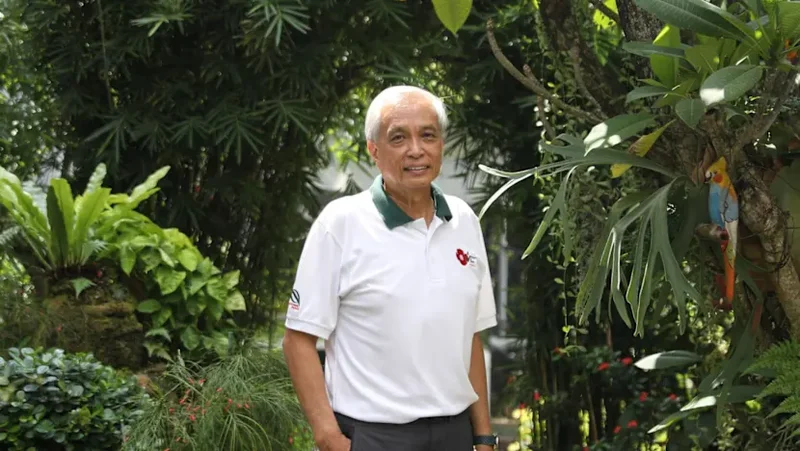
This community gardener doesn't just grow fruits and flowers, he nurtures kampung spirit
From planting 2,008 trees in a day to leading award-winning gardening teams, Mr Yeap Keat Tong, 66, is now using his green fingers to combat isolation and build stronger communities, especially among fellow retirees.
Until recently, the term "community gardener" always brought an image to my mind of elderly people tending to small pots and planters of chilli and spinach in a neatly ringfenced space, moving slowly and gingerly in the way that retirement allows and advanced age requires.
Then, I met Mr Yeap Keat Tong.
When we visited the Bukit Batok community garden known as Cosy Garden on Monday (Jul 20) morning, the 66-year-old retiree strode up to us with all the vigour of a man decades younger, greeting us with a firm handshake before taking us on a tour through what he called his "second home".
I had come expecting a modest vegetable patch. Instead, I entered into a 1,858 sq m plot – the rough equivalent of four basketball courts – nestled in a cluster of public flats.
We wandered through an impressive variety of flora and fauna including succulents, orchids, Brazilian spinach, fig and coffee trees. Bright pops of red and orange from flowers and fruits brought the greenery to life.
Among the carefully organised clusters of plants were solar panels powering ceiling fans at the guest area, little ponds of koi and turtles, and even metallic sculptures – most, if not all, installed by the community of residents there.
"You don't have to be good at gardening to contribute to a community garden," he told us. "All you need is the willingness to learn and desire to contribute."
FROM BREAKING UP CHARCOAL TO COMPANY'S 'CHIEF' GARDENER
Over 50 years ago, a teenage Mr Yeap spent many an hour watching his father tending to orchids in their landed home in Serangoon Gardens.
He recalls his father as a "typical dad (of) that time – they don't talk much". The elder Mr Yeap had a high-pressure job as a banker and turned to gardening to relieve stress.
Mr Yeap remembered his father's stoic demeanour softening whenever it came time to attend to the family garden – particularly the orchids, his favourite.
"Through gardening, you can get close to him. He'll be very friendly (and) teach you things."
Mr Yeap was the only one of his four siblings inspired to try his hand at their dad's favourite hobby. Partly because of this, he added, he also developed a closer relationship with his father.
As a child, one of Mr Yeap's earliest gardening tasks was to break big charcoal chunks into smaller pieces, to be placed in the orchid pots to improve air flow and water drainage. He started learning voraciously from his father about gardening – how to fertilise different types of plants, how to grow new plants from existing ones, and so on.
Like with many other childhood hobbies, life eventually got in the way of the father-son duo's shared passion.
The younger Mr Yeap went on to complete his National Service, start full-time work, and even did a stint overseas for his master's degree in the United States. During these years, his father sold their Serangoon Gardens property and moved to a flat in Hougang with his mother. Gone was the family house – and along with it, their beloved garden.
In the late 1990s, Mr Yeap bought his own landed property in Sengkang.
His father started visiting him, occasionally bringing plants such as orchids to place in his new garden – and their shared passion for gardening blossomed again.
"He'd give me pointers on what orchids to buy, or ask things like: 'Did you fertilise this? It's not growing so well'," he recounted with a hearty laugh.
In 2006, while Mr Yeap was working at ST Engineering Land Systems, his employer learnt of his interest in gardening and asked him to take charge of greening up the company's Boon Lay compound. Overnight, he became the company's unofficial chief gardener.
That same year, the company began holding annual initiatives where staff members plant trees and shrubs in the company's compound. In 2008, Mr Yeap suggested setting up community gardens that interested staff could take charge of tending to.
"We organised one Saturday where over 100 staff came down … they brought with them the tools, the plants, and they created their own garden."
Mr Yeap retired in 2022 after 37 years of service, 16 of them spent overseeing the company's compound greening efforts.
Under his watch, the company's gardens won six platinum and two diamond awards from the National Parks Board (NParks).
By the time Mr Yeap stepped down to retire, he estimates that around 20,000 trees and shrubs had been planted in ST Engineering's compounds.
TURNING GARDENING INTO A TEAM AFFAIR
To date, one of Mr Yeap's proudest gardening achievements is an ST Engineering corporate social responsibility activity in 2008.
Under his leadership, the event saw more than 1,000 staff, with guests including family members and stakeholders, coming together to plant 2,008 trees in Admiralty Park.
At first, Mr Yeap was a little apprehensive, as it was the first time he had attempted a gardening project of this scale. He was grateful for the support he received from his management and team.
"I was relieved and happy that we managed to pull it off successfully."
The achievement went on to earn them a spot in the Singapore Book of Records for the most number of people planting trees at the same time.
It's almost as if a switch flipped for Mr Yeap – gardening was no longer just a personal, private hobby, but a shared activity that could bring people together.
He went on to take part in all eight editions of the Singapore Gardeners' Cup since the inaugural one in 2010, being appointed leader for his cluster in the first seven and co-leader in the latest one this year.
Of the eight iterations, Mr Yeap's cluster won the top award for three of them – a truly impressive feat, I came to understand, as he patiently explained the gruelling preparation involved in these tournaments.
The cup itself is usually held every two years around July at the biennial Singapore Garden Festival, but preparations typically start as early as the last quarter of the preceding year.
Each cluster typically brings together a number of gardening groups, anywhere from five to 12 depending on how districts are organised each year. The groups involved would first meet up, visit and take stock of each other's gardens and get to know each other's strengths before brainstorming ideas for the show garden.
In Mr Yeap's experience, most gardeners in the community are very open to connecting with each other, particularly when it comes to pooling resources.
"They will share their knowledge, share what they know, and they will even share their harvest."
Months go into propagating plants, testing display prototypes and refining plant arrangements, before the teams are given about a week to assemble the final show garden.
For example, for this year's cup, Mr Yeap's team chose the futuristic theme Quantum Fair 3026. Their garden included a 1.5m-wide flying saucer sculpture that held about 600 succulents. The team tried three different variations of the design before finding one that worked best.
"Then we spent three full days at the Singapore Garden Festival, about four or five people, just doing that (assembling the succulents)."
This year, each district's team comprised 12 community gardens. And with around 10 volunteers per garden, he estimated about 100 participants were involved in the district's showcase.
The hard work paid off as the district won the best of show award – the third such accolade won by a district headed by Mr Yeap since the cup was inaugurated.
But even as I expressed my awe, Mr Yeap deflected the credit to his fellow gardeners.
"They are very creative, resourceful and cooperative, and our bond is strong."
While Mr Yeap has achieved many milestones in gardening, unfortunately the man that inspired the journey – his father – was not able to witness most of them, as he died in 2009 aged 85.
Mr Yeap recalls his father being "very sick" in 2008. "When I mentioned (to him) about the 2008 (record-breaking) event, he was pleasantly surprised.
"If my dad was still around, he would be very proud of me bringing gardening to others to enjoy. Awards are just recognition of the efforts."
A BUSY RETIREMENT
Mr Yeap may have started out as a man who loves plants, but as our conversation progressed it became very evident to me that he is more than a simple gardener. He is a true community leader and organiser – horticulture was just his mode of expression.
Besides the community garden we visited at Bukit Batok Central, he also volunteers at another one in Jurong East, typically spending a day or two there each week.
He was also involved in the revamp of the garden at his church a few years ago, and lends a helping hand to maintain it weekly.
(My fellow gardeners) are very creative, resourceful and cooperative, and our bond is strong.
His latest gardening passion: terrariums. Recently, he has begun leading workshops to teach others how to make these self-contained miniature gardens.
This, I learnt, is much harder than simply chucking a stone and a few plant shoots into a tank.
"I tell them … to try to create something memorable, like (to commemorate) a place you've visited before," he said.
Mr Yeap showed me a terrarium he made with pebbles arranged in an ascending manner – his homage to the many steps on the popular Southern Ridges hiking trail.
His penchant for organising and leading extends beyond gardening. For instance, he often organises hiking outings with friends, usually at least once a fortnight.
Many times, instead of sticking to conventional trails, they will attempt to find some long-lost mansion or a lesser known war bunker off the beaten path.
"Singapore is so urban, you always see very curated gardens, parks and buildings. These kinds of things, you (have to) try to venture out and find."
FROM SIMPLE HOBBY TO GREATER PURPOSE
Besides community gardens like the ones Mr Yeap is active in, residents interested in gardening can also do so in public spaces such as allotment gardens.
Piloted in 2016 by NParks, the allotment garden scheme allows households to bid for leases on rectangular plots where they can grow their own plants.
The scheme has grown in popularity since, with over 2,500 such plots now in 29 parks and gardens across Singapore. However, while such plots may encourage the greening of public spaces, in Mr Yeap's view, it is in community gardens where interaction among residents and community building really happen.
A study conducted by the Institute of Mental Health found that depression affects about 5.5 per cent of senior citizens in Singapore. Another survey in 2025 found about half of Singaporean residents plan to continue working upon retirement, with the majority of them citing reasons such as seeking a new purpose and curing boredom as a reason to do so.
"Some people, after retirement, they really have nothing to do. They just sit there, watch television every day," he said, noting that community gardens alleviate this sense of isolation.
"In a community garden like this, everybody can come in and share the garden. You start talking (with other gardeners), you get to know the person better, and the person will share their experiences or (tips on) how to grow this plant.
"It's good. You don't feel lonely."
Outside of gardening, Mr Yeap does have a robust fitness routine, including weekly cycling and hiking activities.
However, he also believes that gardening doesn't just provide seniors with healthy physical activity. By its nature, it's an activity that requires skills such as planning, learning and sharing of information – skills that could also help the elderly keep cognitive conditions like dementia at bay.
Throughout the years, Mr Yeap has tried to share his passion with his family, just as his father did with him decades ago. However, his wife and three daughters seem to prefer admiring the beautiful results of gardening over engaging in the physical activity itself.
As a family, they always make it a point to visit gardening events or garden attractions when they travel overseas.
One such memorable trip for Mr Yeap was the Suncheonman International Garden Expo in South Korea, which his daughter specially planned for them to visit during a family trip to Korea two years ago.
"It's like the Singapore Garden Festival, but on a bigger, bigger scale – very big scale," he said, his face lighting up. "You need one whole day to walk. We enjoy that."
Mr Yeap seems to be at peace with his children's apparent lack of interest in getting their hands dirty, content to have their sincere appreciation for horticulture.
Nevertheless, he finds amusement in how they still make comments and observations about the plants he keeps at home – echoes of conversations he once had with his own father.
"Sometimes my daughter will tell me: 'Dad, I think there are mites in your curry leaves. Can you go and do something about it?'" he laughed. "Now they advise me."
Just last week, his eldest daughter attended a terrarium workshop that he conducted – and enjoyed it.
"Some other participants, after teaching, still mixed up the steps … but my daughter knows. And she could also (land)scape it a bit," he said.
"So I thought to myself: 'Maybe some of my genes are there?' It's a good start."