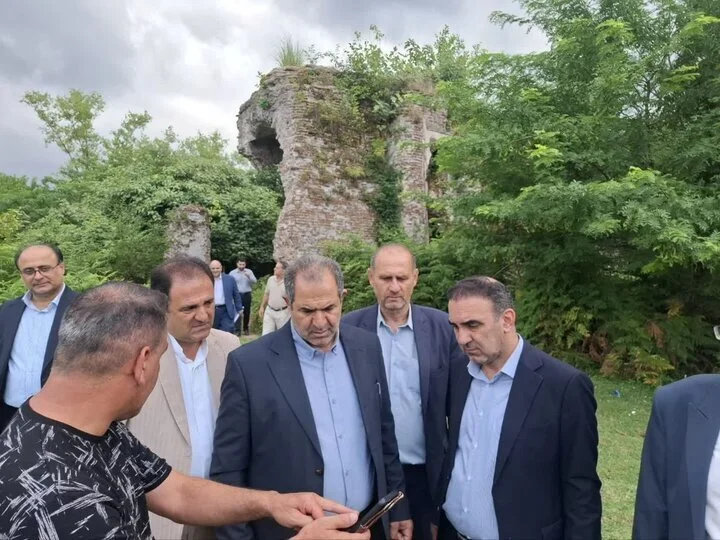
Ancient Espi Mazget up for restoration, tourism development by private sector
TEHRAN - Authorities in Iran's northern Gilan province plan to protect, restore and develop the historic Espi Mazget monument for tourism through a partnership with a private investor, a senior provincial official said during a visit to the site on Saturday.
Ali Bagheri, deputy governor-general of Gilan province, said the provincial government was pursuing the participation of a private-sector investor to conserve, restore and prepare the historic monument for tourism use while preserving its historical character.
"The use of private-sector capacity in the field of cultural heritage, alongside protecting valuable historical monuments, can contribute to tourism growth, job creation and balanced development in the counties [of the province]," Bagheri said during an inspection of historical sites in Rezvanshahr county.
He said the plan aims to preserve the authenticity and historical identity of Espi Mazget while turning it into a sustainable tourism destination capable of creating economic opportunities for the surrounding area.
Bagheri also visited the historical Ponel Brick Bridge together with the governor of Rezvanshahr and the director general of Gilan's Cultural Heritage, Tourism and Handicrafts Department. The officials reviewed the bridge's condition, tourism potential and conservation requirements, ISNA reported.
The governor's office said the Ponel Brick Bridge is one of Rezvanshahr's important historical landmarks and that its protection and promotion could support tourism development in the region.
Espi Mazget, meaning "White Mosque," is located about 80 km west of Rasht, the provincial capital, and 22 km south of Talesh in Gilan province, which is bounded by the Caspian Sea.
According to sources, the monument dates to the pre-Islamic period and continued to be used during the Seljuk and Safavid eras. It was registered on Iran's National Heritage List in 2000 under registration number 2796.
Only the monument's main entrance, part of its prayer hall and several adjoining walls remain standing. The entrance features a high arch associated with Seljuk architecture.
Espi Mazget has often been described as a former Sassanid-era (224-651) fire temple that was later converted into a mosque. However, archaeological excavations have not uncovered Sassanid architectural remains or pottery at the site. Surviving inscriptions date the structure to the fourth and early fifth centuries of the Islamic calendar, while all pottery recovered from the site belongs to the eighth century AH, corresponding to the Ilkhanid period.
Gilan is divided into a coastal plain, including the large delta of Sefid Rud and adjacent parts of the Alborz range. In the course of history, the Gilan region was within the sphere of influence of the successive Achaemenian, Seleucid, Parthian, and Sasanian empires that ruled Iran until the 7th century CE. The subsequent Arab conquest of Iran led to the rise of many local dynasties, and Gilan acquired an independent status that continued until 1567.
AM