Roelf Meyer arrived in Washington, DC, on Friday, 24 July, eager to deploy his considerable negotiation skills to tackle the challenging task of repairing South Africaâs damaged relations with the US. He is encouraged by what he detected on a âscoping exerciseâ to the US capital late last year âthat we still have a lot of friends in America, on both sides of the house, Republicans as well as Democratsâ. And, he says, we must use âthe opportunity to reach out to acquaint people with South Africa againâ.
He also detected that the long absence of an ambassador â itâs now been 16 months since his predecessor, Ebrahim Rasool, was expelled â had created a large gap in South Africaâs engagement with Washingtonâs decision-makers. This is what he now intends to remedy.
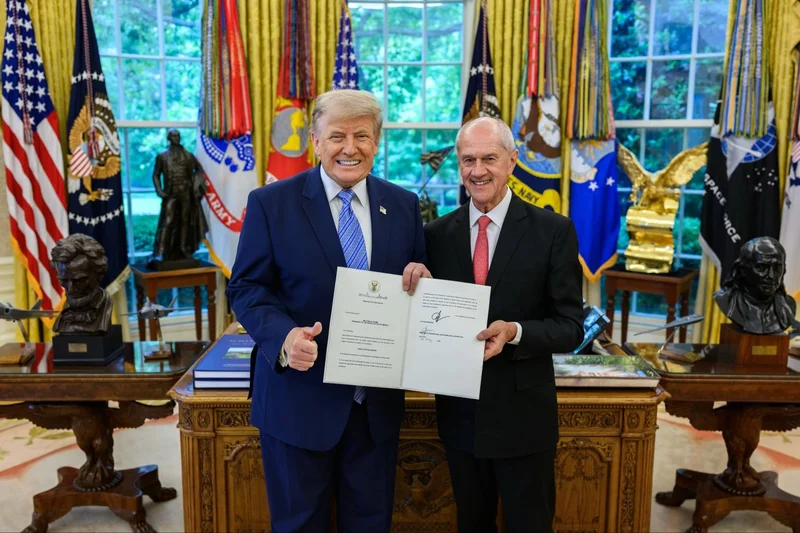
Meyer (79), who negotiated South Africaâs constitutional democracy with Cyril Ramaphosa in the early 1990s, was appointed by President Cyril Ramaphosa as ambassador to the US in May. The Americans gave their approval sooner than Pretoria expected, so Meyer had to rush to Washington to formally present his diplomatic credentials to President Donald Trump almost immediately. Then he returned to South Africa to complete legal and other formalities such as signing a contract. He is now ready to take up his post in earnest.
During the past three months in South Africa, Meyer has prepared himself by consulting widely with government ministers, Âofficials, business leaders and others about Âvarious issues with the US.
âI also managed to build a fairly good relationship with Ambassador Bozell,â he said about his US counterpart, Leo Brent Bozell III. âAnd, in certain ways, we are seeing eye to eye about the subjects which are relevant. I think he has done a good job so far in reaching out to the South African environment. He said to me in our very first meeting that his approach was to listen and learn.â
Veteran mediator
This is clearly also Meyerâs own approach. As a seasoned mediator in conflicts around the globe and in South Africa for some 30 years, he has the objectivity and realism to tackle one of his most difficult assignments.
However, right-wing Afrikaner groups such as AfriForum, Solidariteit and the FF Plus criticised Meyerâs appointment, complaining that he was an ANC member and so would not represent their interests.
âThe reality is I havenât been a member of any political party for more than 15 years,â Meyer told Daily Maverick.
He led the old National Partyâs team at the Codesa talks that negotiated South Africaâs constitutional democracy. He and Ramaphosa, who led the ANCâs negotiating team, kept the talks alive when murderous attacks on black communities by a murky âthird forceâ nearly derailed them.
Meyer and Bantu Holomisa (now deputy defence minister) formed the United Democratic Movement in 1997. He retired from politics in 2000. About four years later, he âdid join the ANC when Thabo Mbeki was presidentâ, he said, because he thought Mbeki was doing a good job, particularly with the economy.
But he dropped his ANC membership when then president Jacob Zuma began misÂgoverning, and since then had felt no need to renew it.
Yet Meyer said he had continued to fulfil his national responsibilities by mediating in international conflicts and also organising domestic development efforts such as the public-private growth initiative.
He noted that although leaders of the FF Plus, AfriForum and Solidariteit had criticised his appointment, he had since held good meetings with them all. He thought they had realised âthat Iâm there, Iâm appointed and they can either ignore me or keep on criticising me, or they can come forward and letâs work togetherâ.
He had also met the leaders of all 10 parties in the Government of National Unity (GNU), except one, as a suitable date could not be found. He said he had the full support of all the parties in the GNU â including the FF Plus.
âMy approach is that I represent the full spectrum of South Africans.â
Facilitation vs diplomacy
Meyer said he and Bozell had agreed most on the need to help US businesses succeed in South Africa and get more of them to invest, because his ultimate objective as ambassador would be to create jobs. He is encouraged by the US corporation Alcoaâs recent acquisition of the Hillside Aluminium smelter in Richards Bay.
And he said he would also seek to expand South African exports to the US, especially of critical minerals and agricultural products such as avocados and citrus.
There is much less, if any, agreement â at least publicly â between the two ambassadors so far on the political issues: the âfive asksâ the Trump administration has raised.
It is basically asking the South African government to prioritise the protection of rural communities from violence; condemn the notorious Kill the Boer chant as hate speech; scrap the expropriation without compensation law; end the requirement that foreign investors must surrender ownership of 30% of their businesses to black South Africans under broad-based black economic empowerment (B-BBEE) laws; and demonstrate that it is really non-aligned globally, as it claims to be, by distancing itself from US enemies such as Iran.
Meyer said the executive order Trump signed on 7 February last year â less than three weeks into his presidency â banning US aid to South Africa and offering Afrikaner farmers asylum in the US because they were supposedly victims of genocide â would not be lifted until the US was at least partly satisfied with regard to the five asks.
It was not yet clear if all five asks would have to be completely addressed or if some might fall away.
âWe will have to⦠see how we can manoeuvre on this.â
In March, Bozell publicly complained that the US was growing impatient as it had put the five asks to the South African government more than a year earlier and had not received an answer.
Meyer insisted that the South African government was in fact ready for a dialogue about the five asks and suggested that Bozell was under pressure from Washington and âwill struggle with them as much as we struggle with them, because he has to get consent from Washington. The decision doesnât lie with him.â Likewise, âour answers to the five asks donât lie with meâ.
Instead of criticising, he seemed to imply, both he and Bozell should be exploring where the opportunities lay to advance political goodwill and business opportunities.
B-BBEE
Meyer said some US companies had told him B-BBEE was not a deterrent to investing and they were more concerned about how long it takes to get licences and authorisations to do business. Nonetheless, he said, without giving up the principle of black empowerment, South Africa should explore alternatives to requiring investing companies to surrender equity.
One possible alternative was the âequity equivalenceâ concept, which is already allowing international companies such as Amazon to help finance black communication companies rather than sharing ownership of their own companies.
âAnd I guess the same would apply to Starlink,â he said, referring to Elon Muskâs refusal to invest in South Africa because of B-BBEE.
âThe question is how do we come around to find a solution that will satisfy the Americans? We have to do it in such a way that it fits all. We canât make an exception only for one country.â
Meyer also thought the imminent judgment in the challenge to the Expropriation Act brought by AfriForum and others in the Western Cape Division of the High Court in Cape Town may âsatisfy the askâ â that is, it may satisfy Americaâs objection to expropriation without compensation.
Meyer noted that AfriForum had not asked the court to scrap the whole act, but only certain sections allowing expropriation without compensation.
And although he couldnât be sure, his sense was that Kill the Boer âmaybe has become less of a demand⦠because I think the ANC has proved at least that they are not using it â and thatâs for everyone to take note ofâ.
The Trump factor
Meyer said the issue of violence against white farmers ârests entirely in the White House⦠and that remains a difficult one to address. It doesnât help us to say itâs not the case⦠It remains part of the reality that we have to deal with.â
He said he had asked a whole range of people in Washington to explain Trumpâs thinking on the matter, and none could. So he would only know how to deal with it âif we get closer to the fireâ â by going to Washington.
One reason he wanted to see Trumpâs executive order lifted was that doing so would end the Afrikaner refugee programme, âbecause for me, as an Afrikaner myself, I find it embarrassing that the tribe that I belong to are regarded as refugeesâ.
Meyer thought it was possible to answer Americaâs fifth âaskâ, that South Africa should really be non-aligned geopolitically.
âThere is sufficient proof that we can actually⦠give with regard to that.â
The proof was how many US companies were doing business in South Africa and vice versa, though he added that some Americans â and this included Democrats as well as Republicans â felt that South Africa had not engaged maximally with the US. This required greater engagement with all parts of the US system, including Congress, the State Department and the White House.
Bozell clearly sees things differently, regarding non-alignment as South Africa being less friendly to the USâs enemies, not just more friendly to the US.
In June, after Iranâs deputy foreign minister visited Pretoria and Deputy President Paul Mashatile visited China, Bozell posted on X: âPretoria calls this ânon-alignmentâ. We call it what it is: a choice. The South African people deserve an honest conversation about who their government is choosing to stand with.â
Meyer said he had questioned Bozell about this post directly âin a friendly wayâ, telling him it was a strange comment since Trump had just been to China on a state visit, and the US was holding peace talks with Iran in Geneva.
Meanwhile, Meyer confirmed that South Africaâs protracted trade negotiations with the US were continuing. Most recently, the US threatened to impose a 12.5% import tariff on 60 countries, including South Africa, for allegedly failing to prevent the import of goods produced using forced labour.
South Africa has told the US it should be exempt from the 12.5% tariff as it does have laws that can be invoked to prohibit goods produced with forced labour.
Meyer agreed that South Africa should be able to counter this threat either with existing or new legislation. But he worried that the US allegation âcould be that we are importing stuff from China that falls in that category. If that is so, it immediately has an impact on the type of answer that we give.â
South Africa could not afford to ignore this threat, but he added that he had spoken to some agri-exporters and for them the priority was to have access to the US market. An extra 2.5% (on top of the existing 10% tariff, as he saw it) âis not going to kill themâ.
Forward focus
Meyer also expressed concern about the future of the African Growth and Opportunity Act (Agoa). It had benefited South Africa significantly for about 25 years, but was allowed to expire in September 2025 before being retrospectively extended until December this year. He said it was Congress that would have to renew it, but time was running out because the midterm US congressional elections were looming in November.
Another danger was that the US was reviewing the eligibility of individual African countries to participate in Agoa. Meyer agreed that South Africaâs enemies in Congress might use the review as an opportunity to punish the country. He also felt there might be some competition with South Africa on the continent for Agoa eligibility.
Although the Department of Trade, Industry and Competition was largely dealing with these and regular tariff negotiations, âthe embassy in Washington has to take a clear role as the front line and on a coordinated basis⦠and itâs one of the reasons Iâm anxious to get thereâ.
He was looking forward to âbuilding the broadest possible network with everybody that mattersâ including politicians, government officials, business leaders, civil society and think tanks.
Meyer said his contract was for the usual four years, but he had told Ramaphosa he would take on the job for two years.
âAnd if I feel okay after two years, I can probably proceed another year.â
His measure of success would be in how many jobs he helped create, he said.
âBecause the people in office will change⦠from term to term. But if we could show success in terms of more investment and more trade, then we have delivered as far as the embassy is concerned.â DM
This story first appeared in our weekly DM168 newspaper, available countrywide for R35.