Fifty years after Baathist Syria made the fateful decision to intervene in Lebanon’s bloody civil war, Damascus is being asked again to intervene in its small western neighbor. President Donald Trump has repeatedly suggested that post-Assad Syria should combat the Iran-backed Shia militia Hezbollah instead of Israel, arguing it’s much better suited for such an unenviable mission.
In recent weeks, much to the alarm of both Israel and Lebanon, President Trump has repeatedly suggested that Syria under incumbent President Ahmed al-Sharaa should fight Hezbollah in Lebanon. While the Syrian president has ruled out such a scenario, Trump keeps repeating it. When he hosted Lebanese President Joseph Aoun at the White House on July 21, he again pushed his idea that Syria rather than Israel could “do something with Hezbollah,” erroneously claiming that Sharaa “would like to come in.”
Many have already pointed out the severe political sensitivities of any Syrian intervention in Lebanon. After intervening in 1976 under President Hafez al-Assad, Syria’s military remained in Lebanon for 29 years, finally withdrawing in 2005 under Hafez’s son and successor Bashar. Sharaa later led the push that finally deposed Bashar in December 2024, more than a decade after the Syrian revolt against his brutal and corrupt rule began in 2011.
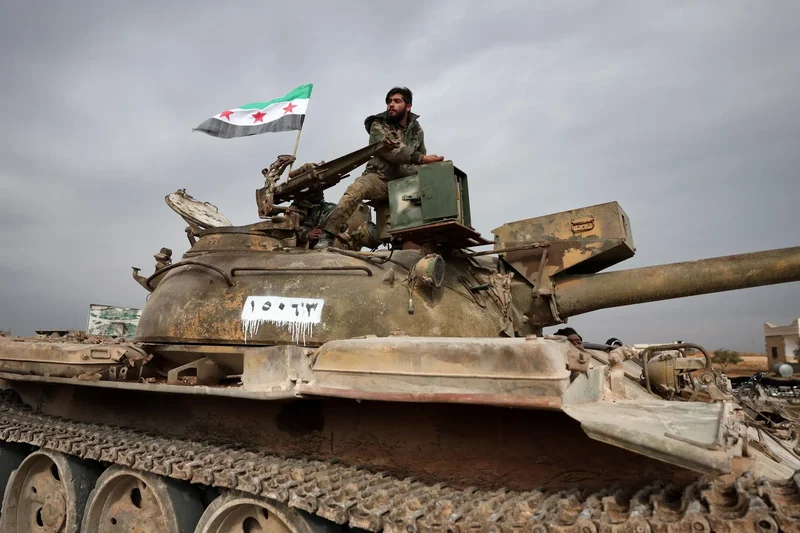
While no doubt politically infeasible, any Syrian intervention in Lebanon at present would certainly be militarily infeasible even if Sharaa actually wanted to launch one. The Syrian military today is a shadow of its Soviet-equipped predecessor that intervened in Lebanon half a century ago and will remain so for the foreseeable future.
“The Sharaa-led government in Syria is not in a strong enough position to contest Hezbollah in Lebanon, and a Syrian military campaign into Lebanon could shatter the Lebanese state and splinter the Lebanese army,” Nicholas Heras, Interim Executive Director at the Middle East Policy Council and Senior Director at the New Lines Institute, told me.
“The Syrian military is still a patchwork of militia forces that have varying degrees of organization, armament, and logistical support,” Heras said.
Joshua Landis, Director of the Center of Middle East Studies and the Farzaneh Family Center for Iranian and Persian Gulf Studies at the University of Oklahoma, echoed Heras’ assessment.
“The new Syrian Arab Army has neither the discipline nor the weaponry to take on Hezbollah,” Landis told me. “Syria’s state institutions are all being rebuilt from the ground up and can hardly support a foreign war.”
“Syria’s reconstruction depends on stability and will require the undivided attention of its new rulers,” he said.
For now, Landis sees the Syrian military as a “mess” that has been “patched together” out of the scores of armed groups that overthrew Assad, including al-Sharaa’s officially disbanded Hayat Tahrir al-Sham, with weak command and control.
“That weakness showed itself during the small wars that the new army waged against Syria’s recalcitrant minorities, which have resisted domination by Syria's new Sunni-led Army,” Landis said.
He recalled that the central command failed to contain massacres perpetrated by militias against Syria’s Alawite minority on the coast in March 2025 and the Druze in the southeast the following July. Similar violations took place in early 2026 after the new government launched an offensive against the Kurdish-led Syrian Democratic Forces in the northeast.
“Pro-Sharaa forces have not completely consolidated the interim government’s rule over the western region of Syria and are primarily focused on preventing cross-border incursions from Hezbollah in Lebanon into Syria,” Heras said.
“Sharaa is not in a position to do much more than interdict Hezbollah’s supply lines from Iran into Lebanon.”
Nicholas Blanford, a non-resident senior fellow at the Atlantic Council and author of the 2011 book “Warriors of God: Inside Hezbollah's Thirty-Year Struggle Against Israel,” similarly assesses that a Syrian offensive against Hezbollah in Lebanon is a “non-starter.”
“Militarily, there’s obviously no love lost between HTS and various other Sunni jihadi groups in Syria that are now a component of the new Syrian army and Hezbollah,” Blanford told me.
“They fought each other for many, many years,” he said. “But if they were to stage some kind of military incursion into Lebanon, and that would presumably be in the Northern Beqaa, they would not encounter just Hezbollah; they would encounter tens of thousands of very heavily-armed Shia tribal fighters.”
These tribes, he explained, are taking all of this “extremely seriously,” as is Hezbollah. They have been “watching very closely” the northern border of the strategic Beqaa Valley and the eastern border for any potential Syrian move indicating it’s staging an incursion, a forewarning of what a major undertaking any cross-border operation would be for Damascus.
“They wouldn’t just be dealing with Hezbollah in isolation; they would be marching into an environment that is predominantly Shia, that is tribal,” Blanford said. “And whether these tribes like or dislike Hezbollah, there would be a clear incentive for all of them to band together to fight the external threats posed by Sunni jihadists, even under the guise of the new Syrian army.”
Heras of New Lines Institute similarly warned that any American pressure for Sharaa to do more than try to secure Syria’s border regions with Lebanon would lead to another crisis in Lebanon and even “pit the Lebanese army” against the new Syrian leader.
“That scenario would be a volatile situation where Sharaa’s forces could be defeated, thereby weakening his position further, or result in a cascade of sectarian conflict in Lebanon's border region with Syria that could destabilize both Lebanon and Syria,” he said.
For his part, Landis suggested that Washington can help Syria succeed not by urging or pressuring its “cobbled together military” to enter a potential quagmire in Lebanon, but by helping it build a capable government.
“Syria is riven with sectarian distrust following its long and bloody civil war,” he said. “The last thing it needs is to rush headlong into a war against Lebanon's Shiites, a war that will surely exacerbate Syria's divisions at home.”
“A stable Syria will do more for Lebanon and for regional security than a fragile Syria which is fighting someone else’s war.”
Hezbollah expert Blanford clarified that Trump’s repeated suggestions of a Syrian intervention are being pushed in a rather “ad hoc manner” that isn’t necessarily reflective of his administration’s actual strategy as clarified by other officials.
“The Syrian authorities are not big fans of Hezbollah, but what we’ve encouraged Syria to do is to focus on its own internal challenges that it has in building a nation state,” Secretary of State Marco Rubio told reporters a day after Trump received Aoun.
Consequently, Blanford doesn’t see any Syrian intervention happening. Still, he outlined the possibility of “rogue elements” within the new Syrian army predisposed to jihad that could cause problems. He pointed to several “small isolated incidents” since the beginning of 2025 that have affected the Lebanese Army.
“There have been small incursions by Syrian forces into Lebanese territory, particularly in areas where the border is in dispute,” Blanford said. “There’s been sort of random shootings, and it’s never quite clear whether the shooting was conducted by smuggling gangs or whether it was by elements of the Syrian army.”
Despite such border incidents, he concluded that there is very little chance of any larger push by Syria under President Sharaa against Hezbollah.
“I think he knows it’s a non-starter,” Blanford said. “And I think he’s looking for a different kind of relationship with the Lebanese state.”
“He’s made it quite clear that they don’t want to go back to the era of tutelage under the Assad regime’s father and son.”