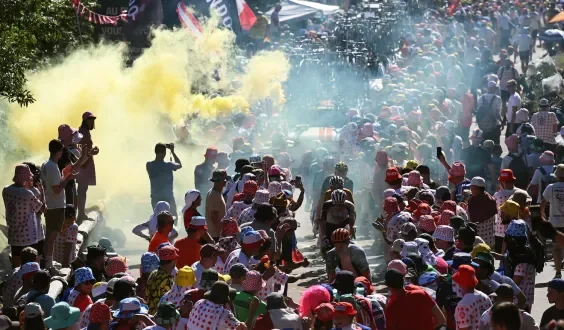
ALPE D'HUEZ, France — Roughly halfway up the final climb of Stage 19, and roughly five hours before the riders hit the base, our car indulged the thick snarl of besotted fans who wanted to do the wave with us. This slowed us across a critical speed threshold, beyond which our car was no longer something worth avoiding but rather something worth rocking. I'd seen videos of cars getting shaken the night before, and hoped to get shaken myself, though I was not prepared for how jarring and violent it felt in the car, as if we were pebbles and the hooting mass of jolly Europeans was the flood. This was Alpe d'Huez, the most legendary and chaotic arena in cycling.
There is nothing like Alpe d'Huez in all of sports. FranceTV reported that 600,000 people slammed onto the sides of the Alpe, the most dedicated arriving over a week ago, the stragglers on foot and on bikes after French cops shut down car traffic more than 24 hours before the race. Alpe d'Huez is 13.8 kilometers long at an 8.1 percent grade, though the important number to know is 21. That's the number of hairpin corners, which compresses the climb like the innards of an accordion and turn it into a natural arena. In a sport whose operative spatial property is diffusion, the Alpe's tortuous nature gives fans the rare luxury of density.
This year, Tour organizers made the prospect of pilgrimage more enticing by running Stage 19 up the main path, then running Stage 20 up the Col de Sarenne on the backside and having riders once again finish on the final four kilometers of the traditional Alpe. Offered a rare two-for-one deal, fans obliged and packed onto Alpe by the hundreds of thousands. This is part of what I mean when I say there's nothing like this in sports: a crowd six times the size of those in the biggest traditional stadia, distributed across nine miles of road, inches away from the best riders in the world, and it's all free. In the summer of the $10,000 Knicks ticket and the heinously expensive World Cup, the Tour de France's financial accessibility stands out even further. But what fans save in money, they sacrifice in convenience, since the logistics of watching a stage Alpe d'Huez require a serious level of dedication. You only do something like this if you really care about it.
That passion translates to the character and intensity of the crowds. On the drive up, we saw a dutiful herd of shirtless bros hauling a speaker set the size of a Mini Cooper, a group of British guys in Beefeater getups jumping around and singing, and a quintet of Belgians dressed as traffic cones who committed to the bit and would start directing traffic when engaged with. Tents were scattered on any available patch of grass or dirt, most of which were heinously slanted. The blood surely pooling in so many ankles was also dosed with plenty of warm beer, and by noon, the crowd was starting to get rowdy again after a night of revelry on Thursday. We kept the windows closed, which neither stopped various mischievous children from trying to super-soaker us from the roadside nor kept the anthem of the mountain out of earshot.
Then it was time to get among it. We took a télécabine down to turn seven, and walked up a few kilometers filled with costumed revelers. A guy with casts on each wrist laughed and danced, holding two beers despite his injuries. Two people in full ski gear held a faux race along the slope. A concerningly activated Frenchman screaming indecipherably into a megaphone lit a green flare and everyone went nuts. The mountain is a festival of guy-remembering, with plenty of love for the big riders and Paul Seixas in particular, but also for more obscure riders like Frits Biesterbos, Liam Slock, and Brent Van Moer. Austrian rider Felix Gall is not here at the Tour, though I both heard the Felix Gall EDM tribute song blaring out of speakers and interviewed its creator several hours later. "I'm not that much into making music," Maximilian Überschall said. "It's all about the vibe." (One charming quirk of Euro-ESL is how often that word is pronounced "wibe.")
I ran into Matthew Riccitello's family, the great Steve Porino of NBC, who briefly lost touch with his cameraman in the chaos, and someone dressed as a clown, waving a poster of Tadej Pogacar photoshopped in dictator garb. We missed the two old guys who got into a nasty fight over some caravan-thrown trash. Anyone who managed to evade the gendarmes and slip their bike past the cordon was cheered on as if they were in the race. I ran after one such rider, through a wall of French noise and various clashing Eurotrash tracks. At the end of my run, someone in striking drag with a stuffed banana for a dick wound up and kicked me in the ass.
This sort of mass frenzy is by definition impossible to control. Most people who'd been here before though it was wilder than usual. Though gendarmes put the traditionally nutty Dutch corner behind barriers, the madness wasn't contained, merely distributed. The Tour de France needs spectacles like this, since offering anyone who wants to be face-to-face with the riders the ability to do so for free is how they get the unbeatable atmosphere of Alps d'Huez. But it's impossible to create a cauldron like that without having it affect the race. Riders barely have enough road to ride in a straight line, and though authorities tried to barrier as much of the start and finish of the climb off from fans, disaster struck nonetheless.
About six kilometers from the finish, a fan fell right in front of the UAE team car, which braked suddenly and caused Einer Rubio to slam into the back and shatter his face. Pascal Ackermann was nearly felled by a fishnetted ass. Remco Evenepoel, currently running a distant second place, tried to attack, only to be blocked by the motos. "It's a shame that I can't finish the attack in one go, because that would have been a different result," he said. Everyone who's waited days to be right in front of their favorite riders wants to make the most of it, not stand dutifully behind the barriers. We settled in at the frenzied Nordic corner, which absorbed the energy reserved for Dutch corner and roared like a jet engine for every rider who came by.
"I don't understand," said the friendly bartender I chatted with later that night. "All these people come just to watch someone ride their bike by them for 10 seconds?" She had a point. One thing a $10,000 Knicks ticket gives you is the chance to watch a full NBA game, whereas even the most premium spot on Alpe d'Huez gives you mere seconds of action. But ultimately the point is proximity and, as the Belgians say, wibes. My friend Joe, who traveled from New York and slept in his car on the side of the mountain, put it best. "It's like being at Coachella for two days," he said. "You're camping out, meeting people, and taking in the vibe. Then all of a sudden, the race comes and you're on the field at the Super Bowl, where the opening kickoff is being returned right at your face." When we met up an hour after the finish, his first question was who'd won.
Tadej Pogacar, of course, won. The dialogue in the days leading up to the Alpe d'Huez day centered around a conflict between Pogacar's clear ambition to add the most legendary climb in the Tour de France to his soon-to-be unmatched palmares and the rapidly deteriorating condition of his UAE team. Would he really marshall his domestiques to gut themselves pulling back a strong breakaway when he'd already lost a key supporter and the rest of his team was dealing a combination of head colds and doo-doo ass? Yes, just enough to put him on the bottom of the climb with three minutes to make up on a strong trio. He wound up smashing the Alpe d'Huez climbing record. I was grateful to be on the side of the road to see just how much faster Pogacar was than the few riders ahead of him. They were lurching on the pedals, looking around nervously at each other, while Pogacar was zooming in perfect harmony with the bike. Even he had to wave off spectators so he could ride without getting knocked over.
This gets at the central contradiction of something as uncontrollable as the Alpe d'Huez. The atmosphere of the mountain is untouchable, a vital part of what makes the Tour de France special. There's nothing else that offers the proximity and passion of the Tour, all for free. The howling drunkards and costumed freaks are what light up the race, and without them, the spectacle of some guys riding their bikes wouldn't matter. On the other hand, you can't have guys breaking their faces. I am shocked more incidents don't happen, that the 600,000-person mass organism can conduct itself mostly without disaster, but some gnarly incidents are basically unavoidable without somewhat severe restrictions on movement or alcohol intake. Which is to say, I'd understand if the ASO or the French government tried to make it less crazy, though they can't go too far, because the sport only exists because of the passion on display at places like Alpe d'Huez. It's all about the wibe, sometimes for worse, but mostly for better.