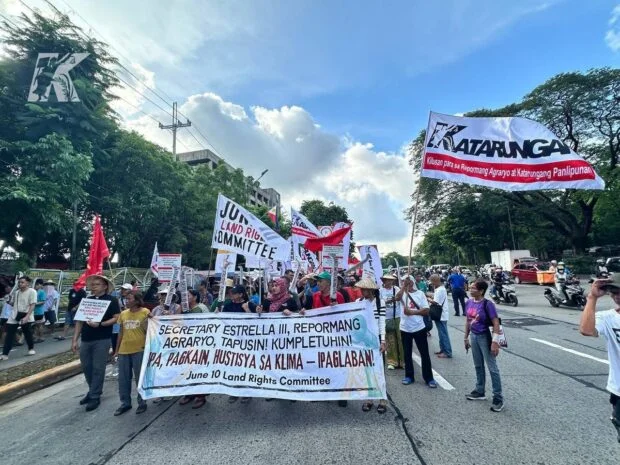
Farmers’ group calls for genuine agrarian reform ahead of Marcos’ Sona
LUCENA CITY, Quezon – A national peasant organization urged President Ferdinand R. Marcos Jr. to go beyond calls for unity and translate his commitments into concrete measures to address the continuing struggles of Filipino farmers as he delivers his fifth State of the Nation Address (SONA) on Monday, July 27.
“The true measure of this administration will not be the promises it makes from the podium, but whether it finally delivers justice, security, and dignity to agrarian reform beneficiaries (ARBs) and all those who feed the nation,” The Kilusan Para sa Tunay na Repormang Agraryo at Katarungang Panlipunan (Katarungan) said in a recent statement.
The group stressed that without genuine agrarian reform and social justice, government commitments would remain beyond the reach of the very farmers whose labor sustains the country.
Article continues after this advertisement
Katarungan recalled that during Marcos’ fourth SONA following the 2025 midterm elections, he appealed to government officials to set aside political differences and focus on their common responsibility of serving the Filipino people.
The organization noted that Marcos had acknowledged public dissatisfaction over the government’s delivery of basic services despite reported economic gains.
The President also vowed that the remaining years of his administration would focus on improving the lives of Filipinos and fulfilling his government’s commitments.
“One year later, these commitments must be judged not by rhetoric, but by results,” Katarungan said.
The group said the administration’s commitment to farmers should be measured by how effectively it protects, completes, and implements agrarian reform while improving the conditions of rural communities.
Article continues after this advertisement
“For millions of ARBs and farmers, dignity cannot be measured by speeches or symbolism,” the organization said.
Instead, Katarungan said dignity means having secure and undisputed rights to the land they cultivate, protection against land grabbing and displacement, full use of awarded lands, fair prices for farm products, sufficient production and marketing assistance, climate resilience, and the ability to provide for their families through farming.
Article continues after this advertisement
“These, not speeches or symbolism, are what give dignity to those who feed the nation,” the group emphasized.
Katarungan said that 38 years after the implementation of the Comprehensive Agrarian Reform Program (CARP) in June 1988, the promise of comprehensive land reform remains largely unfulfilled for millions of Filipino farmers.
The group pointed out that many ARBs continue to experience delays in securing land ownership due to legal disputes, cancellation of land titles, landowner retention claims, land conversion efforts, and lengthy government processes that may take years or even decades to resolve.
It added that several farmers continue to face harassment, intimidation, violence, and legal battles that prevent them from fully exercising the land rights promised under agrarian reform.
The organization also criticized what it described as the failure of Department of Agrarian Reform (DAR) Secretary Conrado Estrella III to engage directly and meaningfully with ARBs and farmers to address long-standing agrarian concerns.
“This stands in stark contrast to the considerable time devoted to producing and appearing in vlog-style content, which many have perceived as resembling early senatorial campaigning rather than the urgent discharge of official responsibilities,” Katarungan observed.
The group warned that unresolved land disputes, insecure land tenure, delayed justice, and weak government response continue to erode public confidence in the administration’s commitment to genuine agrarian reform and social justice.
Beyond land ownership, Katarungan stressed that many ARBs still struggle to make their farms productive due to inadequate government support services, high production costs, limited access to credit and infrastructure, low farmgate prices, and growing threats from climate change.
“Land ownership alone cannot uplift rural communities if the state fails to ensure that ARBs can make their lands productive and their livelihoods sustainable,” the group said.
The group concluded that for the country’s tillers of the soil who feed the nation, “a truly meaningful SONA is one that speaks honestly about these realities and commits to concrete action.
“The nation deserves more than carefully crafted words,” the organization said.
Photo of protest rally from Katarungan.
File photo of farmers harvesting palay in Quezon province (Delfin T. Mallari Jr.)