No one is seriously questioning whether the best red light masks work anymore. The professional skincare community and dermatologists largely agree on their effectiveness. The more nuanced question is which red light therapy devices provide the best visible results. When choosing a red light mask or LED skincare device, factors like light wavelength, irradiance, and bulb placement all determine whether a mask is actually doing anything for your fine lines or inflammation.
Since consistency is so key for visible results, the best red light mask is the one that you'll actually feel like wearing on a daily basis. So, over months and months of at-home testing, Mashable reporters and editors used popular red light therapy devices from Shark, Solawave, CurrentBody, and more. After trying over 10 different products, we ultimately found six that delivered consistent results for our testers — and two we can't recommend.
Overview
These are the tech, tools, and products — from laptops to e-readers, from earbuds to robovacs, and more — that Mashable ranks best in class.
Table of Contents
How to choose a red light face mask: Look at wavelength first
There are some ways to tell that a red light face mask won't be effective before you buy it and use it for a few months.
Wavelength is the first factor anyone will tell you to consider. You want to find products that emit light within the therapeutic window, or the range of wavelengths that can be effective when treating common skin conditions. There is now an abundance of evidence that specific wavelengths of red light can be effective for:
- Reduction of fine lines, dark circles, and crow's feet
- Improving skin texture
- Fighting wrinkles
- Boosting collagen production
- Reducing inflammation and redness
To be effective, the light coming from the mask must penetrate different layers of your skin. There are optimal wavelengths for each type of light a face mask emits, and any reputable brand will put their mask's wavelengths front and center in the listing. These carefully chosen ranges are strong enough to penetrate your skin, but gentle enough to avoid over-activating delicate face skin.
Red light does its work in the middle layer (dermis) of your skin, requiring wavelengths between 630 and 633 nm to reach past the top layer. There, red light stimulates cells to produce rejuvenating proteins like collagen and elastin, evening out surface redness, and preventing scarring or post-pimple red spots.
Most red light masks also use near-infrared red light therapy, which requires longer wavelengths to travel further than regular red light. Near-infrared light between 830 and 850 nm reaches into tissue under the dermis to further stimulate cell turnover, firm skin, and heal deep-seated spots or stubborn dark circles.
What about blue light therapy?
Blue light is often used to target acne, and some of the best red light masks use a combination of blue and red light therapy.
Blue light operates on the top layer (epidermis) of your skin, so its ideal wavelength is shorter than either red light standard. Blue light at 415nm has an antimicrobial effect, ideally killing the bacteria that cause acne before a breakout starts. If hellbent bacterial acne makes it past the blue light phase — or if you're also dealing with hormonal or cystic acne not caused by bacteria — red light swoops in to neutralize inflammation and speed up the healing process.
The thing is, most mainstream LED face masks hit those wavelength marks. So, how do you choose between masks if their wavelength numbers are all the same?
The importance of irradiance
Irradiance is another major element that determines whether or not a red light mask actually works. While wavelength refers to the length the light can travel, irradiance refers to the amount of light energy that's actually reaching your skin per session (not just the intensity of light being generated at the bulb). If wavelength numbers are correct but irradiance is low, the mask will still be kind of a dud.
Irradiance is officially expressed as milliwatts per square centimeter. The optimal irradiance range for a red light face mask is pretty wide (anywhere between 30 and 100 mW/cm²), though many brands don't directly provide that number.
Most brands do note the length of each session, which is one way to quickly gauge irradiance without getting into calculations. Dr. Mamina Turegano sums it up best on her YouTube account: "Higher irradiance means more effective energy delivery per minute of use." Longer sessions don't automatically mean that results will be more powerful — a mask with sessions that last for less than 10 minutes has higher irradiance than a mask with sessions that last for 20 to 30 minutes. Since a mask with lower irradiance needs to sit on your face for longer, you might be less likely to keep up with wearing it.
Are bulb count and bulb placement a big deal?
The number of bulbs and the placement of bulbs inside the mask can also impact efficacy, especially if you're expecting results on a specific area of your face. Masks with more bulbs packed evenly across the face will provide more even coverage across every inch of your face than masks with more sporadically-placed bulbs.
Some masks also provide more light sources overall by emitting both red and blue light simultaneously from every single bulb, like the Shark CryoGlow. This would be a better option for full-face acne prevention than masks with blue and red LEDs only concentrated in certain spots, like the Dr. Dennis Gross DRx SpectraLite.
What red light masks worked for us?
Of course, you probably didn't come here for a science lesson. You want to find the best red light masks Mashable's testers used and loved.
After trying out 11 different products, we ultimately found six that we can recommend. These masks delivered visible results for our product testers.
Remember: Consistency is essential for the best results (or any results)with LED face masks. You'll need to wear your mask consistently for at least 1-2 months.
The Good & The Bad
- Every single bulb can emit blue, red, and near-infrared light
- 480 light sources total
- Significantly reduced the number of pimples popping up on my face
- Fine lines in my forehead look less deep
- Unique eye chilling pads are soothing
- Countdown timer on remote screen is very handy
-
FDA-cleared with clinical trials under its belt
-
Too bulky for traveling
- Some users report eye pads hinder under-eye targeting
- Cooling feature drains battery in a few days
- Remote is always connected to the mask
Our review
Who it's for
After testing it for several months, I believe the Shark CryoGlow mask is a universally good choice for just about anyone. It offers carefully curated settings that target signs of aging and acne, automatically switching between red and blue light depending on the skin concern you've chosen on the remote. The unique under-eye cooling pads are such a treat for anyone who hates mornings.
Frequent traveling is the only case where the CryoGlow won't be the most convenient choice — its bulky, hard-shell design isn't exactly travel-friendly.
Why we like it
It would be hard to argue that any mask is a better value or offers a more premium experience than the Shark CryoGlow. If it tells you anything, I always revert to the CryoGlow after finishing testing windows for other masks. At $349, the Shark mask is actually relatively budget-friendly compared to multiple competitors that don't have blue light at all: The CurrentBody Skin Series 2 and OmniLux both cost around $100 more.
The Shark mask is lined with 160 evenly spaced tri-wick bulbs. Every single bulb can emit red, near-infrared, or blue light, and each bulb can emit all three light types simultaneously for 480 light sources total. That's true full-face coverage for the duration of any setting, compared to other masks that turn red light bulbs off completely if you're on the blue light setting.
The CryoGlow's blemish mode played a major role in saving my chin, cheeks, and jawline from raging adult acne that wasn't responding to my very consistent skincare routine. Rather than each setting being tied to one specific wavelength, the LEDs automatically switch between a combination of various wavelengths depending on the skin concern. Blemish Repair starts on blue and infrared to target acne-causing bacteria, then shifts to a purple glow of blue and red to fight inflammation from any pimples that have already popped up.
The under-eye chill pads are the CryoGlow's other unique feature. The cool compress feels amazing on groggy eyes in the morning or post-shower on a summer night. Just remember that the de-puffing effect is only temporary, and the pads do take the place of bulbs that could be targeting fine lines or dark circles. But the Shark mask is also affordable enough to pair with a dedicated red light eye mask.
Details
The Good & The Bad
- More bulbs than competitors
- Massage feature
- Automatic cycles
- Red, blue, and red + infrared lights
- Cordless and hands-free
- Removable eye guard
- Comes with display stand
-
FDA-cleared and backed by clinical studies
-
Expensive, with $50 price increase since launch
- Hard to tell when the battery is dying
- Mask feels heavy unless adjusted exactly right
Our review
Read our full review of the TheraFace Mask. This red light mask review comes from Mashable Deputy Shopping Editor Miller Kern.
Who it's for
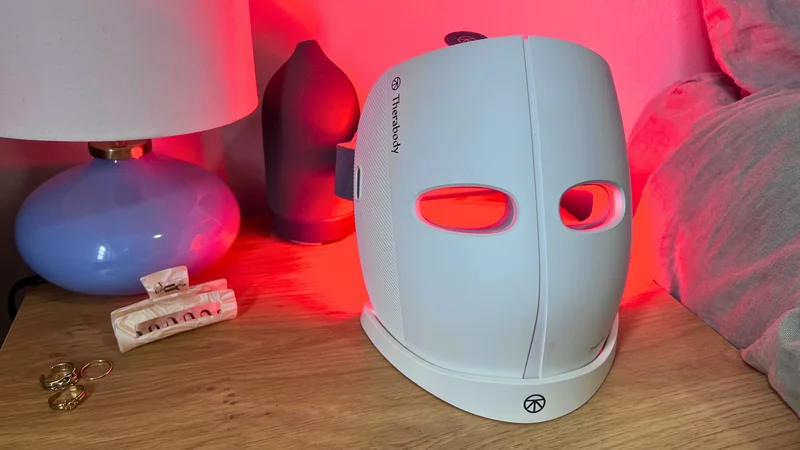
Therabody's TheraFace Mask is for someone who wants to focus on facial health as a whole. It combines LED light with vibrational massage to provide a well-rounded facial treatment. It's also for someone who has room in their budget for a splurge.
Alternative: If you don't need vibration, but like the sound of the mask otherwise, check out the more budget-friendly TheraFace Mask Glo for $379.99.
Why we like it
As the most expensive option on this list, the TheraFace Mask has to stand out. It does so by offering the most LEDs of the bunch (648) and offering Therabody's signature massage therapy directly on the mask. The combination of LED and vibration is meant to help with skin appearance and ease tension and boost circulation.
One of my favorite features of the mask is that it has built-in treatments, so you don't have to guess how long you should run different light cycles. It's also totally remote-free — there are just two buttons on the mask to control the LEDs and vibrations. One press of the LED button on the right side of the mask triggers a 9-minute treatment that cycles through red, blue, and red plus infrared lights (3 minutes each) and different massage patterns across the face and head strap. You can press both buttons to turn the massage feature on/off, stick with just one light color, or turn off the LEDs altogether for just a head massage. The mask also has a removable eye shield, which you can take out if you want to target wrinkles close to the eyes.
Even after my initial two weeks of testing the TheraFace Mask, I noticed my acne getting smaller and flatter. My skin also felt firmer and softer. I sometimes get lazy with my skincare routine and don't always feel like incorporating a nine-minute LED treatment. But as soon as I feel a new cystic pimple creeping under my skin, the TheraFace Mask is my first line of defense.
Details
The Good & The Bad
- Five different wavelengths for a variety of skin concerns
- Customizable brightness and session length
- Remote is completely wireless
- Lightweight, flexible, and easy to pack
-
Doesn't shine directly in your eyes
-
Floppy fit on bottom half of face
- Sometimes leaves light marks on forehead
- Not sure how effective yellow or green modes are yet
Who it's for
Simply put, you won't find a better budget red light mask than the Dreame Chrona. Its MSRP of $269.99 is already much easier to stomach than the $400 to $600 price tags on other popular masks — but budget shoppers should be able to find it on sale for as low as $224.99 on a regular basis.
The Chrona is also the ideal LED face mask for someone who wants to stay productive while red light therapy-ing. The lights don't cloud your vision, and not even the remote is wired to the mask, so you'll be able to complete tasks on your to-do list without interruption.
Why we like it
The Dreame Chrona isn't just a great mask for the price — it's a great red light mask period. (Who would have thought that the brand behind the best robot vacuum I've tested in 2026 is also the brand behind the best red light mask I've tested in 2026?)
First, the Chrona mask is such a chill red light mask to wear around the house. It's one of the few out there that doesn't have a remote attached to it, so there's no cord in the way when you're trying to do a chore or feed a pet. The lights near the eyes aren't so intense that you can't see, and the ultra-slim design doesn't mess with your peripherals.
The Chrona mask has an expansive selection of light modes to cover anti-aging from all angles. Past the red, near-infrared, and blue light settings that everyone expects, there's also green light (for neutralizing redness) and yellow light (for balancing and brightening your complexion). I think my cheeks look a little less red after two months, but I'm confident that I'll see better results if I stay more consistent with these two unique settings.
I always get nervous to pause my Shark CryoGlow usage to test a new mask (I just trust it that much). I'm happy to report that the Dreame Chrona has sustained results in my two staple categories. I haven't really gotten any major non-hormonal pimples in my initial two-month window. I've also noticed less texture and smoother makeup application on my nose and chin. You can really tell it's working when my CC cream and pressed powder aren't settling into fine lines anymore, even after several hours.
Details
The Good & The Bad
- Two weeks of daily use on one charge
- Each bulb has two LEDs
- Very lightweight and comfortable
-
100-day warranty
-
Pricier than most dedicated eye masks
Who it's for
iRestore is a popular brand on Amazon that's best known for its popular red light device for treating hair loss. I put the brand's red light eye mask to the test for this guide.
I found that the iRestore Illumina Eye Mask is the premium choice for those who are more concerned about an eye area glow-up than their entire face. iRestore's eye mask costs more than most other red light eye masks due to its densely-packed LED layout, so the ideal buyer would be willing to pay a little extra for more precise anti-aging coverage around their crow's feet or 11 lines.
Why we like it
For a mask that only covers half of your face, there's quite a bit of power packed into the eye mask version of iRestore's Illumina. Each bulb holds two LEDs, adding up to 180 total LED sources compared to 80 LED sources in CurrentBody's $249.99 eye mask.
I had been noticing that my crow's feet look deeper than those of my similarly-aged friends when we're all smiling in a group photo. However, you wouldn't peg me as someone who smiles, laughs, or has any whimsy or energy at all if you saw how dark my under-eyes are on some days. (I've had insomnia for a decade and it shows.) Though the Shark CryoGlow mask is my all-time favorite, I'd be remiss to not mention its major blind spot: The cooling pads take the place of LED bulbs that would target your eye area, and the de-puffing effects of that cooling are very temporary.
So, I introduced the iRestore eye mask as a supplement to my routine — if I used the Shark mask in the morning that day, I used the iRestore eye mask before bed. My eye area definitely saw a sustainable glow up. CC cream under my eyes doesn't look nearly as raisin-y, even if I add powder — the lines that they used to settle into aren't as deep anymore. I say CC cream instead of concealer because my under-eyes are no longer so dark that I have to brighten them to look alive. I don't think the iRestore eye mask can completely eliminate crow's feet or match the effectiveness of Botox, but I certainly believe it can stretch the amount of time I need between appointments.
The elite Shark and eye mask combo costs $598 all together, which doesn't seem that wild in comparison to other masks, given the robust combination of red, near-infrared, and blue light that you're getting to every inch of your face.
The Illumina Eye Mask is significantly easier to pack than a full-face mask, even the bendy ones. It's super thin and barely weighs a pound. Since it lasts for at least 10 days on one charge, it'd be safe to take on vacation without worrying about the charger.
Details
The Good & The Bad
- Rare option with 1,072 nm deep NIR
- Easy to pack
-
Battery life lasts for more than a week of daily usage
-
Still too expensive for no blue light
- Remote is very basic
- Red glow is very intense around eyes
Who it's for
The CurrentBody Skin Series 2 and its rare deep near-infrared light would be a good choice for those with advanced signs of aging, stubborn scarring, or other intense texture concerns.
Why we like it
Having tried other LED face masks that do much more, I'm not convinced that the CurrentBody Skin 2 provides a premium-enough experience to cost what it does. Still, it's one of the only mainstream masks that hits deep near-infrared at 1,072 mm, offering even more extensive penetration than the 830 nm (regular near-infrared), where most masks max out.
Deep NIR reaches into the skin's deepest tissue layers to be absorbed by mitochondria and turned to cellular energy, which can help with collagen production and serious blood flow stimulation. This powerful CurrentBody speaks more to shoppers trying to combat deep-rooted wrinkles or severe loss of elasticity, especially around the eye or mouth area.
Since preventing acne and treating fine lines are my main concerns when testing a red light mask, the CurrentBody Skin 2 wasn't the best value for me. It doesn't have blue light at all, and it's pretty expensive for my mostly preventive anti-aging goals — I could pay $100 or $200 less for a mask that still reaches 830 nm NIR to treat my super-light wrinkles.
Not for nothing, I kind of dreaded putting this mask on every day. Though it's flexible and lightweight, it felt oddly constricting and sweaty. The deep NIR bulbs around the eyes are so intense that the entire room turns blue and a little blurry. For such a pricey mask, the remote is incredibly basic with no countdown time or adjustable settings to be found. Because there's no screen, the only way to find out that the battery ~~is~~ was low is when the mask suddenly dies.
Details
The Good & The Bad
- Silicone pad adds extra comfort
- Very lightweight
-
Easy to clean
-
Very bright in your eyes during use
Who it's for
Who it's for: Guys (or anyone, really) who aren't ready for a full Hannibal Lecter-style face mask yet, but who are tired of looking at dark circles under their eyes. It's also a super-affordable entry point into the category. As an added bonus, it's easier to pack during travel than the best red light face masks.
Why we picked this
This red light mask review comes from Mashable Tech Editor Timothy Beck Werth.
For people who are primarily worried about the eye area, the Luminator is a smart and low-cost way to try out red light treatment. It also makes a great gift for men.
The Luminator has a sleek design and attractive price point, making it less intimidating than most $500 red light masks. In addition, you only need to wear it for three minutes each day, and it's comfortable on the face.
I didn't even need to use the included straps — it just fit perfectly on my face. I did notice improved luminosity in my under-eye and crow's feet areas, and I've seen improvement to dark circles as well. Honestly, the only thing I don't like about it is cleaning it.
One of our freelancers has also tested this particular device and gave it similarly high marks for ease of use and effectiveness. It uses multiple wavelengths of light to penetrate deep into the skin, and, according to Lumen, can help boost collagen production and improve signs of aging.
In our experience, it had a positive impact on dark circles and skin texture around the eyes.
Details
The Good & The Bad
- Quick treatment time
- Easy to store and travel with
- Might be good to grab during a BOGO sale
-
Great battery life
-
More expensive than other masks for less versatility in treatments
- No blue light
- Light too close to eyes
- Hard to find a comfortable fit that covers all areas of the face
- Remote doesn’t detach from the mask
Why we're not obsessed with it
This red light mask review comes from Lead Shopping Reporter Bethany Allard*. *
Of course, the brand behind the viral red-light skincare wand also has a red light mask, and though I had high hopes, the Solawave Wrinkle Retreat Pro mask didn’t quite hit the mark for me. It’s not that it didn’t work — after about a month of regular use, I noticed my skin was glowier, smoother, and generally more even in tone. Even immediately after use, my skin looked perked up. So what’s the problem? Well, at $499, it’s not exactly the cheapest option out there, and it’s missing the more robust experience — like facial massage, heat and cooling therapy, and blue light — that I’d expect at that price point.
The lack of blue light was especially disappointing. Even though the Solawave mask reduced the redness of breakouts, I know from my experience with the Shark CryoGlow that blue light can make all the difference — Shark’s mask basically made it so I never had breakouts in the first place.
That said, this mask does have great battery life and is super easy to store or pack into a suitcase. Solawave runs buy-one, get-one-free deals relatively often, so if you have another person in your life you want to gift a mask, this could be more worth it, but for the majority of people, I recommend checking out one of the other options on this list instead.
Details
The Good & The Bad
- Red light, blue light, and purple combo settings
- Countdown timer on remote
- Good battery life
-
Thin and lightweight for hard shell design
-
More expensive but less fancy than Shark CryoGlow
- Silicone eye guards leave big mark on forehead
Why we're not obsessed with it
I actually had an overall positive experience with the iRestore Illumina mask. It's extremely lightweight for a mask that's not the floppy silicone material and seems to last forever on one charge. I prefer my LED masks to have countdown timers on the remotes, and the iRestore is one of the few that does.
But as a hard shell red light mask that also offers blue light, I can't put the iRestore mask head-to-head with the Shark mask, and it suffers for the comparison. The iRestore is the more basic option in that duel, despite costing $50 more than the Shark. It also leaves deep suction cup dents in my forehead that last for hours.
If the iRestore Illumina ever dropped from $399 to $299, I'd tell you to consider it. Don't get too excited if you're seeing $799 crossed out — it's always like that at Amazon, so it's not exactly a crazy deal.
Details
Frequently Asked Questions
Light therapy is a friendlier-sounding term for photobiomodulation, which describes how lightwaves communicate with your mitochondria to kickstart biological processes like collagen production, tissue repair, or general boosted cellular activity.
The specific wavelengths of red and near-infrared light used in an LED face mask can penetrate the skin barrier to stimulate the cells responsible for healing or slowing signs of aging.
Every red light mask in this list was tested for at least eight weeks, which is the average amount of time it takes to see visible results with daily usage. Many were used over a period of three months or more. Per each brand's instructions, the masks were only used on clean, dry skin before any other skincare products were applied.
Each reviewer's skin goals were obviously a main consideration, as well as the ease of incorporating the mask into their everyday skincare routine. Here's a breakdown of our testing process for red light masks.
Obviously, the biggest question is whether or not each red light therapy device actually made improvements to the skin. Each reviewer specifically considered skin goals like less frequent breakouts, faster healing of active breakouts, or fine line reduction.
Red light masks need to be worn consistently to work as intended, and you'll only be consistent if the mask is easy to wear every day. We considered several aspects of mask comfort, from the physical bendy or shell design to visibility while the LEDs are glowing near your eyes. Battery life also impacts day-to-day use — does the device need to be charged too often to be convenient?
Red light need to emit certain wavelengths to effectively penetrate the skin. We ensure that each device's red light bulbs emit the recommended 630 to 660 nm. We give extra points to masks that can switch to near-infrared between 810 and 850 nm or blue light between 415 and 445 nm. Extra settings like cooling or vibration therapy are also taken into account for the overall experience.
Mainstream full face red light masks range from $249 to $649.99. What we care about most is the bang for your buck. If a mask is toward the pricier end of the spectrum, are the settings and results premium enough to justify a higher cost? If a mask is at the cheaper end of the spectrum, is it a true affordable steal or only affordable because it's crappy? Could this one-time purchase become more cost-effective over time if you can spend less money on fancy serums or esthetician appointments?
Leah Stodart is a Philadelphia-based Senior Shopping Reporter at Mashable where she covers and tests essential home tech like vacuums, TVs, beauty devices, and eco-friendly hacks. Her ever-evolving experience in these categories helps her make thoughtful recommendations for how to spend your money during shopping holidays like Black Friday, which Leah has been covering for Mashable since 2017.