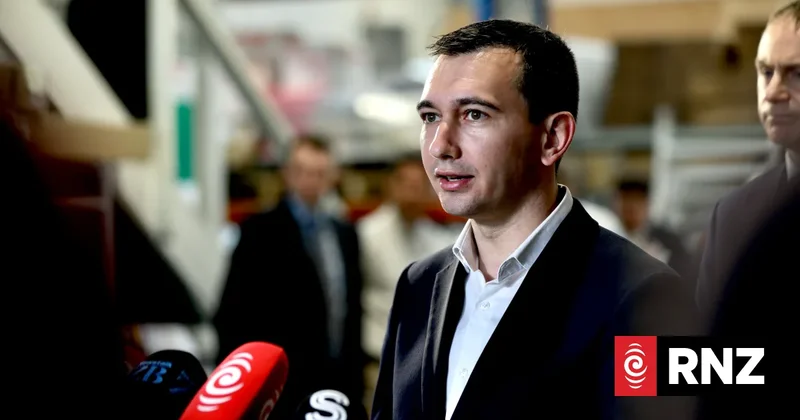
A multi-million dollar radiation therapy machine which can precisely target tumours has been installed at Wellington Regional Hospital.
Health Minister Simeon Brown said the new linear accelerator - or LINAC machine - is the first of two coming to the hospital, replacing older machines which have reached the end of their life.
But an organisation representing radiologists says while the development is great news, hundreds of people are still missing out on radiation services throughout the country due to a history of under-investment.
Radiation therapy is used to treat cancers including breast, prostate, lung, head and neck, and gynaecological cancers, and can relieve pain.
Brown said the cost of both LINAC machines for Wellington Hospital, including installation, is $12.6 million - with each machine costing around $6 million.
"They're very expensive machines, they weigh several tonnes, but it's also about installing them and putting them in place. They're incredibly difficult to install - they go into concrete bunkers."
Brown said three of the machines deliver 16,000 treatments to over 1500 patients in the hospital every year.
He said the newer replacement machine would be "far more accurate" in how it targeted radiation towards cancers by using camera-based surface guidance, and monitoring where the patient is throughout treatment.
Dr Melissa James, from the Royal Australian and New Zealand College of Radiologists, said the new LINAC machine for Wellington was great news, but patients elsewhere were still missing out.
James said LINAC machines were vital for treatment, delivering a "precise beam" of radiation therapy to the tumour to destroy cells, while protecting normal healthy tissue.
The newer machines could target tumours to within a millimetre, she said.
James said studies showed that about half of all people diagnosed with cancer would benefit from radiation treatment, but in New Zealand, only a third receive it.
She said over the past 10 years, data the college collected showed the number of cancer facilities hadn't kept up with the numbers of people being diagnosed with cancer.
"So year by year, we're getting a widening gap of those who could benefit, but those who are actually missing out on radiation therapy."
James said LINAC machines also required a planning scanner, specialist software, and dedicated staffing, including radiation oncologists, physcians, cancer nurses, and radiation therapists - and that staff are working longer hours in New Zealand compared to other countries.
"We're really working as hard as we can with the resources we have to deliver cancer services with radiation, but we just don't have the resources we need in either machines or in staff to run those machines."
She wanted to see cross-party support for ongoing investment in radiation oncology, so every patient had timely access to radiation.
Brown said he was committed to improving access to radiation treatment - and installing the machines was "crucially important" for that.
He said the new LINAC machines were part of a roll-out of the machines throughout the country, with new ones recently installed in Auckland, Dunedin, New Plymouth and Whangārei.
A new LINAC machine would also be installed at Hawke's Bay Hospital in the next two years.
"In this year's budget, we've provided funding for the business case and design for the next three sites for LINAC machines, which will be in South Auckland, in Nelson, and at Burwood Hospital in Christchurch."
He said Health New Zealand was working through different models to support staffing of the machines - a team from Palmerston North was helping to establish the machine in New Plymouth.
"But absolutely as we grow the number of machines, we're going to need to grow the number of staff on the front line and that's very clearly the government's expectation of Health New Zealand."