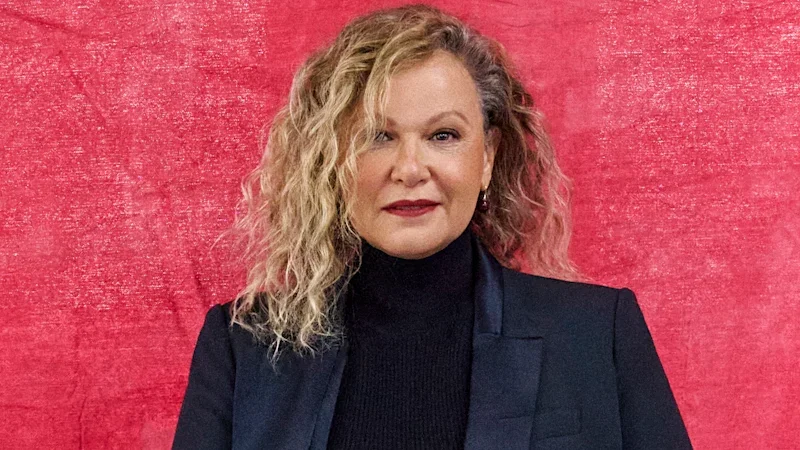
When her mother Florence died at the age of 60, actor Leah Purcell kept two of her prized possessions: a book of Henry Lawson short stories bound in red leather and a purse full of old family photos.
Purcell packed these keepsakes into her yellow Datsun Sunny alongside her baby daughter, Amanda, and at 18 fled an abusive relationship and her home town of Murgon, in rural Queensland. In 1988, she had fallen pregnant at 17, turned 18 in August, given birth to her daughter in September and lost her mother in October. Bound for Brisbane, she was determined to set her life on a new course and pursue her dream of a career on stage.
As a child who hated reading, it was an odd choice to keep a book she’d scribbled in the margins of, to the horror of Florence, an avid reader. But it contained The Drover’s Wife, a childhood favourite she’d beg her mother to read and knew so well she could recite the last line by heart.
Decades later, that battered old book and those faded family photos would become the backbone of Purcell’s body of work as a playwright, actor, novelist, filmmaker and director. Now add librettist to that list – an opera adaptation of her award-winning play The Drover’s Wife opens at the Sydney Opera House next month following a critically acclaimed Queensland premiere in May.
“I’d never in my wildest dreams have thought that when I left Murgon and took that little book, I’d ever turn it into a play, a film, a novel and now an opera,” says Purcell, a Goa, Gunggari and Wakka Wakka Murri woman, like her mother. “It was just something that me and my mum shared.”
Lawson’s story, published in The Bulletin in 1892, is the tale of a woman left alone with her four children, and the drama that unfolds when a black snake enters their bush hut while her husband is droving.
As a single mother of seven, Florence no doubt knew the loneliness of the drover’s wife portrayed by “the people’s poet” Lawson. Purcell’s father, Les Haack, was a white man, a boxing trainer and the town’s butcher, but Purcell was not allowed to acknowledge him as her dad. He had another family, a white family, who lived on the other side of town.
From him, she learnt how to pack a punch. “I always had a good right hook,” she jokes about the sport her boxing father taught her and her brothers.
Some of that story was retold in Box the Pony, the 1997 semi-autobiographical one-woman play she wrote with Scott Rankin. But it was the emotional gut punch in The Drover’s Wife, which she adapted and first performed as a play at Sydney’s Belvoir Theatre in 2016, that lingered with audiences long after she exited the stage.
“At Belvoir, women stayed back in the foyer after performances, drinking champagne and sharing stories,” Purcell says. “Grandmothers would suddenly start talking about things their own mothers had gone through that they’d never spoken about before.”
Purcell, who adapted the play into a novel in 2019 and then wrote the screenplay and directed and starred in the 2021 film version, wove threads of her own experience of domestic violence into her rendering of the Lawson classic. Unlike Lawson, she gave the protagonist a name, Molly Johnson. Molly not only battles isolation, poverty and the Australian bush but also the trauma and threat of male violence.
Inspiration came from Florence and her forebears, three generations of whom worked as drovers or jillaroos and whose images on horseback were contained in the sepia photos in her mum’s purse. The opera is told from the point of view of the son in the story, Danny, who as a 32-year-old reflects on his mother’s ordeal. He’s the one who promises his mother “I won’t never go a-drovin’” – the last line that Purcell remembered so clearly it as a kid. She’s also transformed the threatening “black snake” into an Indigenous fugitive called Yadaka (played in the opera by Marcus Corowa).
“The opera has allowed us to go bigger,” says Purcell. “There’s fantasy, spirituality, dance and an emotional force from the music, some of which is in my grandmother’s language. The opera lets the story breathe in another way. It’s still about a mother’s love for her children and what she will do to protect them – I just sprinkle my black pepper through it.”
Composer George Palmer, a former justice of the NSW Supreme Court, first approached Purcell and her partner Bain Stewart to suggest her script would make a perfect libretto after his wife read Purcell’s novel for her book club. “He put music to my play script first,” Purcell explains. “Then, through workshops, we’d take chunks of dialogue and turn them into arias.”
She describes Palmer’s musical composition as “like a really good doona – it wraps around you and carries the story”.
Purcell first met Stewart, who has an Indigenous father and a white mother and was running a martial arts centre, when she arrived in Brisbane with her baby back in 1988 (they now live with her daughter and two teen grandsons in Sydney’s inner west). She’s probably best known for her acting work in Wentworth, High Country and Redfern Now on television and the movies Lantana and Jindabyne. However, she started as a singer, touring in Bran Nue Dae in 1993, and was once the support act for Shania Twain.
From there, though, it’s quite a jump to her debut as an opera director. And for the first time since she put a name to the character of Molly Johnson, she has handed over the role to her cousin’s daughter, London-trained soprano Nina Korbe. “Her mother and I are like sisters,” says Purcell, adding that Korbe was cautious about taking on the role. “She said, ‘Molly Johnson is you.’ And I said, ‘Not in this one. She’s yours now.’”
Purcell is delighted by the idea of inheritance – of stories passing through generations, from her grandmothers and mother to her cousin’s daughter, just like her mother’s beloved book. And she is thrilled that the opera – set in the Snowy Mountains, which Purcell fell in love with while filming High Country and Jindabyne – received rave reviews when it debuted in Queensland in May.
She is also forever grateful for the friends and family there who shaped her, like the teacher in year 7 who gently encouraged her to write. “I entered a writing competition, but when my teacher handed back my story, it was covered in red-penned corrections,” says Purcell. “I thought I was in trouble, but she told me, ‘We can fix the spelling and grammar. This is a great story.’” She won the Murgon Lions Rotary Writing competition.
She’s thankful, too, to the supervisor at the Murgon meatworks who told her not to come looking for a job there when she finished school. “I thought I’d done something wrong but he said, ‘I saw you in the high school musical. I think you can go far.’ I skipped out of there with an extra bounce in my step.”
The musical was Bye Bye Birdie, in which Purcell played glamorous secretary Gloria. “That was the first time I got a real laugh from an audience,” she says. “I milked it for all it was worth. And I’ve been doing that ever since.”
Above all, though, she’s grateful to her mother. “Molly Johnson is a representation of my mum, her sisters, and the strength of other Aunties within the family,” she says. “I have the opportunity to give voice to their stories, and I’m doing that to show the personal side to something that is always politicised in our country. The death rate from domestic violence is still phenomenal. At this minute, somewhere, a woman is being abused.”
She wishes her mum could be in the opening night at the Sydney Opera House, resplendent in the Christmas decorations she always wore as jewellery as she was too poor to afford the real thing.
“My mum was my hero. She raised seven of her own children and looked after her bedridden mother for 27 years as well as my grandfather and two nephews. There were always extra kids around. She was just amazing, a card, a bit of a performer herself.
“She died at 60 of bowel cancer, which was horrific. She was an Aboriginal woman who was voiceless. A statistic. My grandmother was of the stolen generations, considered subhuman, so for me to not use my talents and chase my dreams and do something positive would be a crime against them.”
Purcell says she hopes this version of the Lawson story helps to keep people talking about difficult subjects. “At the heart and soul of it, the opera, this story, is about celebrating women – all women.”
1800 RESPECT (1800 737 732).
The Drover’s Wife, Sydney Opera House, August 7-15.
Hair: Travis Balcke for Kevin Murphy. Make-up: Mikele Simone. Fashion assistant: Sofie Pye. Stockists: Bared; Bassike; Country Road; Dinosaur Designs; Ngali; Nique; Perri Cutten; Seed; Witchery.