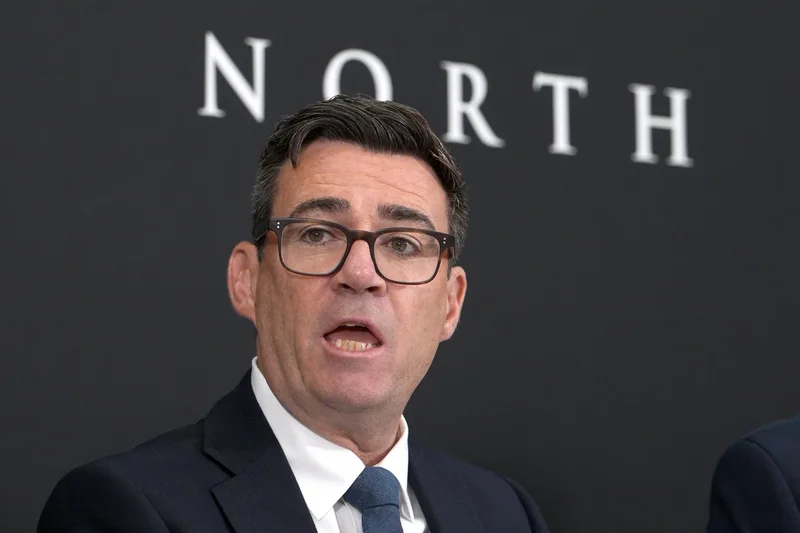
The outpost of the Office for the Prime Minister and Cabinet in Manchester has been derided as a gimmick – and there is an element of tokenism about it. However, it is a token of the right objective, which is to push power out of London.
Andy Burnham opened No 10 North at Heron House in Manchester, declaring it to be “the best day of my life” as ministers gathered there for the first time on Friday.
There are all sorts of practical objections to No 10 North. The most important is probably that the prime minister’s time is a scarce resource at the heart of an effective government, and travelling between London and Manchester may not be the best use of it, if Stakhanovite efficiency were the only test.
However, modern secure communications make it theoretically possible to work anywhere, even if train wifi is in practice an unfunny national joke.
Nor can a prime minister who has promised to spend more time with his MPs be in two places at once. There are inefficiencies and duplications in operating out of two bases, including the one-off costs of relocating civil servants.
It may be, also, that Labour will regret making a fuss about Rishi Sunak’s use of jets and helicopters for domestic journeys if Mr Burnham decides they are the only way of getting to and from Heron House in time for other commitments. He took a government plane there on Friday, but that was because he was travelling from London via Scotland to meet the leaders of the devolved administrations.
These disadvantages are outweighed, however, by the advantages.
Rents and housing costs are cheaper. The civil service will be able to recruit from a different talent pool, including people who cannot afford – or do not want – to move to London. But above all, it will send a signal through the government machine that parts of the country outside the capital have high status. Not just a signal: the reality will be that people outside London will work on some of the highest functions of central government.
The success of the Darlington campus of the Treasury, set up by Mr Sunak, is a trailblazer for this approach. Like No 10 North, it was created by a politician who had a constituency interest – Mr Sunak’s seat in Richmond, Yorkshire, was a few miles away. But it successfully broadened the Treasury’s social culture. Rachel Reeves did not spend much time there, but perhaps John Healey, her successor, will.
Mr Burnham’s obsession with the politics of place is not a matter of mere “vibes”. The resentment felt around the country at the wealth and power of London is real, and contributes to the alienation that so many voters feel from politics, which can feel like something that is done to them from far away.
The prime minister is trying to show that there are better ways to run the country than doing everything from Westminster and Whitehall. Of course, there will be resentment from places outside Manchester about influence wielded from Heron House, but anything that helps to break down the unipolarity of the British polity is a step in the right direction.
And it goes without saying that the regional imbalance of British society, and Britain’s economy, is not going to be changed much by putting a replica door of 10 Downing Street in an office block in Manchester. The dominance of London in England, like that of Paris in France, is the product of centuries of national unity, and it would be more dominant still if it were not for green belts, planning law and regional policy over the past century.
But a great deal can be achieved, and has been achieved, by moving significant civil service and public sector functions out of London. One of the drivers of Greater Manchester’s success during Mr Burnham’s time as mayor has been the BBC’s decision to move a large part of its operations to Salford.
No 10 North may be a gesture, but it is a gesture in the right direction.