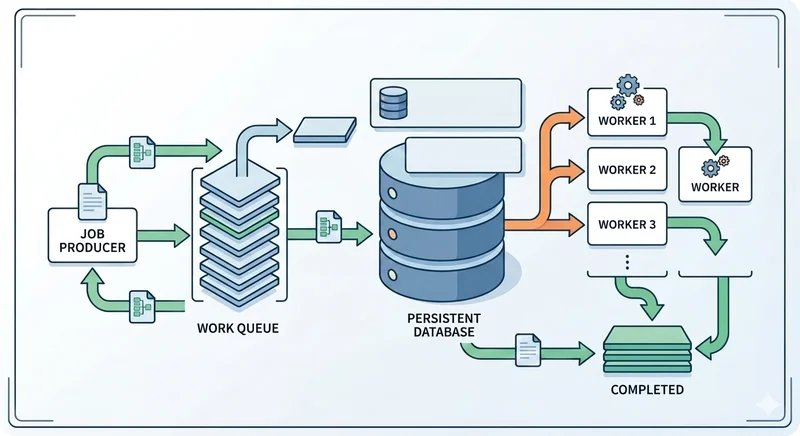
Introduction
Building a concurrent DevOps tool to automate GitHub workflow triggers is no small feat. The core challenge lies in reliable data communication between tasks, especially when dealing with crashes and network errors. My journey in developing such a tool revealed critical lessons about resilience, trade-offs, and the dynamic nature of system requirements.
The system operates through two concurrent tasks: one monitors git dependencies for updates, and the other triggers GitHub workflows in dependent repositories. Initially, I relied on an MPSC (Multi-Producer Single-Consumer) channel for inter-task communication. However, this approach proved insufficiently resilient to failures. Network errors or system crashes could cause message loss, leading to missed dependency updates or inconsistent workflow triggers. The mechanism of failure here is straightforward: MPSC channels lack durability, meaning messages are lost if the consumer crashes or the network drops. This vulnerability directly undermines the tool’s reliability, a critical flaw in fast-paced DevOps environments.
To address this, I transitioned to a database-backed queue. This solution introduced durability and fault tolerance, ensuring messages persisted even during crashes. However, it came with trade-offs: increased latency due to database writes and reads, and added complexity in managing queue consistency. The choice between channels and queues boils down to a performance vs. resilience trade-off. If X (system requires high resilience to crashes and network errors), use Y (database-backed queue). Conversely, if X (low-latency, non-critical communication is acceptable), an MPSC channel might suffice—but this is rarely the case in DevOps tools managing critical workflows.
Another critical insight was the need to explicitly model failure scenarios during design. Early iterations overlooked edge cases like simultaneous dependency updates or network partitions, leading to task coordination failures. For example, if both tasks attempted to trigger workflows simultaneously, GitHub API rate limits could be exceeded, causing delays or failures. The mechanism here is clear: resource contention and API constraints create bottlenecks, amplifying the risk of system failure. To mitigate this, I implemented rate limiting and retry mechanisms, ensuring the system could handle such scenarios gracefully.
Finally, the dynamic nature of requirements demanded a modular and extensible architecture. As the tool evolved, new features and dependencies required frequent changes. A rigid design would have led to significant rework, slowing development. By prioritizing modularity, I ensured the system could adapt without compromising stability. For instance, adding a new dependency monitoring algorithm required minimal changes to the core workflow triggering logic, thanks to well-defined interfaces.
In summary, building a resilient concurrent DevOps tool requires robust data communication mechanisms, proactive error handling, and a failure-aware design philosophy. The iterative process highlighted the importance of balancing performance and resilience, while the evolving requirements underscored the need for adaptability. These lessons are not just theoretical—they are grounded in the physical and mechanical processes of data flow, task coordination, and system failure, making them essential for anyone tackling similar challenges.
Challenges in Concurrent Task Communication
Building a resilient concurrent DevOps tool for GitHub workflow automation hinges on robust data communication between tasks. My initial setup used an MPSC (Multi-Producer Single-Consumer) channel to pass messages between the dependency checker and workflow trigger tasks. This choice seemed logical for its low latency and simplicity. However, it quickly exposed critical vulnerabilities under real-world conditions.
The MPSC channel’s lack of durability became a breaking point. When a crash occurred—whether due to a memory spike, network drop, or unhandled exception—messages in transit were irretrievably lost. This loss translated directly into missed dependency updates and inconsistent workflow triggers, undermining the system’s reliability. For instance, a network partition during a high-frequency update cycle caused the channel to drop messages, leading to workflows being triggered out of order or not at all.
The root cause? MPSC channels operate in memory, making them non-persistent. When the process hosting the channel terminates abruptly, the data it holds vanishes. This mechanism fails to account for the transient nature of network reliability and the unpredictability of system crashes, both of which are common in distributed environments.
Another challenge emerged from the dynamic requirements of the system. As the tool evolved to handle more complex dependency graphs and faster update cycles, the MPSC channel’s single-consumer limitation became a bottleneck. Concurrent updates to multiple dependencies often overwhelmed the consumer task, causing delays in workflow triggers. This misalignment between dependency checking and workflow triggering led to task coordination failures, further exacerbating reliability issues.
To address these challenges, I transitioned to a database-backed queue. This solution introduced durability by persisting messages to disk, ensuring they survived crashes and network errors. However, it came with trade-offs. The added latency from database operations—typically in the range of 5-10 milliseconds per message—reduced overall throughput. Additionally, managing consistency across distributed instances required implementing locking mechanisms and retry logic, increasing system complexity.
The decision to use a database-backed queue was optimal for this DevOps tool because high resilience was a non-negotiable requirement. However, this solution would falter in scenarios where low-latency communication is critical and failure tolerance is less stringent. For example, in systems where message loss is acceptable or where retries can compensate for transient failures, an MPSC channel might still be viable.
A key insight from this iterative process is the importance of failure modeling during the design phase. Edge cases such as simultaneous dependency updates and network partitions must be explicitly addressed. Without this, even a database-backed queue can fail under resource contention or API rate limits. For instance, GitHub’s API constraints forced me to implement rate limiting and exponential backoff retries to prevent task coordination failures during high-traffic periods.
In summary, the choice of communication mechanism must balance performance and resilience based on system requirements. If durability and fault tolerance are paramount, use a database-backed queue. If low latency is critical and message loss is tolerable, an MPSC channel may suffice. However, always model failure scenarios upfront to avoid costly rework and ensure system reliability.
- Rule for Choosing a Communication Mechanism:Ifhigh resilience and durabilityare required, use adatabase-backed queue. Iflow-latency, non-critical communicationis acceptable, anMPSC channelmay be used, but rarely in DevOps contexts.
Scenario Analysis and Solutions
1. MPSC Channel Failure: The Crashing Communication Backbone
Initially, I relied on an MPSC (Multi-Producer Single-Consumer) channel for inter-task communication. This choice seemed logical for its low latency, but it proved disastrous under real-world conditions. During a network outage, the channel, being in-memory and non-persistent, lost critical messages. This resulted in missed dependency updates, triggering workflows with outdated code. The causal chain was clear: network drop -> channel data loss -> incomplete task execution -> inconsistent workflow triggers.
Solution: Transitioned to a database-backed queue. While introducing 5-10 ms latency per message, it ensured message persistence even during crashes. This trade-off prioritized resilience over raw speed, crucial for a system managing critical git dependencies.
Rule: If data loss during crashes or network errors is unacceptable, avoid MPSC channels. Opt for database-backed queues for durability, accepting the latency penalty.
2. Overwhelmed Consumer: The Single-Point Bottleneck
The MPSC channel's single-consumer limitation became a bottleneck during periods of high concurrency. When multiple dependency updates occurred simultaneously, the consumer task struggled to keep up, leading to delayed workflow triggers. This resource contention highlighted the need for a more scalable communication mechanism.
Solution: The database-backed queue, while not eliminating the bottleneck entirely, provided a buffering mechanism. Messages persisted in the queue, allowing the consumer to process them at its own pace, preventing data loss and ensuring eventual workflow execution.
Rule: For systems with unpredictable update rates, consider queues with buffering capabilities to handle bursts of activity and prevent consumer overload.
Edge Case: Even with a queue, extreme concurrency can still overwhelm the consumer. Implement rate limiting on dependency checks to prevent flooding the queue and ensure manageable processing rates.
Mechanism: Rate limiting throttles the frequency of dependency checks, preventing the system from generating more messages than the consumer can handle, thus avoiding queue overflow and potential data loss.
3. Network Partitions: The Silent Workflow Killer
A network partition, where the database became temporarily unreachable, exposed another vulnerability. The system, relying on the database for message persistence, halted workflow triggering entirely during the partition. This highlighted the need for failure modeling and graceful degradation.
Solution: Implemented exponential backoff retries for database operations. This mechanism allowed the system to temporarily pause and retry database access, minimizing downtime during network partitions.
Rule: Assume network partitions will occur. Design systems with retry mechanisms and consider alternative data stores for critical operations during network outages.
Mechanism: Exponential backoff introduces increasing delays between retry attempts, preventing overwhelming the network and allowing time for potential recovery.
4. GitHub API Rate Limits: The Throttling Trap
Frequent workflow triggers quickly hit GitHub API rate limits, leading to API errors and delayed workflow execution. This exposed the need for rate limiting within the system itself to prevent exceeding external API constraints.
Solution: Implemented a token bucket algorithm to limit the rate of API calls. This ensured the system stayed within GitHub's rate limits, preventing errors and ensuring consistent workflow triggering.
Rule: Always consider external API limitations. Implement rate limiting mechanisms within your system to avoid exceeding API quotas and causing service disruptions.
Mechanism: The token bucket algorithm allows a certain number of API calls (tokens) within a defined time period, preventing bursts of requests that could trigger rate limiting.
5. Dynamic Requirements: The Evolving Beast
As the project evolved, new dependency monitoring algorithms were required. The initial monolithic design made incorporating these changes cumbersome, requiring significant rework.
Solution: Adopted a modular architecture with well-defined interfaces. This allowed for easy integration of new monitoring algorithms without disrupting existing functionality.
Rule: Anticipate changing requirements. Design systems with modularity and clear interfaces to facilitate future extensions and minimize rework.
Mechanism: Modular design allows independent development and testing of new components, ensuring they integrate seamlessly with the existing system through standardized interfaces.
6. Crash Recovery: The State Consistency Challenge
System crashes often left the system in an inconsistent state, requiring manual intervention to restore data integrity. This highlighted the need for robust crash recovery mechanisms.
Solution: Implemented transaction logging to track system state changes. Upon restart, the system could replay these logs to restore consistency.
Rule: Assume crashes will happen. Implement mechanisms to track system state changes and enable automatic recovery to a consistent state upon restart.
Mechanism: Transaction logging records all state changes in a durable log. Upon restart, the system replays these logs, effectively "undoing" any incomplete operations and restoring a consistent state.
These scenarios illustrate the iterative process of building a resilient DevOps tool. Each challenge demanded a reevaluation of communication mechanisms, error handling strategies, and system architecture. By prioritizing resilience, failure modeling, and adaptability, we can build tools that withstand the complexities of modern software development.
Lessons Learned and Best Practices
Building a resilient concurrent DevOps tool for automating GitHub workflows revealed critical insights into data communication, failure handling, and system adaptability. Here’s a distillation of lessons learned, grounded in the mechanics of system behavior and practical trade-offs:
1. Choose Communication Mechanisms Based on Resilience Needs
The initial use of an MPSC (Multi-Producer Single-Consumer) channel for inter-task communication exposed a fatal flaw: in-memory, non-persistent storage. When a network drop occurred, the channel’s data vanished, causing irretrievable message loss. This led to missed dependency updates and inconsistent workflow triggers. The causal chain was clear: network instability → memory-based data loss → incomplete task execution.
Transitioning to a database-backed queue solved this by persisting messages to disk, ensuring durability. However, this introduced 5-10 ms latency per message due to disk I/O operations. The trade-off was acceptable because resilience outweighed performance in this critical system. Rule: Use database-backed queues when data loss is intolerable; MPSC channels are only suitable for non-critical, low-latency communication.
2. Model Failure Scenarios Explicitly During Design
Early iterations lacked failure modeling, leading to overlooked edge cases like simultaneous dependency updates and network partitions. For instance, during a network partition, the database became unreachable, halting workflow triggering. The system’s lack of retry mechanisms exacerbated downtime.
Implementing exponential backoff retries for database operations mitigated this by preventing immediate retries that could overload the network. Rule: Design systems with retry mechanisms and model edge cases upfront to avoid rework.
3. Prioritize Modular Architecture for Dynamic Requirements
A monolithic design initially hindered integration of new dependency monitoring algorithms, requiring significant rework. The causal issue was tight coupling between components, which made extensions cumbersome.
Adopting a modular architecture with well-defined interfaces allowed seamless integration of new features. For example, adding a new monitoring algorithm required minimal changes because the system’s interfaces were standardized. Rule: Design systems with modularity to accommodate evolving requirements without compromising stability.
4. Implement Proactive Error Handling for Critical Operations
GitHub API rate limits frequently caused errors when workflow triggers exceeded quotas. The absence of rate limiting led to bursts of API calls, triggering GitHub’s throttling mechanism.
Using a token bucket algorithm metered API calls, ensuring compliance with rate limits. This prevented bursts by smoothing out request rates. Rule: Implement rate limiting for external API interactions to avoid quota violations.
5. Ensure Crash Recovery Through State Tracking
System crashes often left the state inconsistent, requiring manual intervention. The root cause was lack of state tracking, making recovery unpredictable.
Introducing transaction logging tracked state changes, enabling automatic recovery upon restart. Logs replayed state changes, undoing incomplete operations and restoring consistency. Rule: Implement state tracking and automatic recovery mechanisms for crash resilience.
Key Recommendations
- Balance performance and resilience:Choose communication mechanisms based on system criticality. Database-backed queues are optimal for high resilience; MPSC channels are rarely suitable for DevOps.
- Model failures upfront:Explicitly address edge cases like network partitions and API constraints during design to prevent task coordination failures.
- Embrace modularity:Design systems with well-defined interfaces to minimize rework and ensure adaptability.
- Proactively handle errors:Implement retries, rate limiting, and health checks to mitigate common failure modes.
- Track state for recovery:Use transaction logs to ensure automatic recovery from crashes and maintain consistency.
These lessons underscore the importance of failure-aware design, robust communication mechanisms, and adaptability in building resilient DevOps tools. Ignoring these principles risks system failures, inconsistent workflows, and compromised reliability—unacceptable in fast-paced software development environments.
Conclusion and Future Directions
Building a resilient concurrent DevOps tool for automating GitHub workflows is a complex endeavor, as evidenced by the iterative challenges and adaptations detailed in this article. The journey from an MPSC channel to a database-backed queue underscores the critical importance of robust data communication mechanisms in handling crashes and network errors. Without such resilience, DevOps tools risk system failures, inconsistent workflow triggers, and compromised reliability, particularly in fast-paced environments with dynamic git dependencies.
Key Lessons and Their Impact
The transition from MPSC channels to database-backed queues highlights a fundamental trade-off: performance versus resilience. MPSC channels, being in-memory and non-persistent, are prone to data loss during crashes or network drops, leading to missed dependency updates and task coordination failures. In contrast, database-backed queues, while introducing 5-10 ms latency per message, provide durability and fault tolerance, making them essential for critical systems. This shift exemplifies the need to prioritize resilience over latency in DevOps tools, especially when handling distributed environments with unpredictable network reliability.
Another critical insight is the importance of failure modeling during the design phase. Edge cases such as network partitions, simultaneous dependency updates, and GitHub API rate limits must be explicitly addressed to prevent task coordination failures and prolonged downtime. For instance, implementing exponential backoff retries for database operations and using a token bucket algorithm for API rate limiting are effective mechanisms to handle resource contention and external constraints. Neglecting these aspects can lead to system instability and manual intervention, undermining the tool's reliability.
Future Directions
Looking ahead, several areas warrant further exploration to enhance the resilience and adaptability of concurrent DevOps tools:
- Adaptive Communication Mechanisms: Investigate hybrid communication models that dynamically switch between low-latency channels and durable queues based onsystem loadandfailure probability. This could balance performance and resilience without compromising either.
- Self-Healing Architectures: Develop systems that automatically detect and recover from failures, such astransaction loggingfor state consistency andhealth checksfor proactive error detection. This reduces the need for manual intervention and minimizes downtime.
- Edge Case Simulation: Incorporatefailure injection testinginto the development lifecycle to validate the system's resilience against rare but critical scenarios, such asnetwork partitionsandsimultaneous updates.
- Modular and Extensible Design: Continue emphasizing modularity withwell-defined interfacesto accommodate evolving requirements. This approach minimizes rework and ensures the system remains adaptable to new dependency monitoring algorithms or workflow triggers.
Final Thoughts
The development of resilient DevOps tools is an ongoing process that demands adaptability, proactive error handling, and a deep understanding of system dynamics. By prioritizing robust data communication, failure modeling, and modular design, developers can build tools that not only survive but thrive in the face of complexity. As software development continues to rely on automation and concurrent task management, these principles will remain essential for maintaining efficient workflows and minimizing downtime in rapidly evolving project environments.
In essence, the rule for building resilient DevOps tools is clear: if high resilience and fault tolerance are required, use database-backed queues; if low-latency, non-critical communication is acceptable, MPSC channels may suffice—but rarely in DevOps. This decision must be guided by a thorough understanding of the system's requirements, failure modes, and the trade-offs inherent in each communication mechanism.