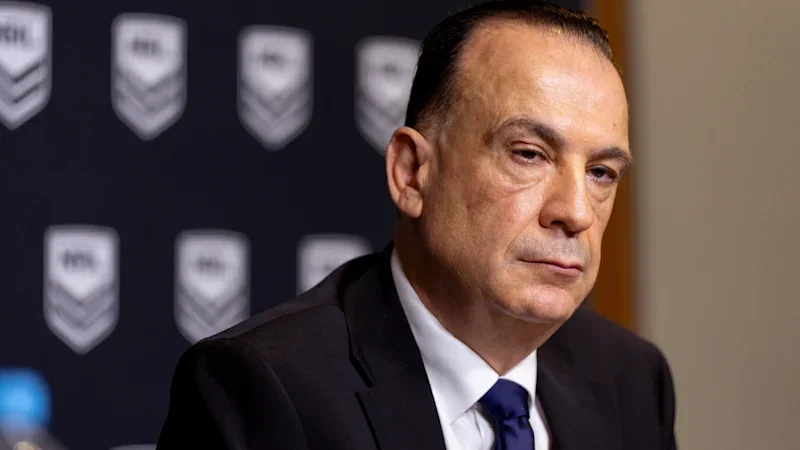
NRL boss Peter V’landys thinks big. So, here is a radical, revolutionary suggestion for him to capitalise on his $5.3 billion broadcasting rights war chest and achieve his dream of “global domination” for the code: Allow one attacking kick, or a forward pass, to an offside receiver per set of six tackles.
NRL halfbacks are so accurate at finding wingers, often on the run, with pinpoint kicks. They can execute with the boot what an NFL quarterback can with a pass to a deep, wide receiver.
Consider the scenario of, say, tackle three in an NRL game with one offside kick/pass per set. A pair of outside backs rush downfield, quickly followed by defenders. Instead of kicking the ball, the half decides to pass it laterally against a depleted defensive line. The ball is then carried deep into opposition territory. The attack still has the one kick to an offside player to use. If the ball is caught and grounded in goal by a teammate who was onside at tackle three, it’s a try.
V’landys has nominated Europe, dominated by soccer, and the USA where NFL wide receivers score most touchdowns, as homes of NRL franchises in the year 2050.
Ask soccer supporters their problem with rugby league and they’ll say “passing backwards”. Ask NFL fans what they admire about rugby league and they’ll say, “playing without helmets and pads.” Allow one kick to a deep offside player per set of six, and the 13 aside game would appeal to Europeans and Americans.
Most of the football codes (soccer/American football/Gaelic football) allow forward passes.
However, if V’landys wants to accelerate global domination, he has to apply my suggested rule change to his international franchises.
Pay TV partner DAZN, the global streaming company which broadcasts rugby league via Foxtel, has 100 million subscribers. Nearly 30 years from today, it could broadcast the game’s best showing off their skills in New York, London or Miami.
However, back in Australia in the mid-2020s, let’s play with the rules and focus more on the Barassi Line than flirting with the advantage line.
The line, named after former Australian Rules VFL champion Ron Barassi, refers to the territory divide between rugby union and league within the states otherwise dominated by Aussie Rules.
The line has moved well north of the Murray River since Melbourne academic Ian Turner coined the term in a lecture in 1978. The AFL has teams in NSW (Swans and GWS) and Queensland (Lions and Suns). However, unlike the NRL, which grants the same amount of money to all its 17 clubs, the AFL heavily subsides the Giants and Suns.
Furthermore, the AFL pledged to spend 10 per cent of all football revenue on the grassroots game, and is targeting Queensland.
NSW Riverina towns such as Temora, which produced league stars like Liam Martin, Trent Barrett, Zac Lomax and Ryan Hinchcliffe, now have an even split between rugby league and AFL. Yet when their fathers played, the 13-a-side code was dominant.
There is some irony in V’landys boasting the NRL’s TV deal has bested the AFL’s contract and then investing in overseas expansion, while the AFL raids the game at home.
The AFL is on the back foot with the women’s game. Chair Craig Drummond was shocked on the morning of May 15 when he learned that the TV ratings for the second women’s State of Origin match eclipsed the AFL’s top game (Lions vs Geelong) played the same Thursday, 1,009,000 to 663,000. And NRLW will continue to eclipse the TV ratings of AFLW, especially when it moves to two full rounds and is potentially screened midweek.
However, the major reason the NRL must invest its TV windfall result in development is to deepen the player talent pool.
NRL players are great athletes but many lack football IQ. Some games produce more tries bombed than scored. Ask any former players the following question: is the top 36 at your club as good as it was 10 years ago?
I have posed it many times recently, and the replies were mainly in the negative. Those who prevaricated conceded defence as a skill, as in both tackling and positional play, has declined. Injuries have exposed a weakness in depth at most clubs.
The NRL will expand to 18 teams next year with the inclusion of Perth; 19 the following year with the addition of PNG, and is anticipated to move to 20 soon after. We need an extra 108 players to field these three clubs at a time the talent pathways are not producing players as skilful as a decade ago.
The choice of Christchurch as the 20th team would certainly help because it would harvest rugby union players.
Another source for the NRL is Victoria, where the game broke through the Barassi Line in 1998 and established the Melbourne Storm. The club has been one of the benchmarks in the competition for generating commercial revenues, but has consistently lobbied the NRL for increased investment in participation and pathways to grow the game in Victoria.
Perhaps that’s why the Storm are considering partnering with private equity to raise funds. Cynics would suggest private equity is traditionally interested in profit and the money would be better coming from V’landys’ war chest.
Recently departed NRL chief executive Andrew Abdo was always confident he would land a big TV deal.
“I knew that our growth strategy would work and that the fundamental valuation would be strong,” he said. “So being able to get the timing right, having implemented the strategy first, was an advantage to us.”
The AFL will also go to the broadcasting market with an expansionist strategy in approximately three years, just as V’landys secured his $5.3b during the AFL’s current deal (2025-31).
After all, the most important TV deal is always, as Abdo suggests, the next one.